Every event below is backed by verifiable evidence: UN resolutions, ICJ orders, court judgments, human-rights field investigations, census volumes, and treaty texts. No state propaganda. Claims that rest only on Armenian sources say so, openly.
116Events
141Verified sources
Antiquity-2026Span covered
84Primary documents
116 of 116 events match the current filter and search
Ancient & Medieval Artsakh
Antiquity-1812Province of the Armenian kingdom, cradle of the faith, land of the meliks
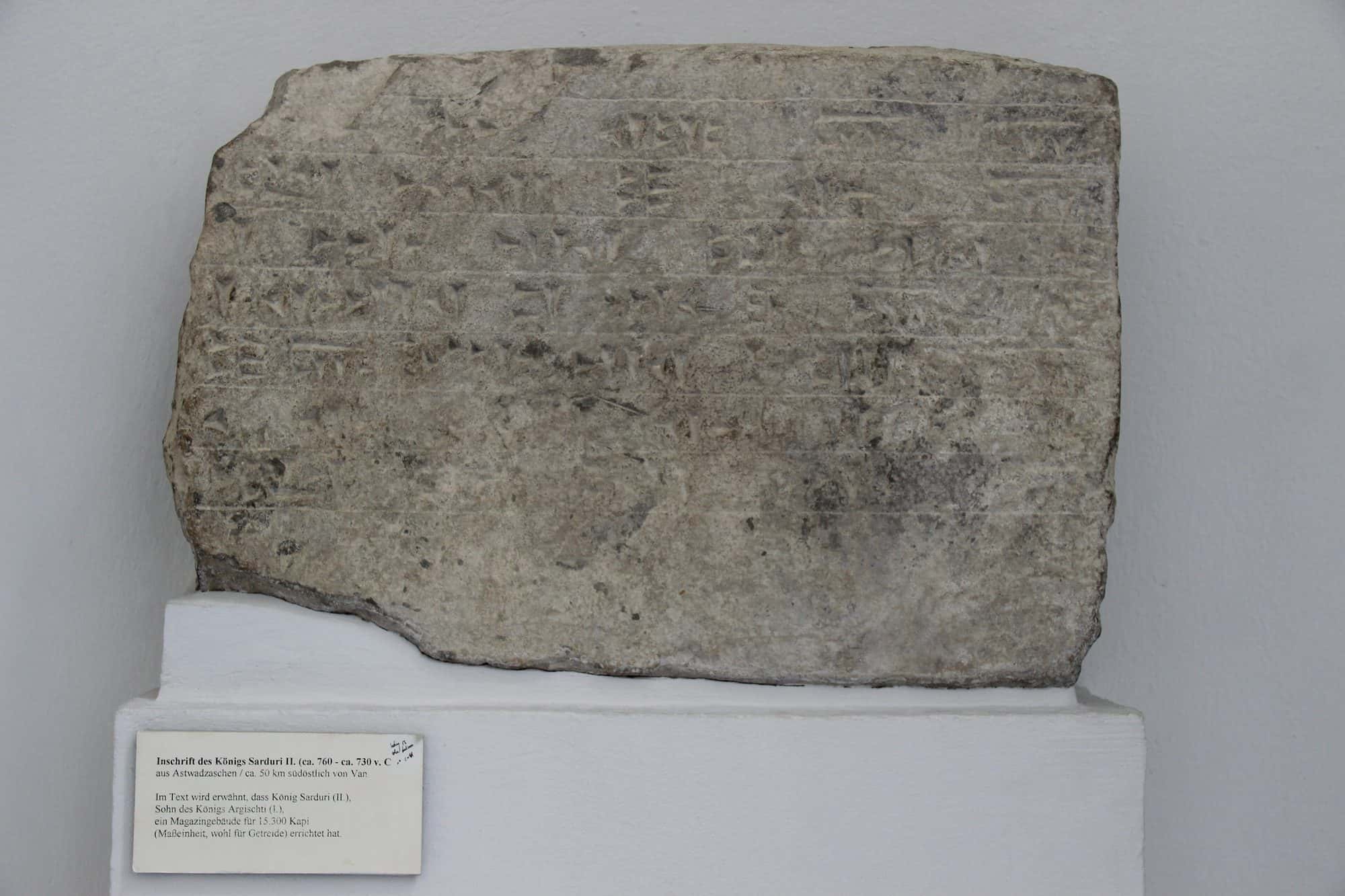
Stone inscription of the Urartian king Sardur II, whose annals name UrtekheGary Todd · CC0
8th century BCE
Urartian inscription of Sardur II records the land of Urtekhe, the earliest attestation of Artsakh
A cuneiform inscription of King Sardur II of Urartu (r. 764-735 BCE), found at Tsovak near Lake Sevan, records a campaign reaching 'the land of Urtekhe.' Scholars including the Urartologist Mirjo Salvini locate Urtekhe/Urtekhini within the territory of Artsakh and treat the name as the likely precursor of the toponym Artsakh, a well-supported scholarly hypothesis that places the region within the horizon of the Araratian kingdom in the 8th century BCE.
Artsakh and the Lake Sevan basinantiquityscholarship
Matenadaran academic volume: quotes the Sardur II inscription, reviews Greek and Roman testimony on Artsakh and the Kura frontier, and treats the region's manuscript culture.
Related
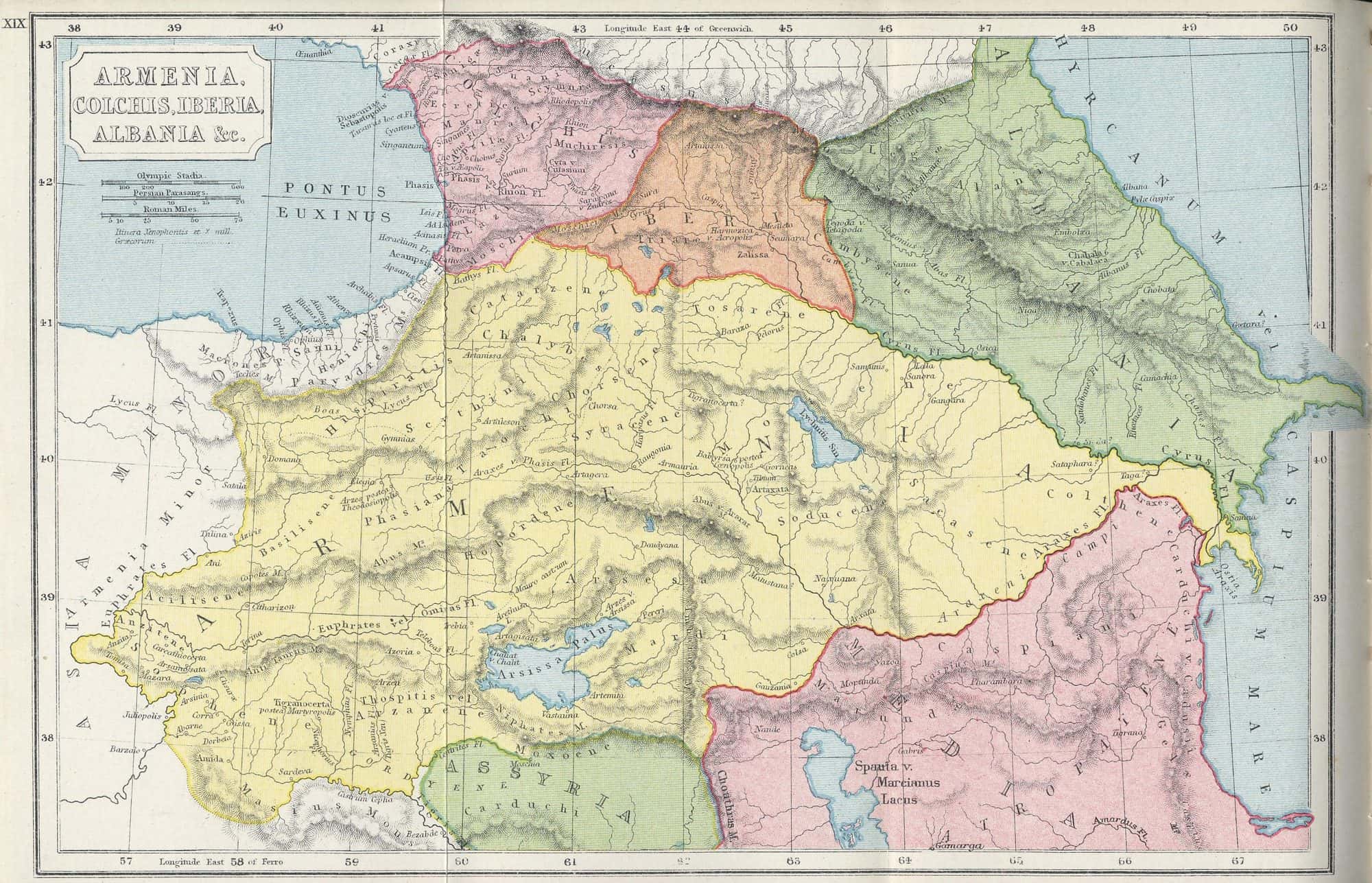
Classical atlas map of Armenia with Colchis, Iberia and AlbaniaSamuel Butler (1774-1839) · Public domain (author died 1839; published 1907)
189 BCE - 4th century CE
Artsakh, province of the Kingdom of Greater Armenia; Strabo records Orchistene
Under the Artaxiad dynasty founded by Artashes I (189 BCE) and then the Arsacids, Artsakh was one of the fifteen provinces of the Kingdom of Greater Armenia, with the Kura river as the frontier with Caucasian Aghvank, a border repeatedly confirmed by Strabo and Ptolemy. Strabo's Geography lists 'Orchistene,' identified with Artsakh, among the provinces of Armenia, noting that it 'furnishes large bodies of cavalry'; the 5th-century historian Pavstos Buzand devotes a chapter of his History to Artsakh as an Armenian land.
Artsakh, Kingdom of Greater Armeniaantiquitypolitical
Matenadaran academic volume: quotes the Sardur II inscription, reviews Greek and Roman testimony on Artsakh and the Kura frontier, and treats the region's manuscript culture.
Amaras founded by St Gregory the Illuminator; his grandson St Grigoris buried there
According to Pavstos Buzand, the church at Amaras in the Haband district of Artsakh was built by St Gregory the Illuminator, who converted Armenia to Christianity. Gregory's grandson Grigoris, consecrated bishop of Iberia and Aghvank, was martyred on the Vatnean plain and his companions carried his body back to Amaras. The grave of St Grigoris made Amaras one of the oldest Christian pilgrimage centers of the region and later an episcopal seat.
Matenadaran academic volume: quotes the Sardur II inscription, reviews Greek and Roman testimony on Artsakh and the Kura frontier, and treats the region's manuscript culture.
Related
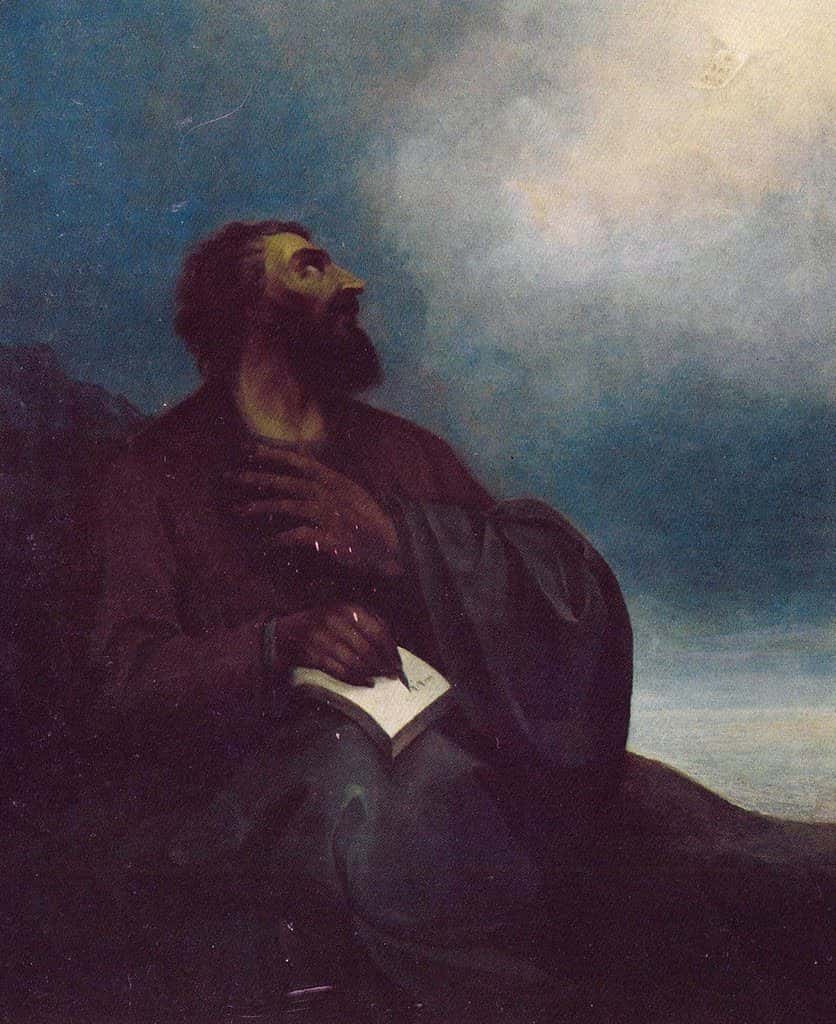
Mesrop Mashtots, creator of the Armenian alphabet, in an 1882 paintingStepanos Nersisyan (1815-1884) · Public domain (artist died 1884)
c. 410s-420s CE
Mesrop Mashtots brings the new Armenian alphabet east; a school at Amaras
Koriun, Mesrop Mashtots's pupil and biographer, records that after creating the Armenian alphabet Mashtots traveled to the eastern regions and to Aghvank, founding schools in the new script. The medieval historian Movses Kaghankatvatsi records that Mashtots established a school at Amaras in Artsakh, remembered in Armenian tradition as one of the first schools to use the Armenian alphabet.
Artsakh and Utik attached to the Sasanian marzpanate of Aghvank after the fall of the Armenian kingdom
Following the partition of Greater Armenia between Rome and Sasanian Persia (387) and the abolition of the Armenian Arsacid monarchy (428), the provinces of Artsakh and Utik were administratively attached to the Sasanian marzpanate of Aghvank, whose capital was moved to Partav. Western scholarship (Hewsen, Toumanoff, Chaumont, Dowsett) is unanimous that this was an internal administrative rearrangement of the Persian empire: the lands right of the Kura had been provinces of Armenia, and their population and church life remained Armenian. Pavstos Buzand records the seizure of Artsakh and Utik from Armenia as a hostile act against the Armenian kingdom.
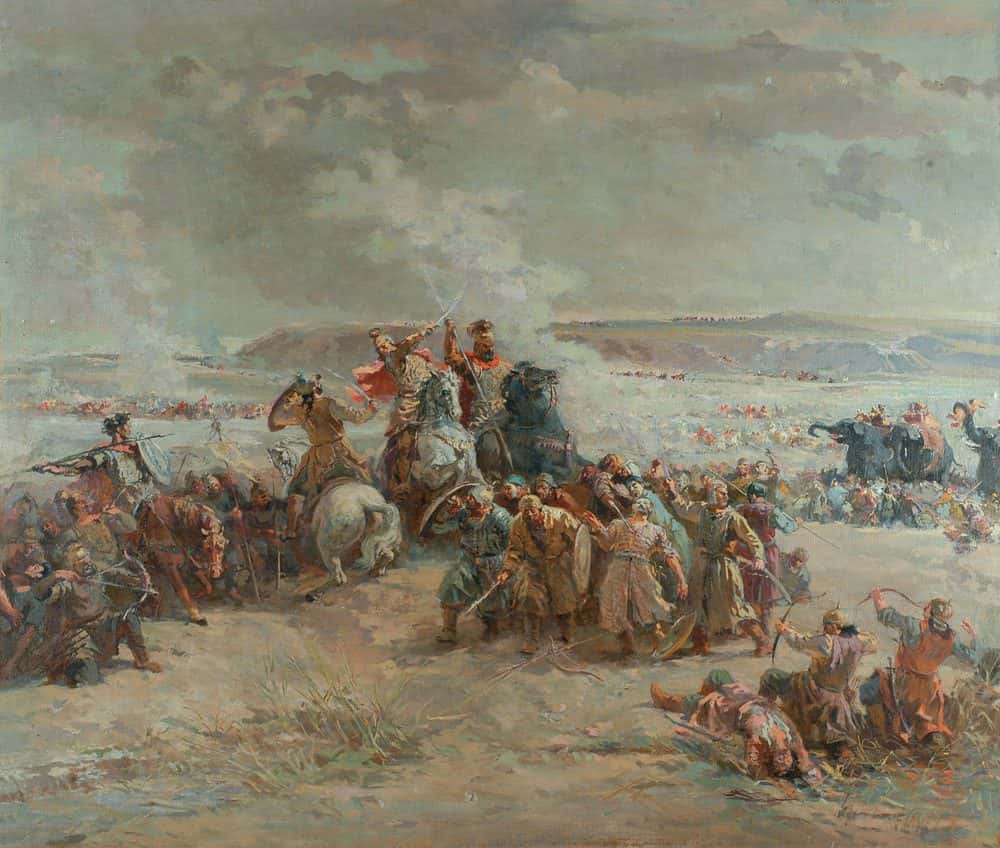
On the Avarayr plain the Armenian army of sparapet Vardan Mamikonian met the Sasanian force sent to impose Zoroastrianism on Christian Armenia. Vardan and over a thousand of his men were killed, yet armed resistance continued until Persia conceded freedom of worship in the 480s. The fifth-century historians Eghishe and Ghazar Parpetsi record that the war also ran through the eastern marches: in 450 Vardan's cavalry campaigned into Aghvank, the land adjoining Artsakh, and defeated a Persian army at Khaghkhagh.
Book II covers the 450-451 uprising and the battle of Avarayr.
Related
Manuscript page carrying the canons issued at Aghven under Vachagan the PiousUnknown medieval Armenian scribe · Public domain (medieval manuscript)
c. 488 CE
Council of Aghven under Vachagan the Pious
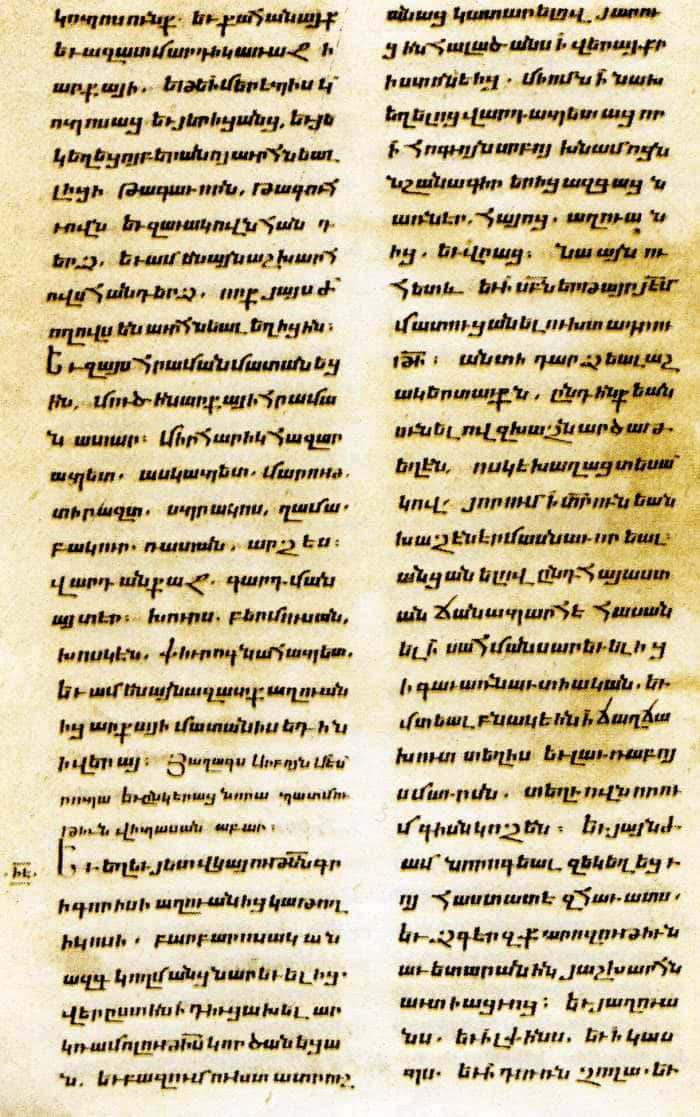
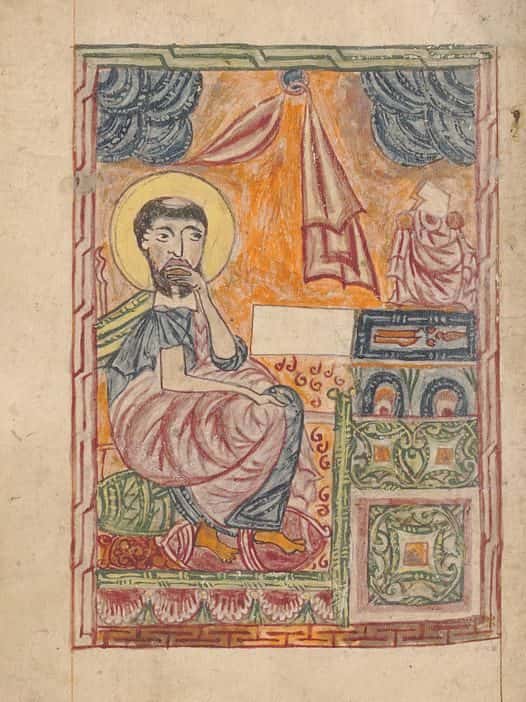
King Vachagan III the Pious of Aghvank, whose realm took in Artsakh and Utik, gathered bishops, priests, and nobles at Aghven and issued a set of canons regulating church income, clerical conduct, and the obligations of laymen. The canons survive in the History of the Country of Aghvank compiled by Movses Kaghankatvatsi, the same chronicle that preserves much of the early history of Artsakh.
The standard scholarly English translation of the key medieval source for Artsakh and Utik.
Related
Kachaghakaberd, the cliff fortress of the princes of Khachen in ArtsakhVahag851 · CC BY-SA 3.0
821/822 - c. 1000
Foundation of the principality of Khachen, nucleus of the medieval Kingdom of Artsakh
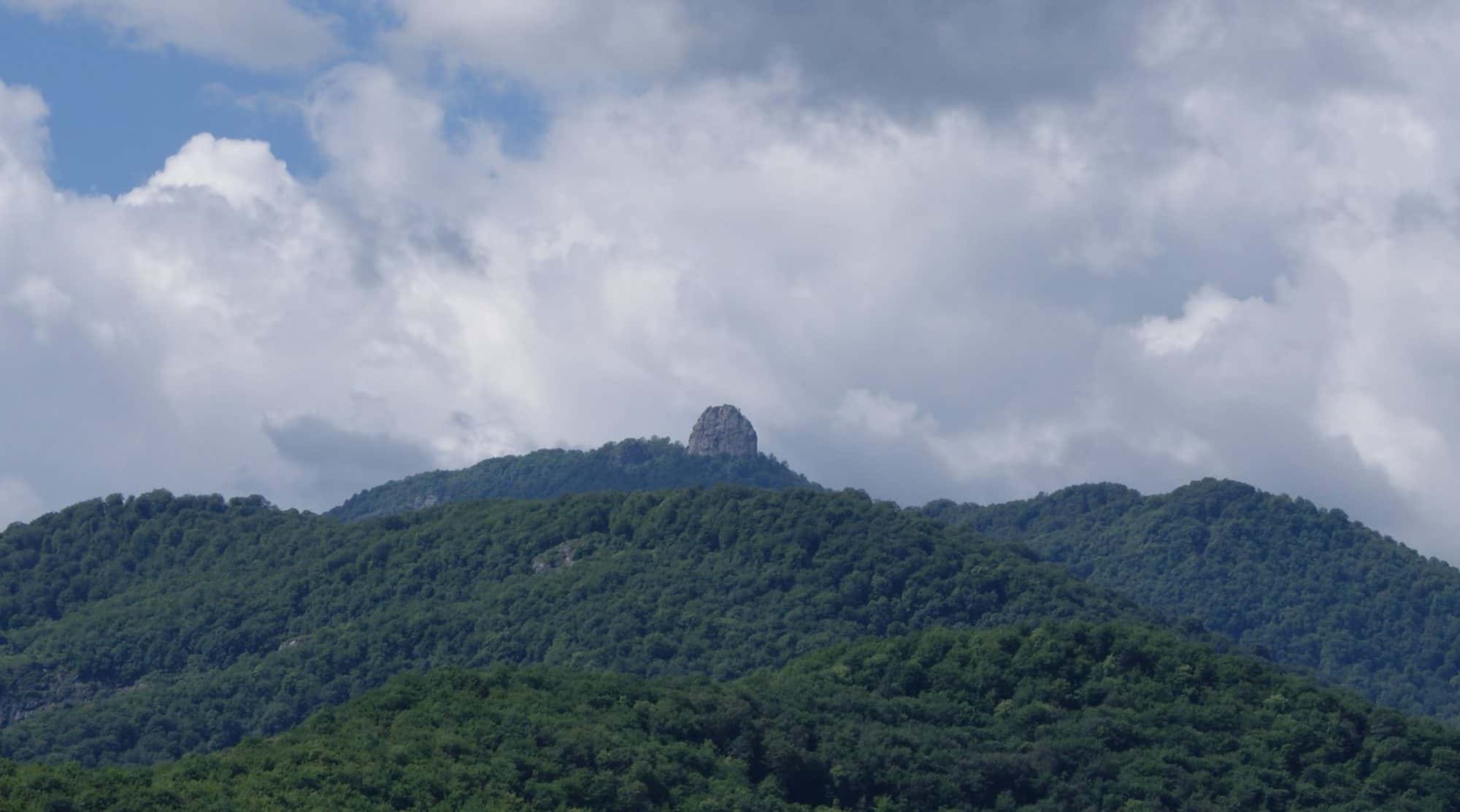
After the murder of the last presiding prince of Aghvank in 822, his heiress Spram was married at the castle of Khachen to Atrnerseh, son of the Siwnid prince Sahl Smbatean; their line step by step regathered the old lands of Artsakh. From about the year 1000 to 1266 the princes of Khachen assumed the royal title, forming what the historian Robert Hewsen calls the 'Kingdom of Artsakh', one of seven Armenian kingdoms functioning at the end of the first millennium.
The standard scholarly English translation of the key medieval source for Artsakh and Utik.
Related
An Armenian manuscript copied in Artsakh, 1551Hayrapet (scribe) · Public domain (1551 manuscript)
10th century CE
Movses Kaghankatvatsi's History of the Country of Aghvank, the key medieval source for the region
The History of the Country of Aghvank, attributed to Movses Kaghankatvatsi and compiled in Armenian by the 10th century from earlier materials, is the principal medieval source for the ecclesiastical and political life of Artsakh and Utik. It preserves the canons of the Council of Aghven under King Vachagan the Pious and the elegy of the poet Davtak on Prince Juansher; the standard English translation is by C.J.F. Dowsett (Oxford, 1961).
Dowsett's scholarly introduction on the manuscript tradition and dating.
Related
Dadivank monastery above the Terter valley in ArtsakhAlaexis · CC BY 3.0
1214
Katoghike cathedral of Dadivank completed by Princess Arzu-Khatun
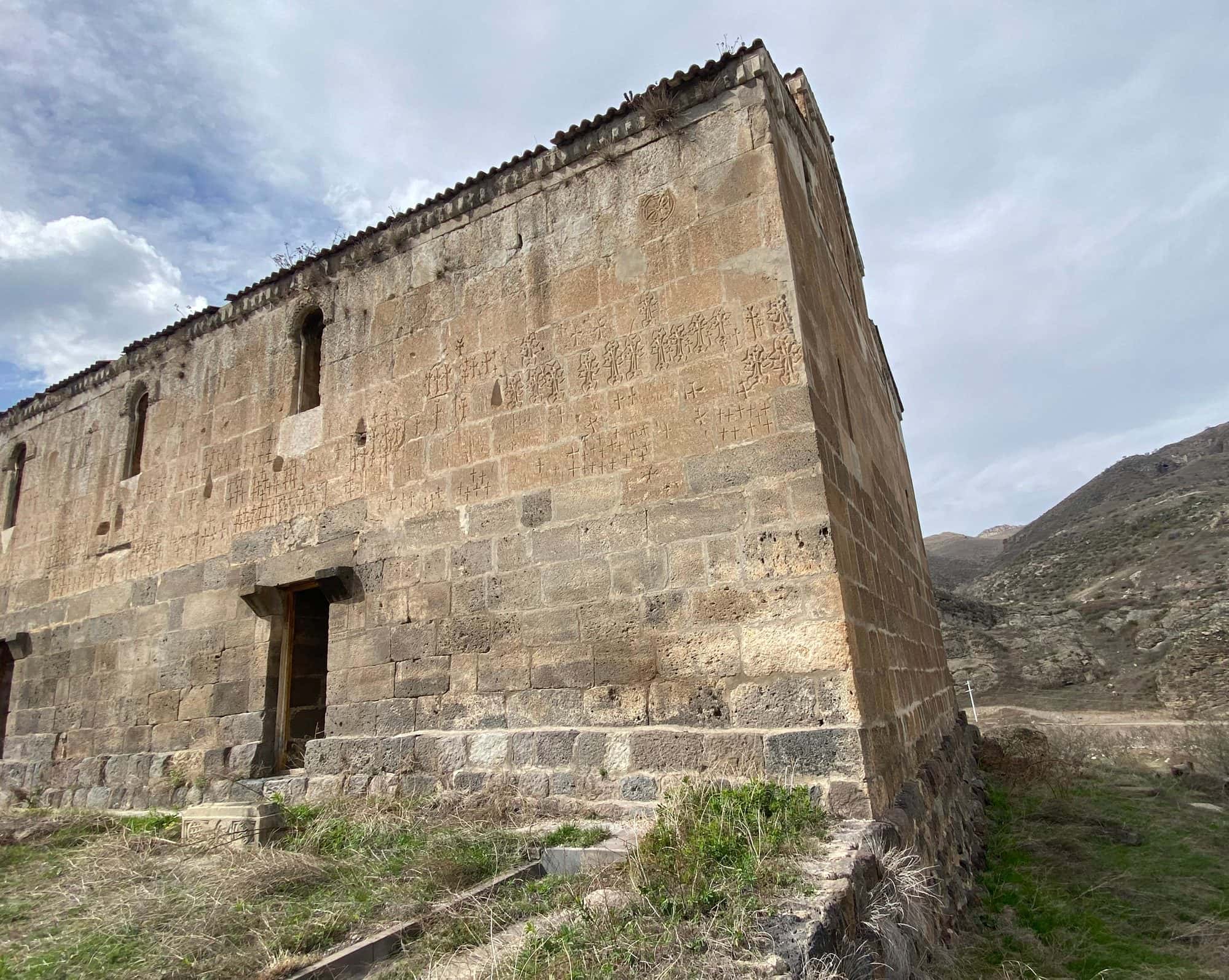
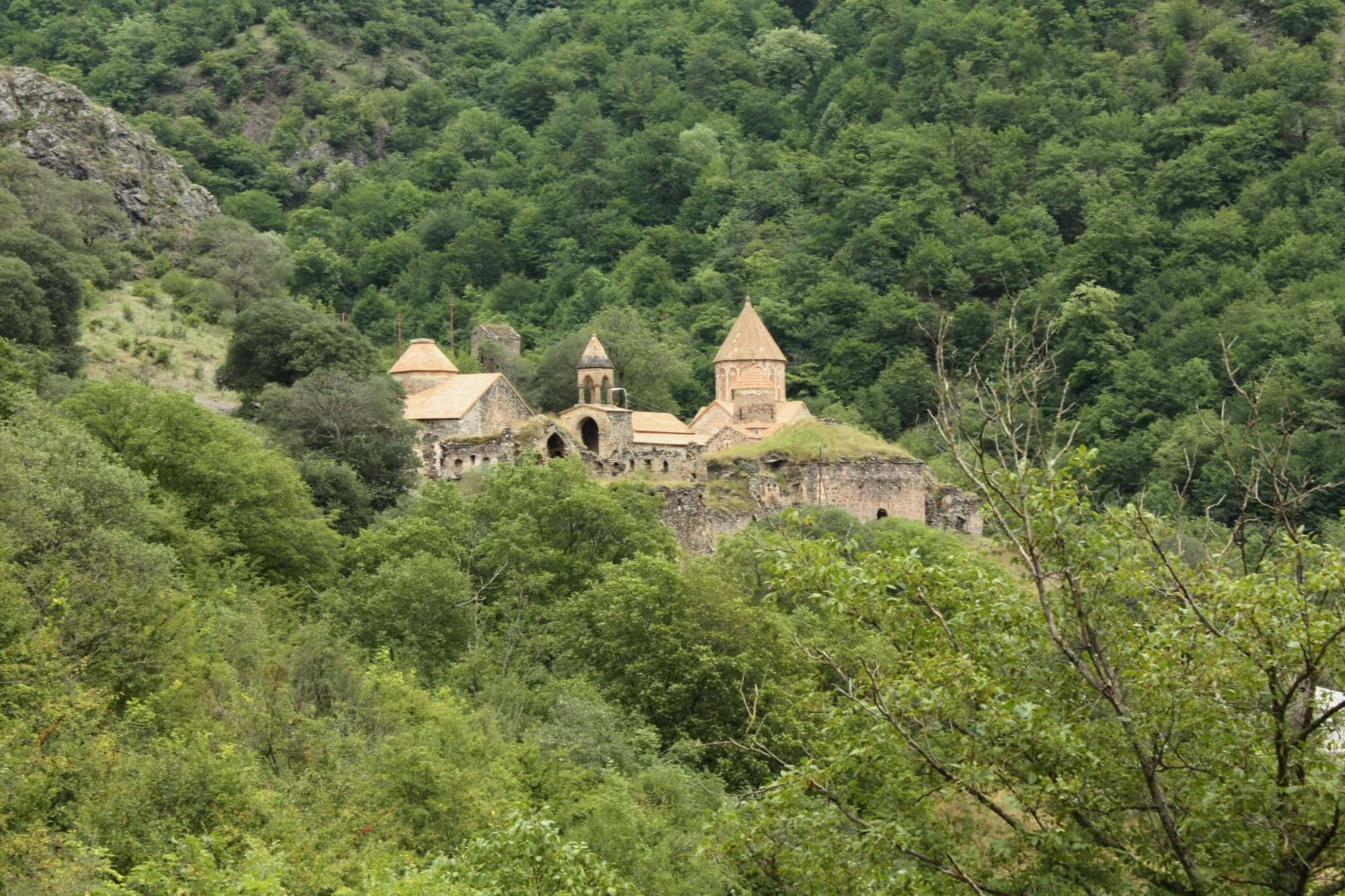
According to its 19-line building inscription, the Katoghike church of Dadivank monastery was built in 1214 by Princess Arzu-Khatun, wife of Vakhtang lord of Haterk, in memory of her husband and sons. The monastery is older still: the chronicle of Mkhitar Gosh records its burning by a Turkish emir in 1145/6 and its rebuilding under the princes of Khachen. Its cathedral, donor bas-reliefs and 1297 frescoes form one of the masterworks of the Artsakh school of Armenian architecture.
Dadivank, upper Terter valley, Artsakhmedievalreligioncultural-heritage
The standard dynastic study of medieval Artsakh: Khachen's 822 origins, the royal period c. 1000-1266, and the melik houses' descent.
Related
Gandzasar, the cathedral built by Hasan-Jalal and consecrated in 1240Nungas · CC BY-SA 4.0
1216-1240
Hasan-Jalal builds Gandzasar; the cathedral consecrated in 1240
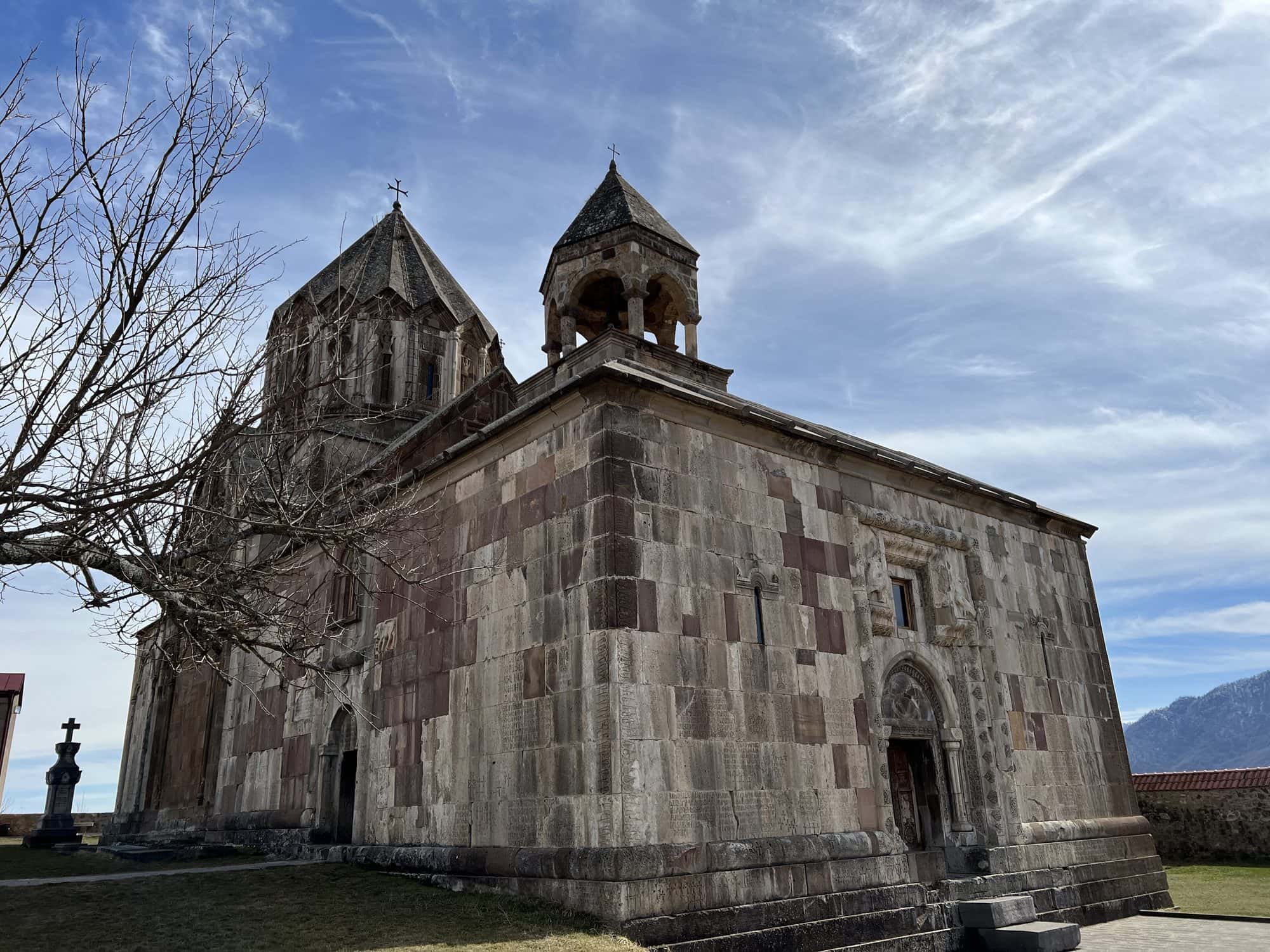
The contemporary historian Kirakos Gandzaketsi records that Hasan-Jalal, prince of Khachen, built 'a beautifully adorned church with a heavenly dome' at Gandzasar, consecrated in 1240 on the Feast of the Transfiguration in the presence of the Catholicos of Aghvank and, it was said, seven hundred priests. Gandzasar became the seat of the Catholicosate of Aghvank, a see of the Armenian Church held by the Hasan-Jalalian family into the 19th century. Hasan-Jalal, who titled himself 'King of Artsakh and Baghk,' was executed by the Mongols at Qazvin.
The standard dynastic study of medieval Artsakh: Khachen's 822 origins, the royal period c. 1000-1266, and the melik houses' descent.
Related
The palace of Melik Yegan at Togh, seat of the meliks of DizakBeko · CC BY-SA 4.0
15th-18th centuries
The five Armenian melikdoms of Artsakh: the Khamsa
From the mid-15th century, descendants of the princes of Khachen were recognized as meliks (hereditary Armenian lords), and Persian shahs repeatedly confirmed them in their domains. The five melikdoms of Gulistan, Jraberd, Khachen, Varanda and Dizak, known collectively as the Khamsa, preserved Armenian self-rule, armed forces and church institutions in Artsakh through the early modern period; their history was classically narrated by Raffi in The Melikdoms of Khamsa (1882).
The classic 19th-century history of the five melikdoms, based on documents and local tradition.
Related
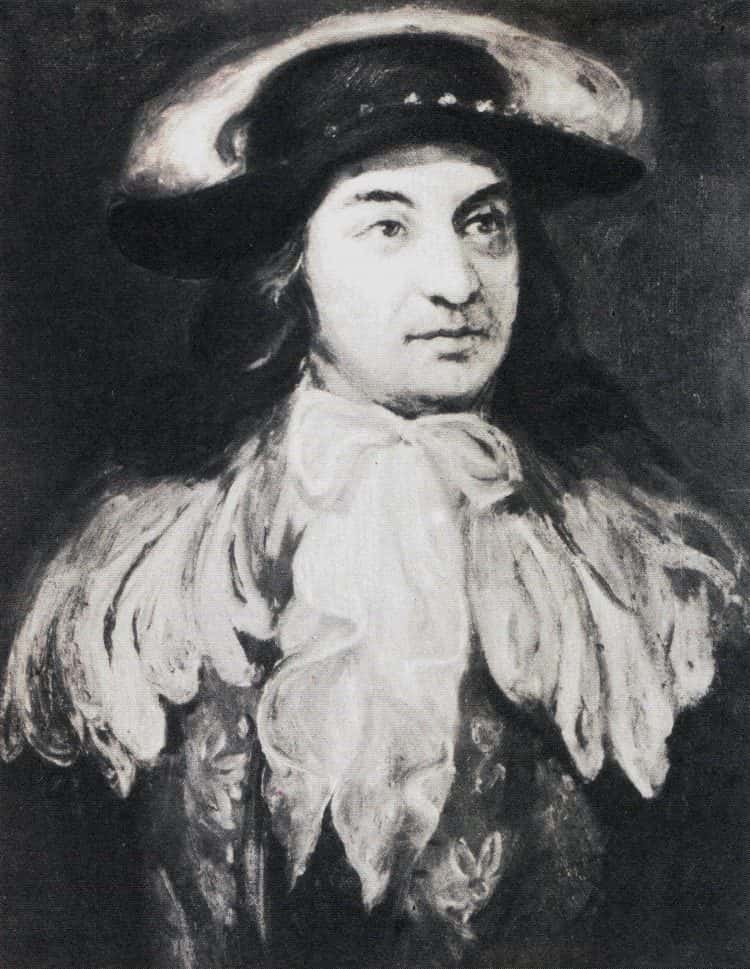
Israel Ori, who carried the meliks' appeals to the courts of EuropeUnknown · Public domain (c. 1700 portrait, author unknown)
1699
The Angeghakot meeting: Israel Ori and the liberation embassies
Israel Ori, a Siwnid-descended notable who had spent two decades in Europe, convened a secret gathering of meliks at Angeghakot in Syunik, which resolved to seek European and Russian support for the liberation of the eastern Armenian lands. Ori carried the meliks' appeals to the Elector Palatine, the Habsburg court and ultimately Peter the Great, opening the era of organized Armenian emancipatory diplomacy in which the meliks of Artsakh played a leading role.
Angeghakot, Syunik / the melikdoms of Artsakhearly-modernpoliticalresistance
The standard dynastic study of medieval Artsakh: Khachen's 822 origins, the royal period c. 1000-1266, and the melik houses' descent.
Related
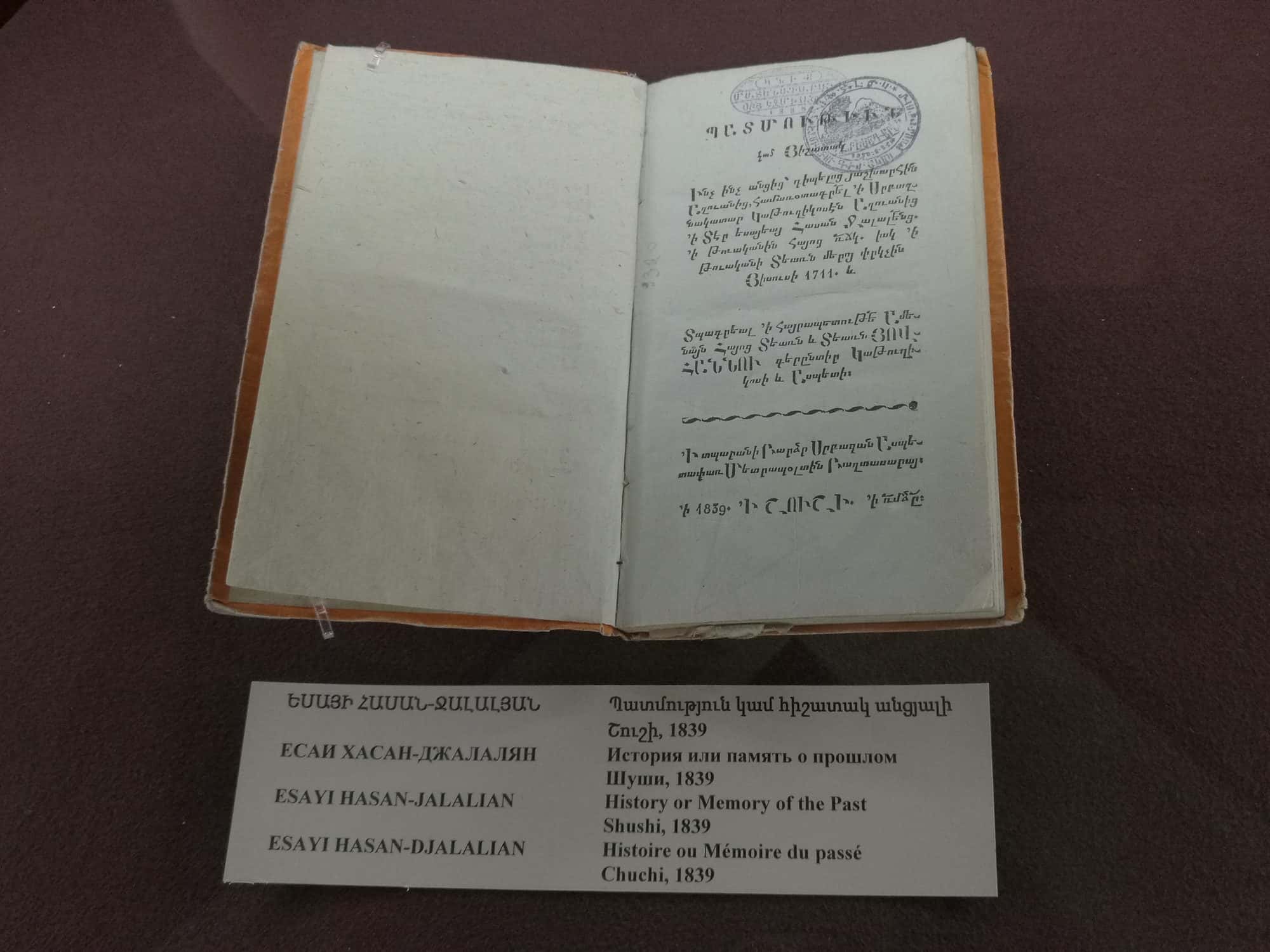
The chronicle of Catholicos Esayi Hasan-Jalalyants, witness to the sghnakh yearsRG72 · CC BY-SA 4.0
1722-1730
The sghnakhs of Artsakh: armed resistance and appeals to Peter the Great
As Safavid Persia collapsed and Ottoman armies invaded the Caucasus, the Armenians of Artsakh organized fortified mountain camps known as sghnakhs under commanders such as Avan Yuzbashi, fielding thousands of armed men and coordinating with Davit Bek's rising in neighboring Syunik. Catholicos Esayi Hasan-Jalalyants of Gandzasar, whose contemporary chronicle documents these years, corresponded with the Russians and encouraged Peter the Great's 1722 Caspian campaign; the resistance held out for most of a decade.
Melik discord and the rise of Panah Ali: the fortress of Shushi and the Karabakh khanate
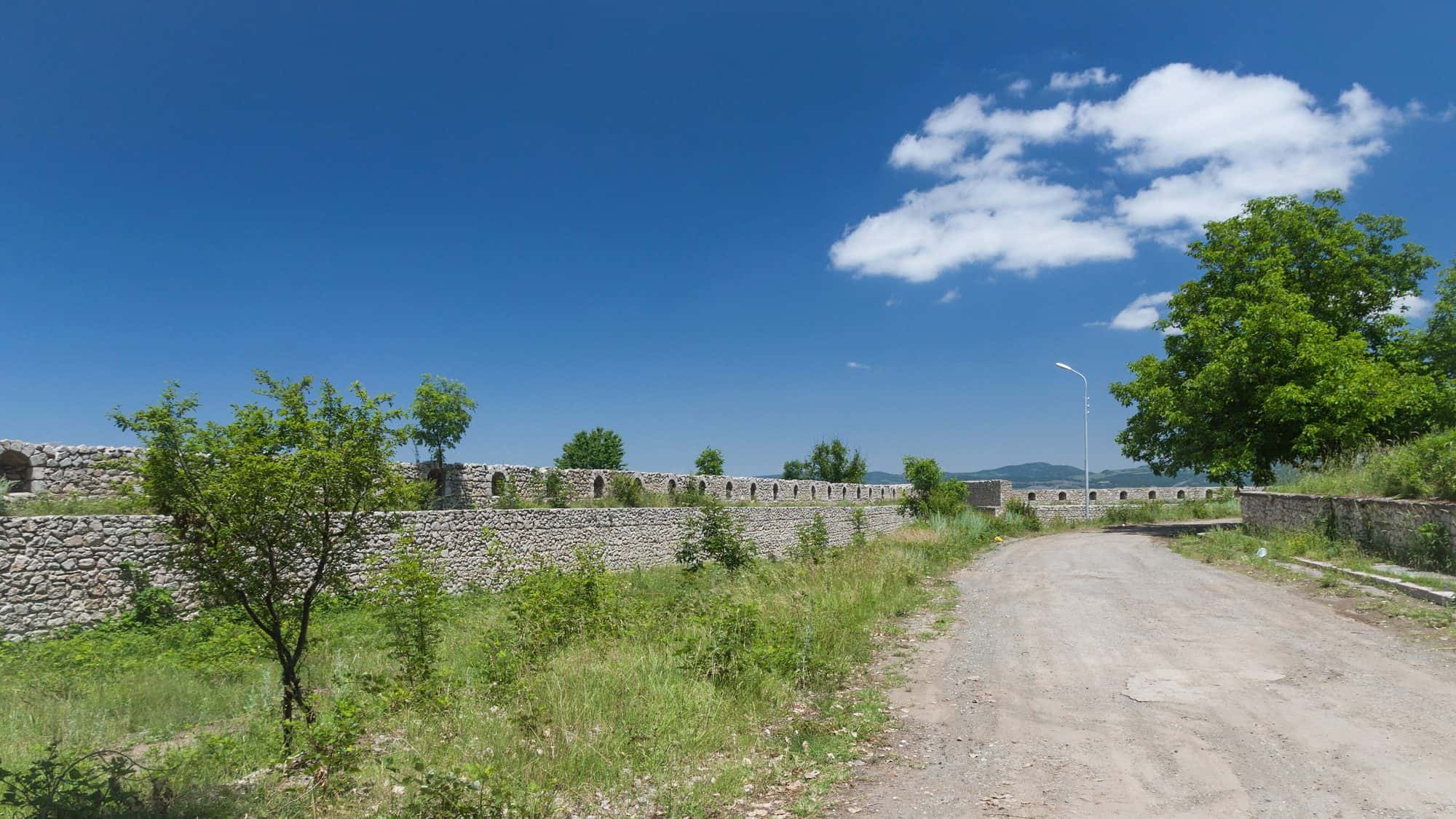
In the turmoil after Nadir Shah's death, Panah Ali, a chief of the Turkic Javanshir tribe, exploited a feud among the meliks (Melik Shahnazar of Varanda allied with him against the other four houses) to establish himself in highland Artsakh, fortifying Shushi and founding the khanate of Karabakh, the first Muslim polity seated within the highland. The melikdoms were progressively subordinated over the following decades, though they retained internal autonomy and repeatedly resisted the khans.
Shushi and the melikdoms of Artsakhearly-modernpoliticaldemographics
The classic 19th-century history of the five melikdoms, based on documents and local tradition.
Related
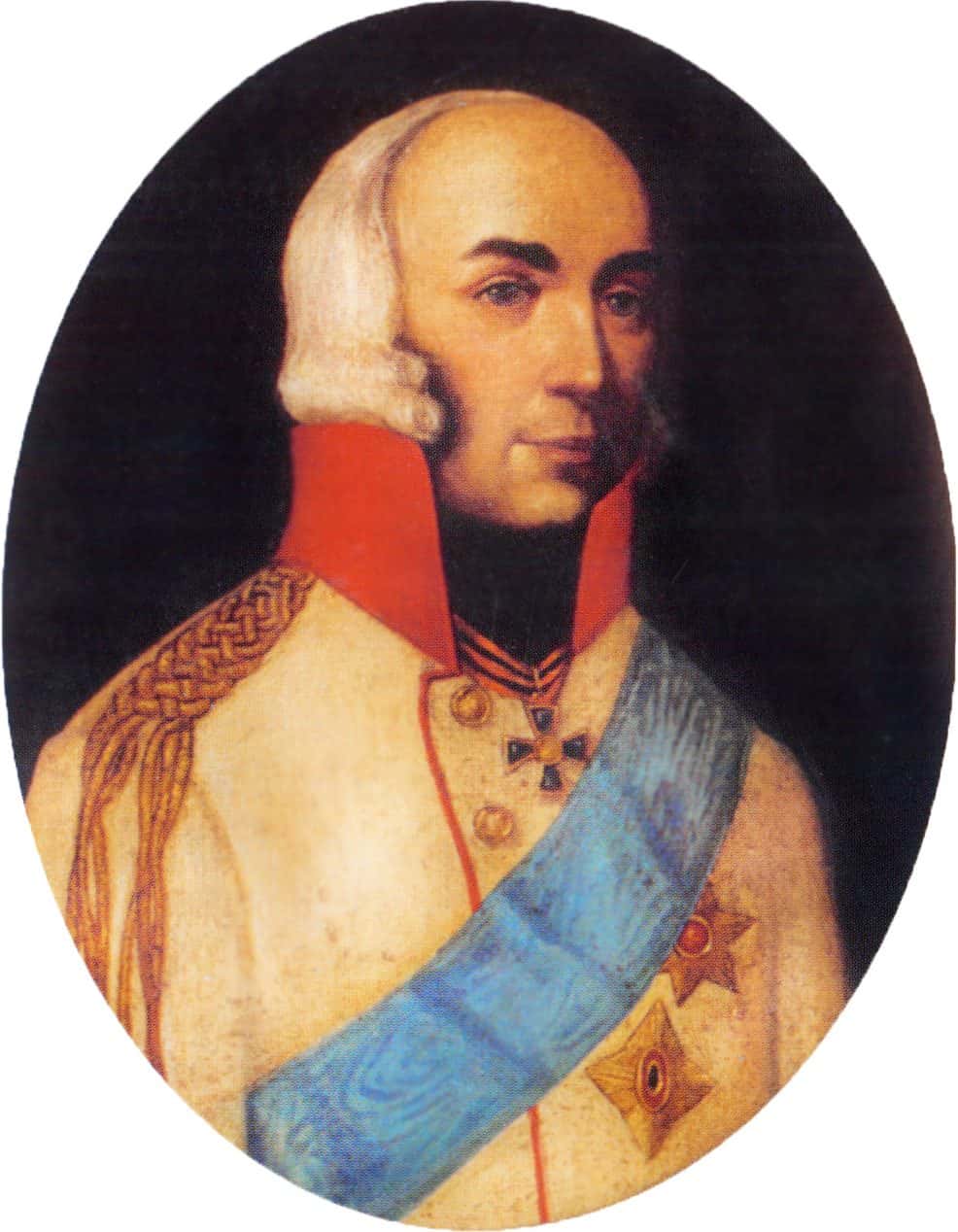
General Pavel Tsitsianov, who took Karabakh under Russian protection in 1805Unknown · Public domain (early 19th century portrait, author unknown)
1805
Artsakh passes under Russian suzerainty, prelude to the Treaty of Gulistan
During the first Russo-Persian war, the khan of Karabakh accepted Russian suzerainty by agreement with General Tsitsianov, bringing Shushi and the surrounding Armenian melikdoms under Russian protection. Persia formally ceded the region to the Russian Empire in the Treaty of Gulistan (1813), closing the era of Persian overlordship over Artsakh.
Annotated critical translations of the local Persian-language chronicles covering 1736-1828.
Related
Under Empire
1813-1987Russian rule, revolution, and the Soviet decision that drew the lines
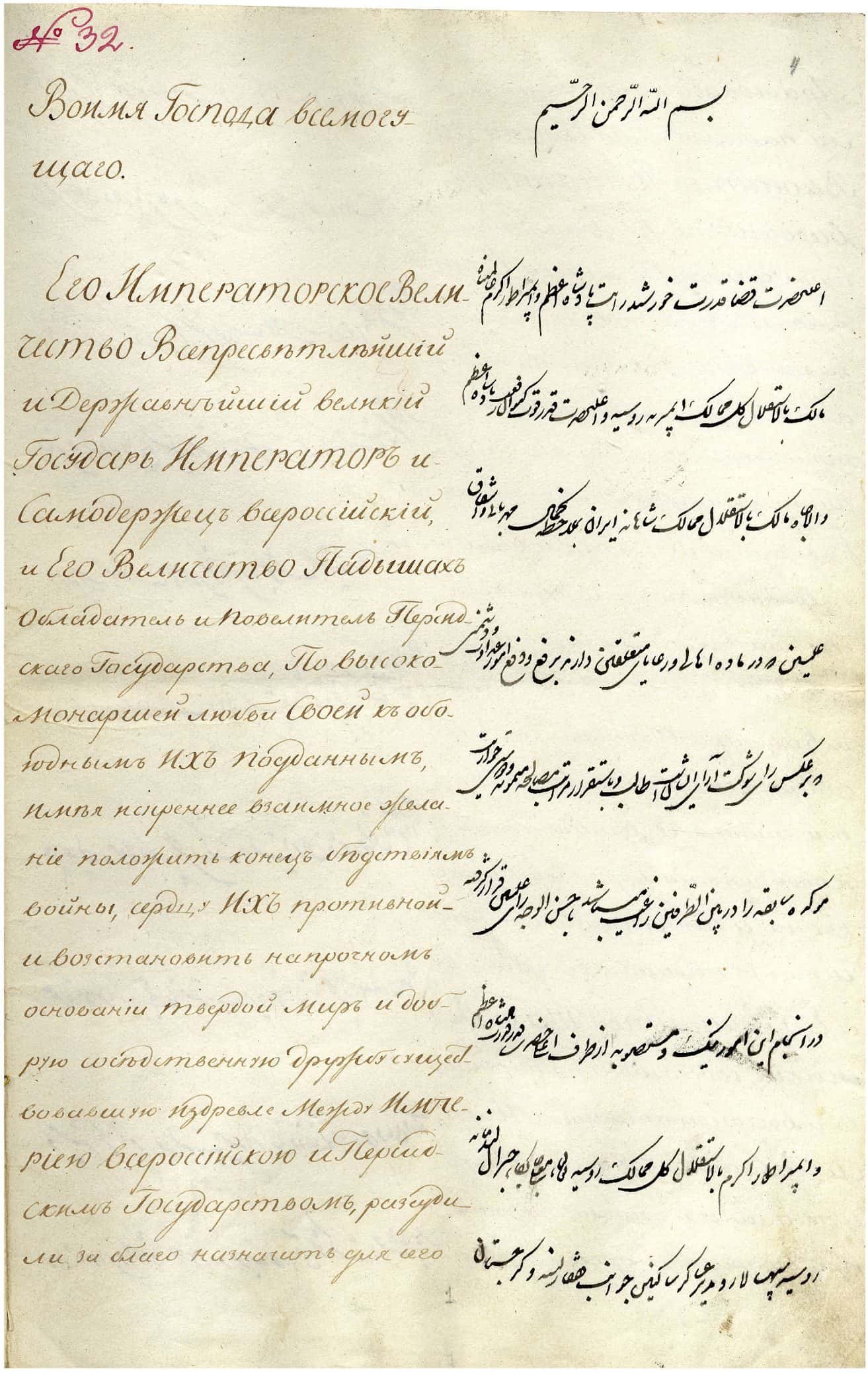
First page of the 1813 Treaty of Gulistan between Russia and PersiaUnknown · Public domain (1813 state document)
24 October 1813
Treaty of Gulistan: Karabakh passes from Persia to the Russian Empire
Russia and Qajar Persia signed the Treaty of Gulistan, ending the Russo-Persian War of 1804-1813. Persia ceded to Russia the khanates of the eastern Caucasus, including the Khanate of Karabakh, bringing the region under Russian imperial rule for the next century.
Standard scholarly documentary collection reproducing the full English texts of the Treaties of Gulistan (1813) and Turkmenchay (1828).
Related
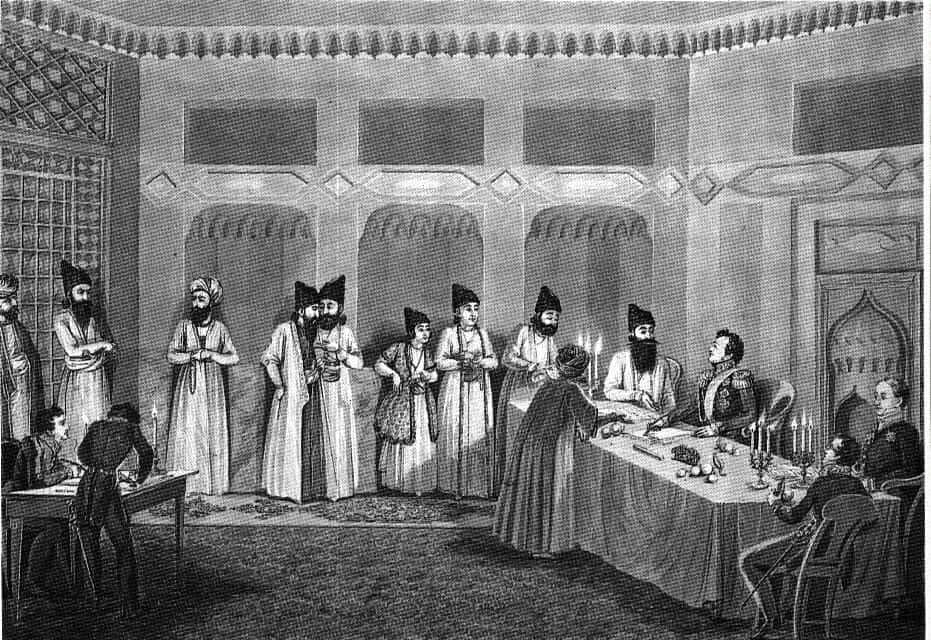
Moshkov's painting of the signing of the Treaty of Turkmenchay in 1828Vladimir Moshkov · Public domain (painted after 1828, artist long deceased)
22 February 1828
Treaty of Turkmenchay and Armenian resettlement into Russian Transcaucasia
The Treaty of Turkmenchay ended the Russo-Persian War of 1826-1828, confirming Russian rule over the eastern Caucasus and ceding the Erivan and Nakhichevan khanates. Article XV permitted free migration across the new border, after which thousands of Armenians from Persia resettled in Russian Transcaucasia, including the Karabakh region.
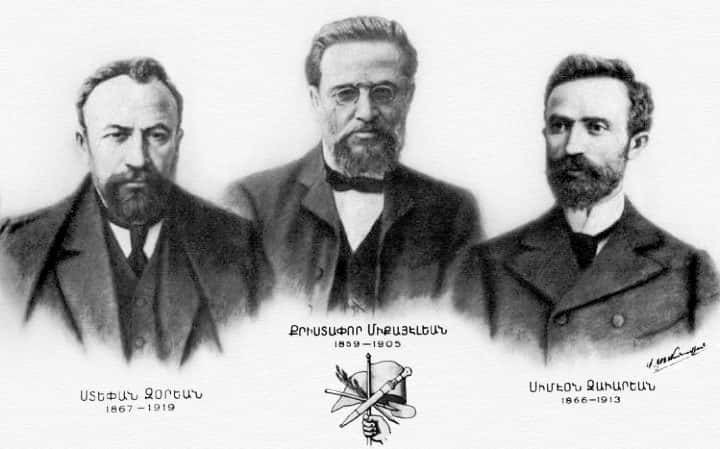
In Tiflis, Kristapor Mikayelian and Simon Zavarian, joined soon after by Stepan Zorian (Rostom), founded the Armenian Revolutionary Federation, drawing scattered revolutionary circles into one organization devoted to the political and economic freedom of the Armenian people. By 1905 it was the strongest Armenian political party, it governed the First Republic of 1918 to 1920, and a century after its founding its structures were again active in both Armenia and Artsakh.
The party's own account of its 1890 founding and later history, cited as an attributed organizational source.
Related
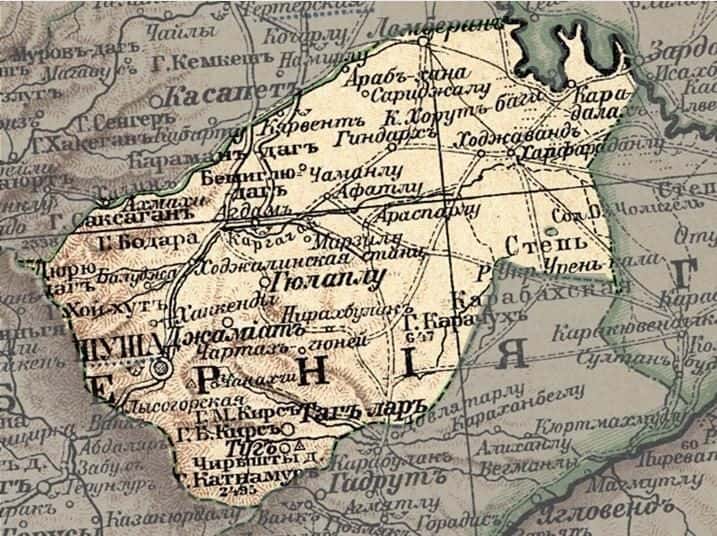
Russian imperial map of the Shushi uezd, the district the census recordedCartography of the Russian Empire · Public domain (Russian imperial cartography, 1903)
9 February 1897
First Russian imperial census records ethnic composition of the Karabakh region
The first general census of the Russian Empire recorded the Shushi uezd of Elisavetpol Governorate, covering most of mountainous Karabakh, at 138,771 inhabitants, of whom 73,953 gave Armenian as their native language and 62,868 Tatar, the imperial census's term for Azerbaijani. The mountainous districts were overwhelmingly Armenian while lowland areas were largely Muslim-populated.
Official published census volume with uezd-level nationality tables, digitized by the Boris Yeltsin Presidential Library.
Related
A main street in Shushi after the fire, published October 1905Unknown · Public domain (PD-old, Russian Empire press photo, 1905)
August 1905
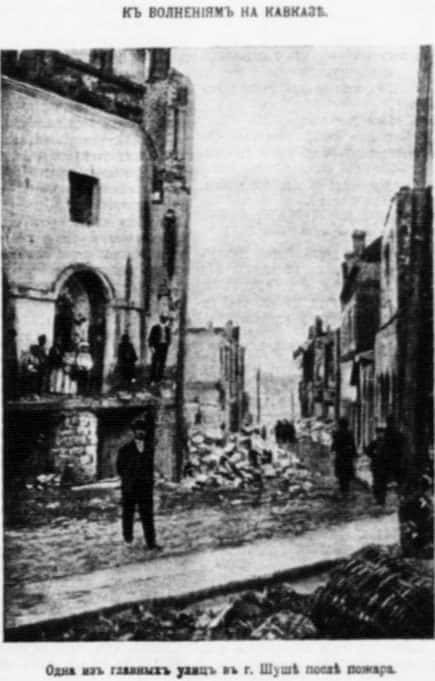
Armeno-Tatar clashes devastate Shushi
During the empire-wide Armeno-Tatar violence of 1905-1906, several days of intercommunal fighting in Shushi in August 1905 left hundreds dead and large parts of the town burned; further fighting followed in July 1906. The Italian journalist Luigi Villari, who traveled through the Caucasus during the violence, documented the clashes and their aftermath.
Contemporaneous eyewitness account of the 1905-1906 Armeno-Tatar violence by an independent Italian journalist.
Related
Armenians deported on foot through the Kharberd province, 1915Unknown · Public domain (published 1918, PD-US / PD-old)
1915 to 1923
The Armenian Genocide
Beginning with the arrest of Armenian community leaders in Constantinople on 24 April 1915, the Ottoman government destroyed its Armenian population through mass killing and death marches into the Syrian desert; about 1.5 million Armenians were dead by 1923. On 24 May 1915 Britain, France, and Russia jointly declared the massacres crimes against humanity and civilization, the first use of that phrase in diplomacy. The annihilation of the western homeland left the eastern regions that survived, Artsakh among them, to carry the demographic and cultural weight of the nation.
Western Armenia, Ottoman Empirenationgenocidedemographicsdiaspora
Full scan of the British parliamentary Blue Book of eyewitness documents on the Armenian Genocide.
Related
Armenian troops before the battle of Sardarapat, May 1918Unknown · Public domain (PD-old-70-1923)
May 1918
Sardarapat and the First Republic of Armenia
With Ottoman armies driving on Yerevan three years into the genocide, Armenian regulars and villagers stopped them at Sardarapat in the last week of May 1918, with parallel stands at Bash Aparan and Karakilisa. On 28 May the Armenian National Council declared the independent Republic of Armenia, the state whose contest with the new Azerbaijani republic over Karabakh runs through the next three years of this timeline.
Sardarapat and Yerevannationwarindependencepolitical
The standard scholarly account of the May 1918 battles and the declaration of the republic.
Related
Shushi, where the Karabakh Armenian assemblies met from 1918Unknown · Public domain (PD-old, pre-1917 Russian Empire postcard)
22 July 1918
First Assembly of Karabakh Armenians declares self-government
After the collapse of Russian authority and the declarations of the independent Armenian and Azerbaijani republics, the First Assembly of Karabakh Armenians convened in Shushi, proclaimed Mountainous Karabakh a self-governing political unit, and elected a People's Government. Karabakh's status remained contested between the two new republics for the entire 1918-1920 period.
Peer-reviewed archival study of Karabakh's political status and the making of the NKAO, 1918-1925.
Related
Khosrov bek Sultanov, appointed governor-general of Karabakh in 1919Unknown · Public domain (PD-old, anonymous early 20th century portrait)
15 January 1919
Azerbaijan appoints Khosrov bek Sultanov governor-general of Karabakh with British acquiescence
Azerbaijan appointed Khosrov bek Sultanov provisional governor-general of Karabakh and Zangezur; the British military command in Transcaucasia provisionally acquiesced pending a final decision at the Paris Peace Conference. The Karabakh Armenian assemblies repeatedly rejected Azerbaijani jurisdiction during 1919.
Seventh Assembly of Karabakh Armenians accepts provisional agreement with Azerbaijan
The Seventh Assembly of Karabakh Armenians concluded a 26-point provisional agreement accepting Azerbaijan's administration pending the decision of the Paris Peace Conference, in exchange for internal cultural autonomy and limits on Azerbaijani garrisons. The arrangement broke down over the following months amid mutual violations and escalating tensions.
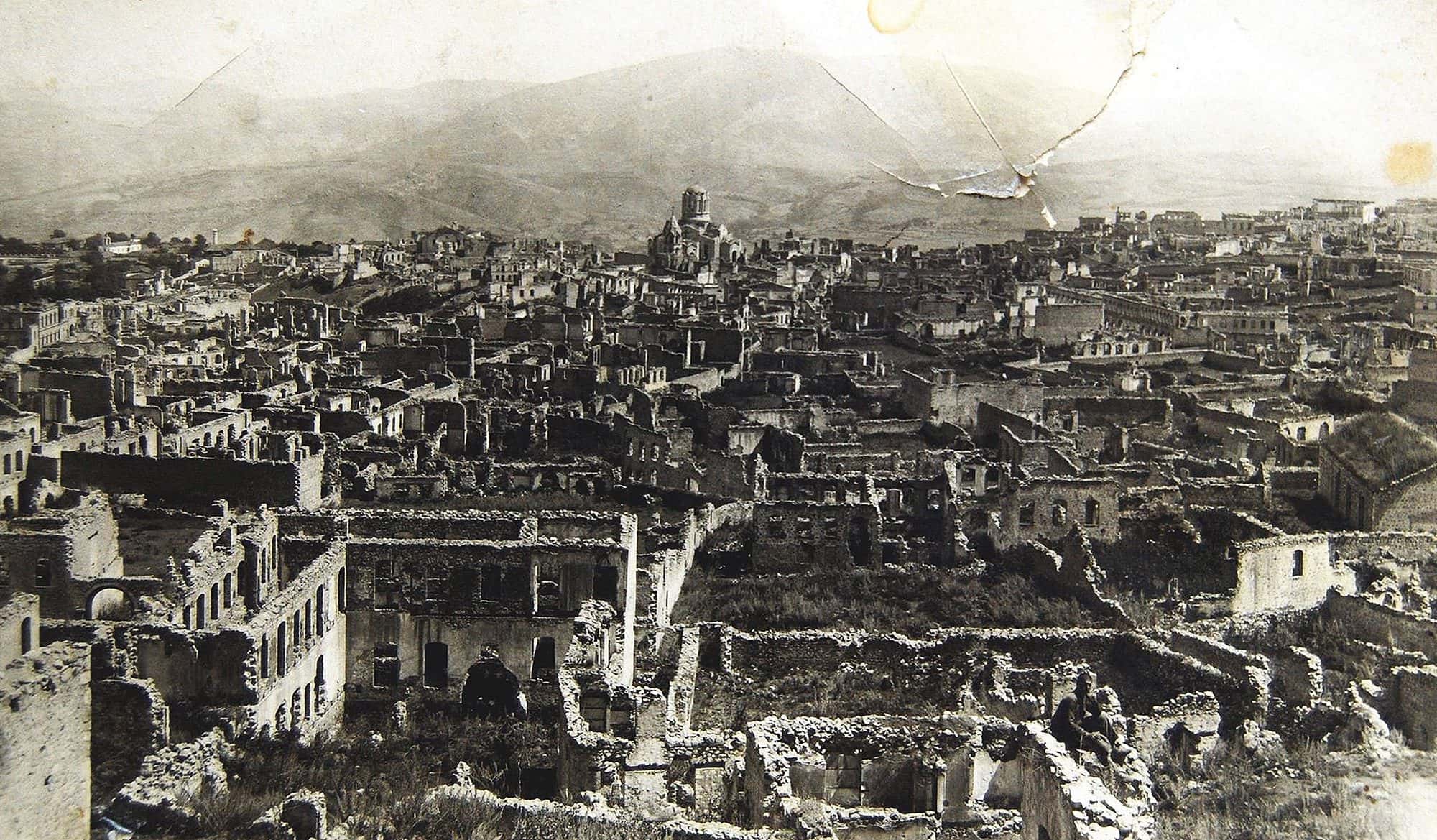
Destruction of the Armenian half of Shushi (the Shushi massacre)
After a failed Armenian uprising against the Azerbaijani garrisons launched on the night of 22-23 March 1920, Azerbaijani troops and irregulars burned and destroyed the Armenian half of Shushi, killed members of its population including Bishop Vahan, and drove out the surviving Armenian inhabitants. Contemporary estimates recorded in Western scholarship put the dead at roughly 500, while Armenian sources report far higher figures, up to 20,000; Shushi ceased to be a majority-Armenian town.
Peer-reviewed archival study of Karabakh's political status and the making of the NKAO, 1918-1925.
Related
Nariman Narimanov, who read the declaration of 1 December 1920Stanislava Klimashevskaya · Public domain (PD-old)
1 December 1920
Soviet Azerbaijan's declaration renouncing claims to Karabakh, Zangezur and Nakhichevan
The day after Armenia's sovietization, Nariman Narimanov read a declaration of Azerbaijan's Revolutionary Committee announcing that the disputed territories of Nagorno-Karabakh, Zangezur and Nakhichevan were resolved in Armenia's favor; Stalin publicized the act in Pravda on 4 December 1920. The declaration was never implemented, and scholars note that different versions of its text circulated; by mid-1921 Karabakh and Nakhichevan were again under Soviet Azerbaijan's administration.
Peer-reviewed archival study of Karabakh's political status and the making of the NKAO, 1918-1925.
Related
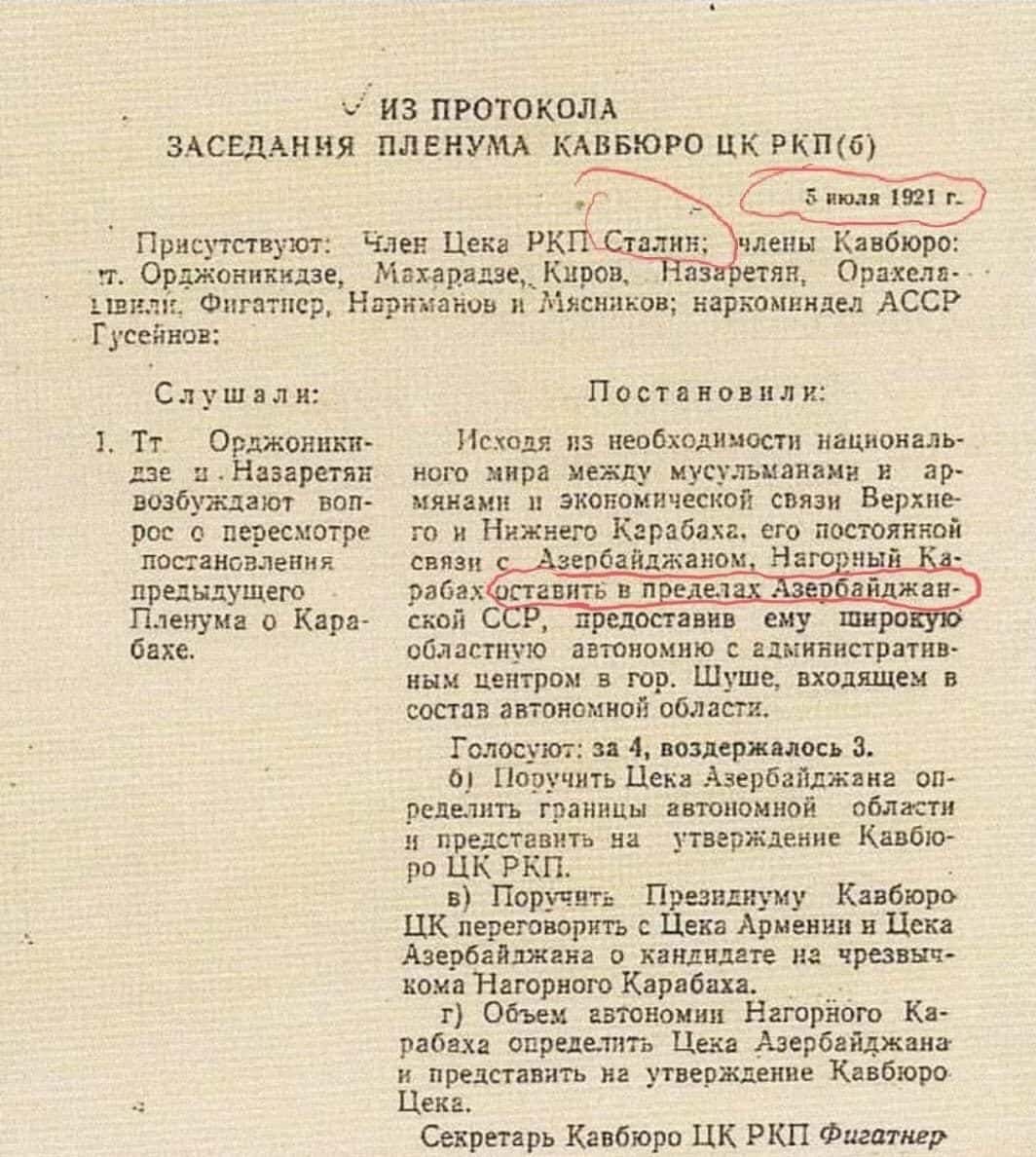
Extract from the Kavburo plenum protocol of 5 July 1921Caucasian Bureau of the RCP(b) · Public domain (PD-RU-exempt, official document)
5 July 1921
Kavburo decision leaves Nagorno-Karabakh within the Azerbaijani SSR
On 4 July 1921 the plenum of the Caucasian Bureau of the Russian Communist Party voted to attach Nagorno-Karabakh to Soviet Armenia, but on 5 July, with Stalin present, the question was reopened and the Bureau resolved that Nagorno-Karabakh would be retained within the Azerbaijani SSR with broad regional autonomy. The decision was taken by a party organ without consulting the region's population.
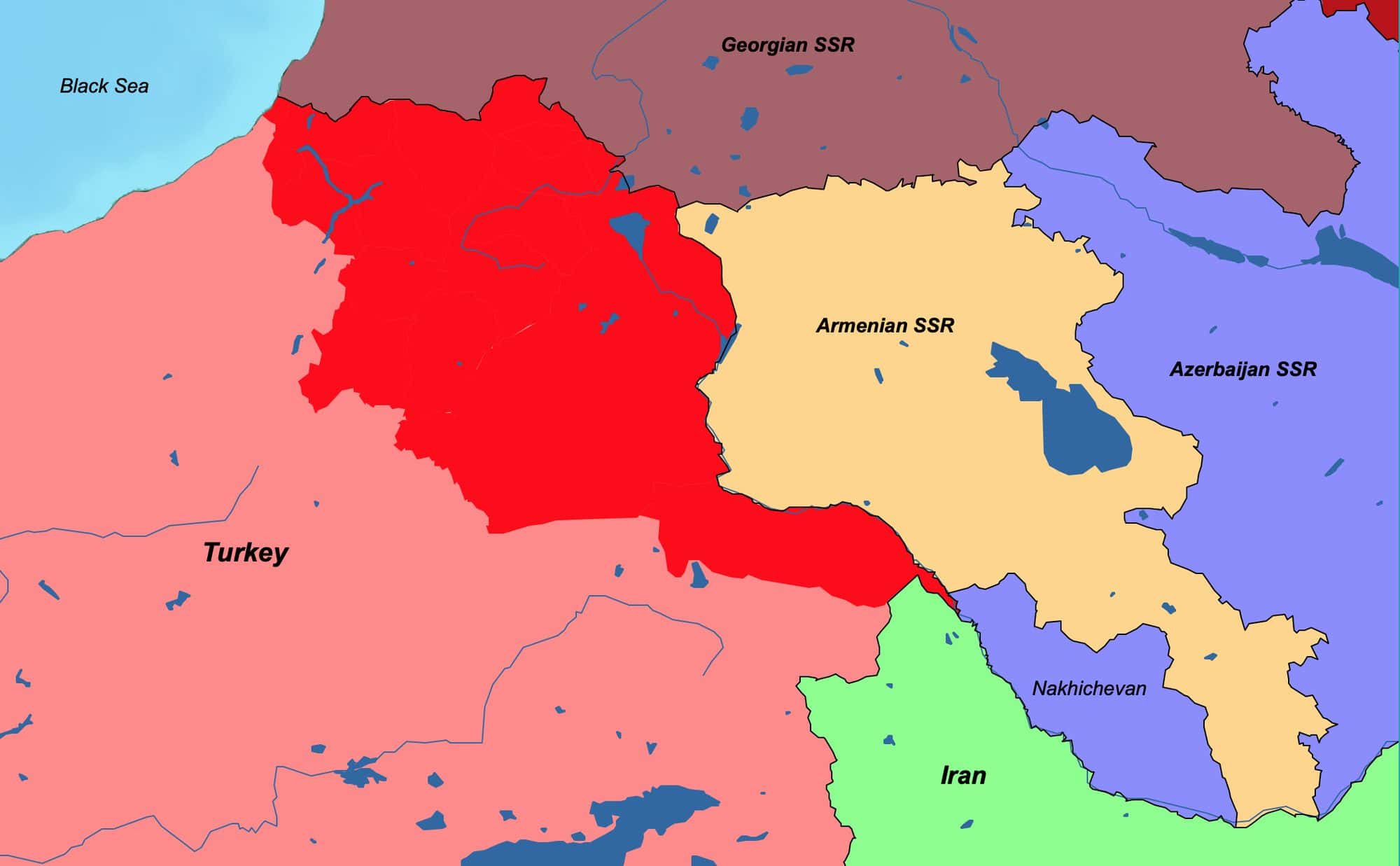
At Kars, Kemalist Turkey signed a treaty with Soviet Armenia, Soviet Georgia, and Soviet Azerbaijan that confirmed the border drawn by the Treaty of Moscow, leaving Kars, Ardahan, and Surmalu with Mount Ararat outside Soviet Armenia. Article 5 made Nakhichevan an autonomous territory under the protection of Soviet Azerbaijan, so that within a single year two Armenian-populated regions, Karabakh and Nakhichevan, were placed under Baku's authority. The medieval Armenian cemetery of Jugha, whose destruction this timeline records, lay in that ceded territory.
Creation of the Nagorno-Karabakh Autonomous Oblast (NKAO)
The Central Executive Committee of Soviet Azerbaijan decreed the formation of an autonomous Armenian region in mountainous Karabakh with its center at the town officially renamed Stepanakert in September 1923. The region's borders were drawn so that the NKAO, though about 90 percent Armenian, shared no boundary with Soviet Armenia, from which it was separated by a narrow strip of intervening territory at the future Berdzor corridor.
Peer-reviewed archival study of Karabakh's political status and the making of the NKAO, 1918-1925.
Related
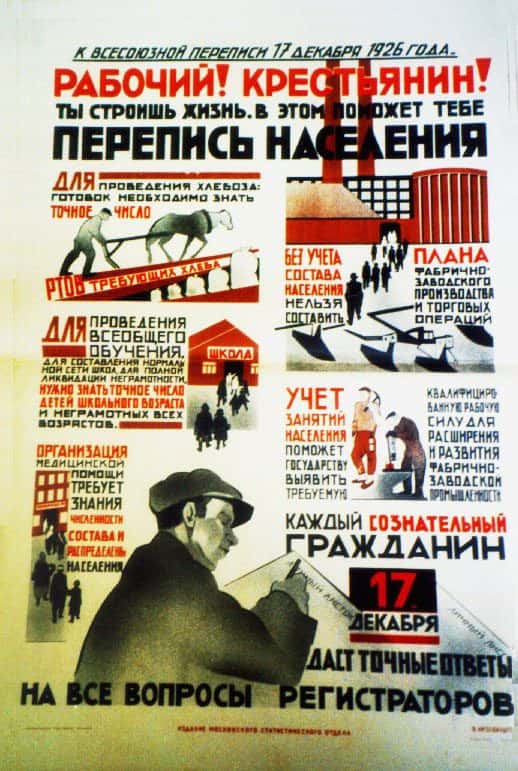
Soviet poster announcing the All-Union census of 17 December 1926Unknown · Public domain (PD-anon-70-EU)
17 December 1926
First Soviet census: NKAO records an 89 percent Armenian majority
The All-Union Soviet census recorded roughly 125,200 inhabitants in the Nagorno-Karabakh Autonomous Oblast, of whom about 111,700 (89 percent) were Armenians. This is the demographic baseline against which later Soviet-era shifts in the oblast are measured.
Peer-reviewed study by a Moscow ethnographer analyzing NKAO census dynamics 1926-1979.
Related
Grigory Arutinov, party first secretary who asked Moscow for the NKAOUnknown · Public domain (PD-Russia-1996, anonymous, published in Ogonyok, 1938)
November 1945 to December 1945
Soviet Armenia's leadership requests transfer of the NKAO to Armenia
Grigory Arutinov, first secretary of the Armenian Communist Party, wrote to the Soviet leadership proposing that the NKAO be transferred to Soviet Armenia; Georgii Malenkov forwarded the request to Azerbaijani party chief Mir Jafar Bagirov, who replied with counter-demands for Azeri-populated districts of Armenia and neighboring republics. The proposal was shelved and Karabakh's status remained unchanged.
Nagorno-Karabakh Autonomous Oblast / Moscowsoviet-erapetitionpolitical
Mass petitions from Karabakh Armenians to Moscow in the 1960s
During the Khrushchev and early Brezhnev years, Karabakh Armenians repeatedly petitioned Moscow for unification with Soviet Armenia: a 1963 petition reported to carry about 2,500 signatures, followed in 1965-1967 by collective letters from Karabakh officials and a mass petition that Armenian sources report bore some 45,000 signatures. The appeals cited economic neglect and restrictions on Armenian cultural life; several organizers were dismissed or punished, and no change of status followed.
Nagorno-Karabakh Autonomous Oblast / Moscowsoviet-erapetitionarmenian-reported
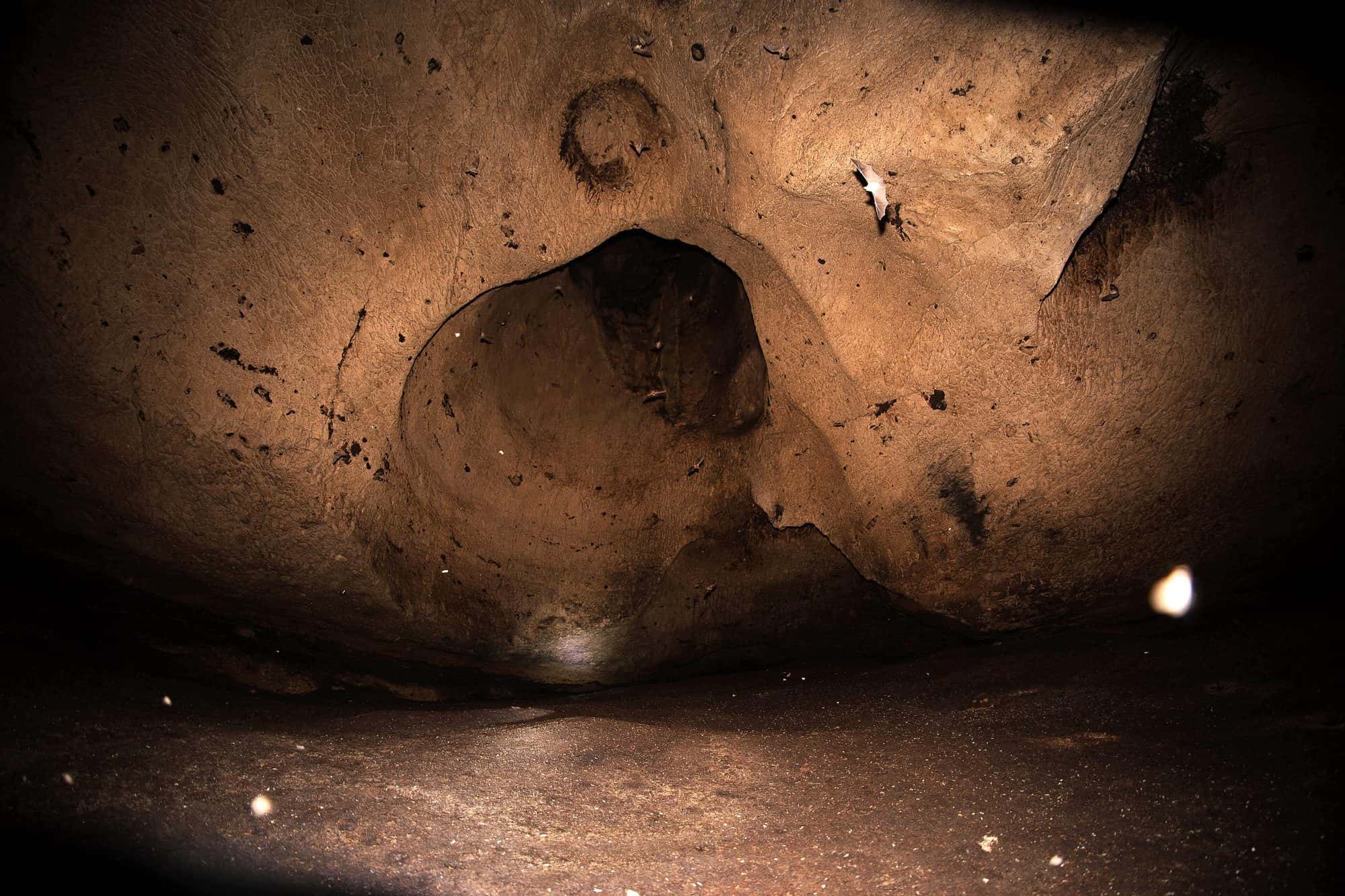
Azokh Cave: a Paleolithic record of human life in Artsakh
Azokh Cave in the Hadrut region holds a sedimentary sequence spanning the Middle Pleistocene to the Holocene, several hundred thousand years of intermittent human presence. A fragment of a hominin mandible, later assigned tentatively to Homo heidelbergensis, was found there in 1968, and the international Azokh Cave Project recovered a Neanderthal molar and modern human remains in its 2002 to 2016 seasons. The findings were synthesized in the peer-reviewed 2016 Springer volume Azokh Cave and the Transcaucasian Corridor.
Renewed appeals for unification during the 1977 Soviet constitutional discussion
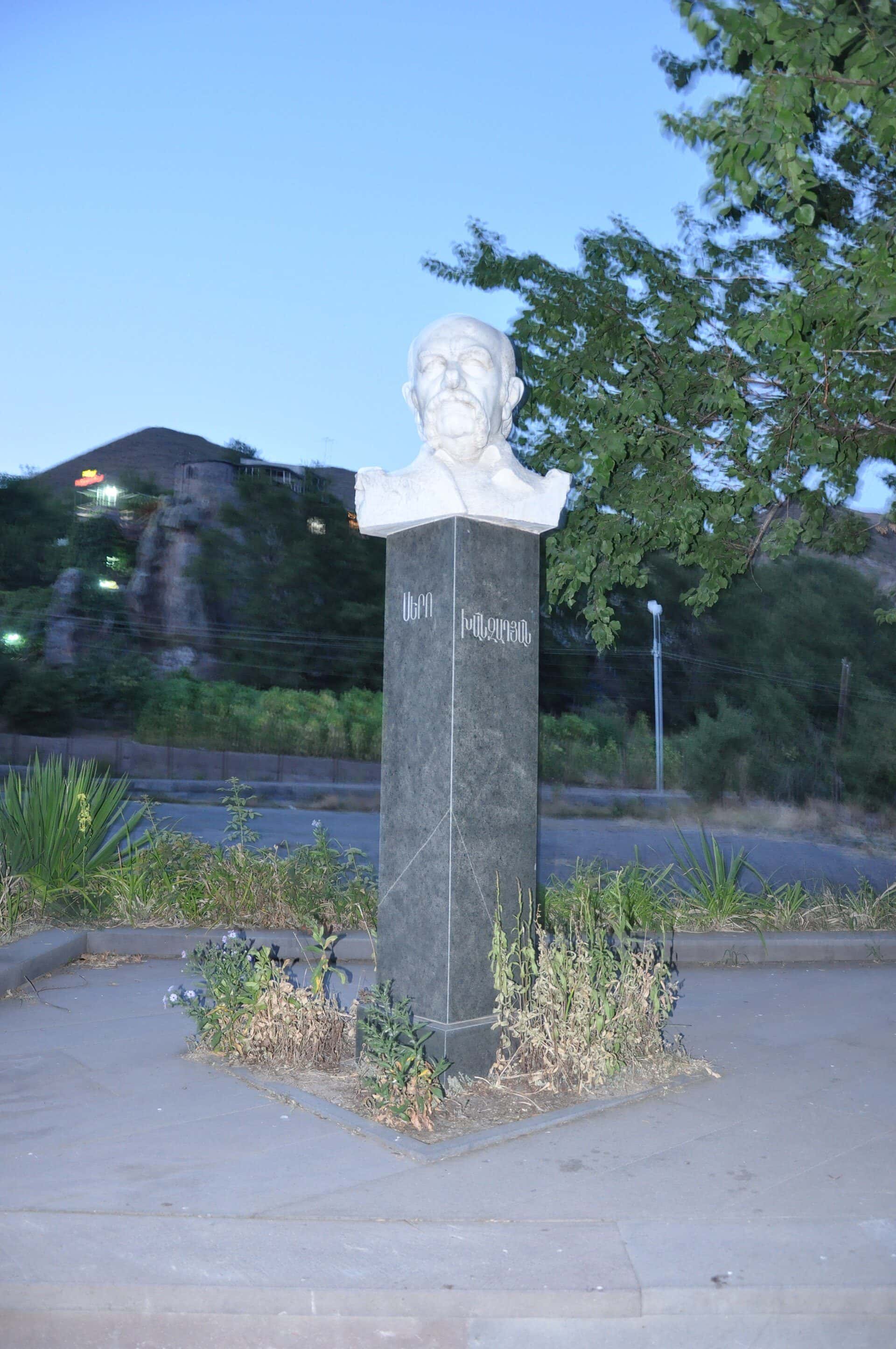
During the all-Union discussion of the new Soviet constitution in 1977, appeals were again submitted for transferring the NKAO to Soviet Armenia; the best known is an open letter to Leonid Brezhnev by the novelist Sero Khanzadyan. Armenian sources report that the letter detailed demographic decline and cultural discrimination against Armenians in the oblast; the appeals were rejected.
Nagorno-Karabakh Autonomous Oblast / Moscowsoviet-erapetitioncultural-heritagearmenian-reported
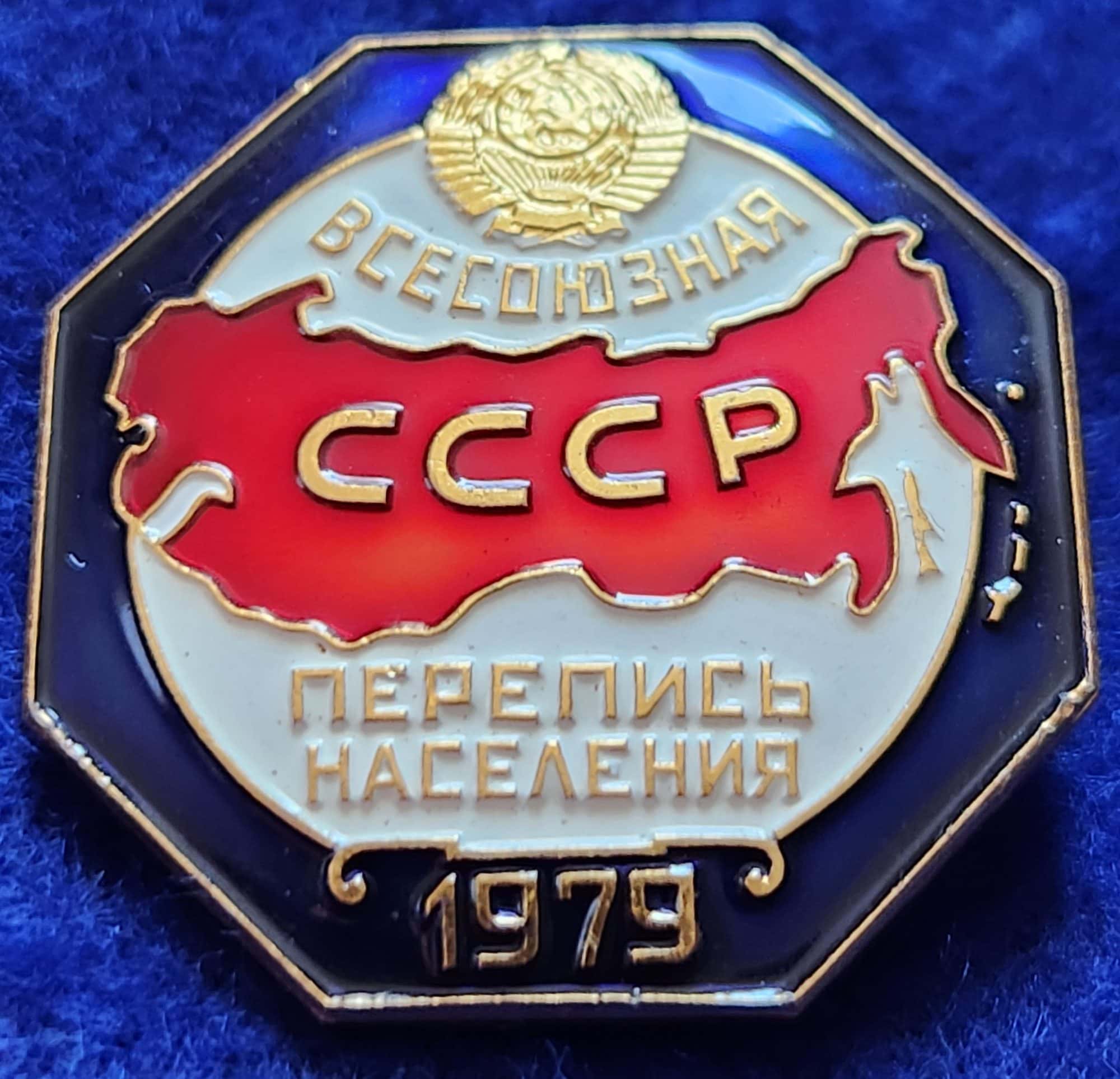
1979 Soviet census records decline of the Armenian share of the NKAO to 76 percent
The All-Union census counted about 162,200 inhabitants in the NKAO, of whom 123,076 (76 percent) were Armenians while 37,264 (23 percent) were Azerbaijanis. Compared with 1926, the Armenian share had fallen from about 89 percent while the Azerbaijani population had roughly tripled, a trend Armenians attributed to Baku's economic and settlement policies and which scholars identify as a core grievance behind the 1988 movement.
Independent Minority Rights Group report on Karabakh's history and demography.
Related
Abel Aganbegyan, whose Paris remarks in 1987 reopened the questionA. Savin · CC BY-SA 3.0
August 1987 to November 1987
1987 petition drive and Aganbegyan's Paris statement reopen the Karabakh question
In the fall of 1987, under glasnost, Karabakh Armenians organized a mass petition drive to the USSR Supreme Soviet requesting attachment to Soviet Armenia, with Armenian sources reporting tens of thousands of signatures. In November 1987 Abel Aganbegyan, an economic adviser to Gorbachev, told French Armenians in Paris that he favored Nagorno-Karabakh's return to Armenia. The remarks were widely taken as a signal of possible change and immediately preceded the mass movement of February 1988.
Nagorno-Karabakh Autonomous Oblast / Moscow / Parissoviet-erapetitionpolitical
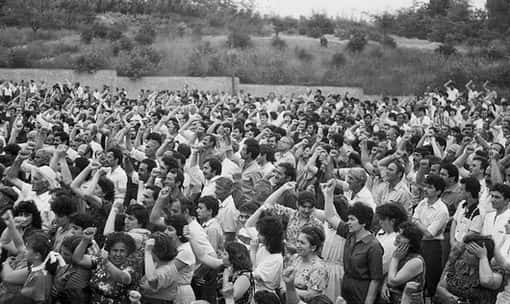
Nagorno-Karabakh regional soviet votes to request transfer to Armenia
At an emergency session, deputies of the NKAO Soviet voted to appeal to the Supreme Soviets of Azerbaijan, Armenia and the USSR to transfer the region from Soviet Azerbaijan to Soviet Armenia. The unprecedented vote, backed by mass rallies in Stepanakert and Yerevan, launched the Karabakh movement.
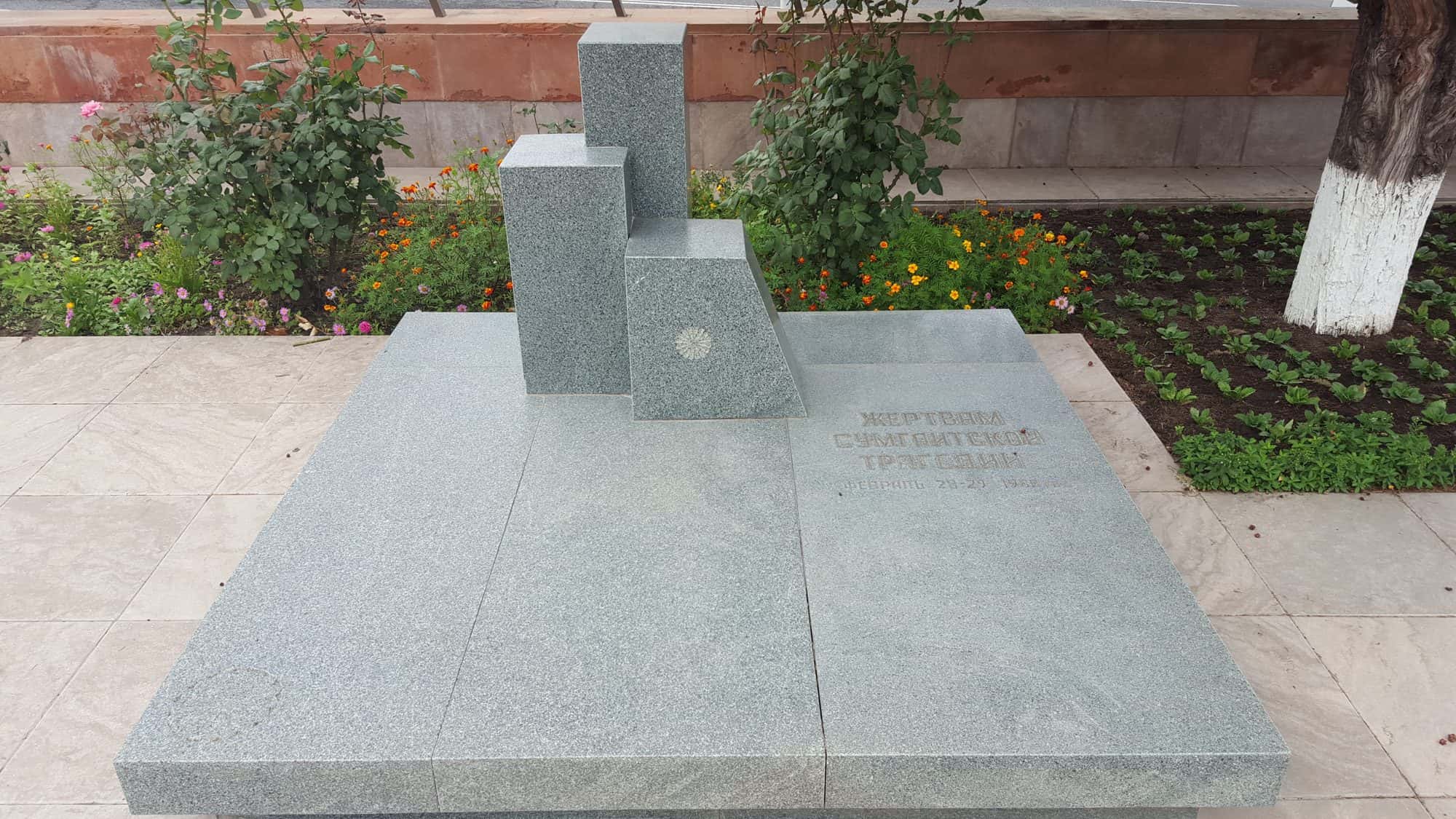
Mobs attacked Armenian residents of Sumgait, an industrial city near Baku, over three days of killing, rape and looting while police largely failed to intervene. Helsinki Watch recorded 32 Armenian deaths and hundreds of wounded; the pogrom set off the mass flight of Armenians from Azerbaijan.
Anti-Armenian riots broke out in Gandzak (then officially Kirovabad), the second city of Soviet Azerbaijan, in late November 1988; Soviet troops were deployed and martial law declared as the city's large Armenian community was driven out. The violence accelerated the two-way expulsion of minorities from both republics.
Contemporaneous wire report on the November 1988 wave of ethnic violence and strikes.
Related
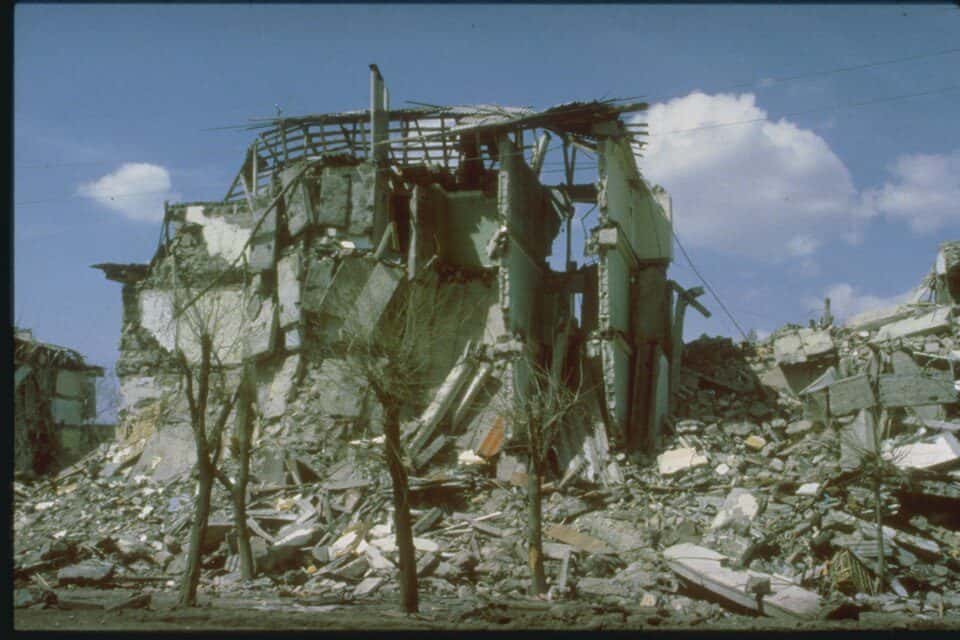
A collapsed apartment block in Gyumri after the earthquake of December 1988C. J. Langer, U.S. Geological Survey · Public domain (US Geological Survey, work of the US federal government)
7 December 1988
Spitak earthquake
A magnitude 6.8 earthquake lasting about twenty seconds leveled Spitak and most of Leninakan (Gyumri) in northern Armenia, killing more than 25,000 people and leaving some 150,000 homeless as winter set in. It struck ten months after the Karabakh movement had filled the squares of Yerevan and Stepanakert, and the double burden of earthquake recovery and the Artsakh conflict shaped Armenian life through the Soviet collapse.
Spitak and Gyumri, northern Armenianationdemographics
Retrospective with casualty figures, magnitude, and the international relief effort.
Related
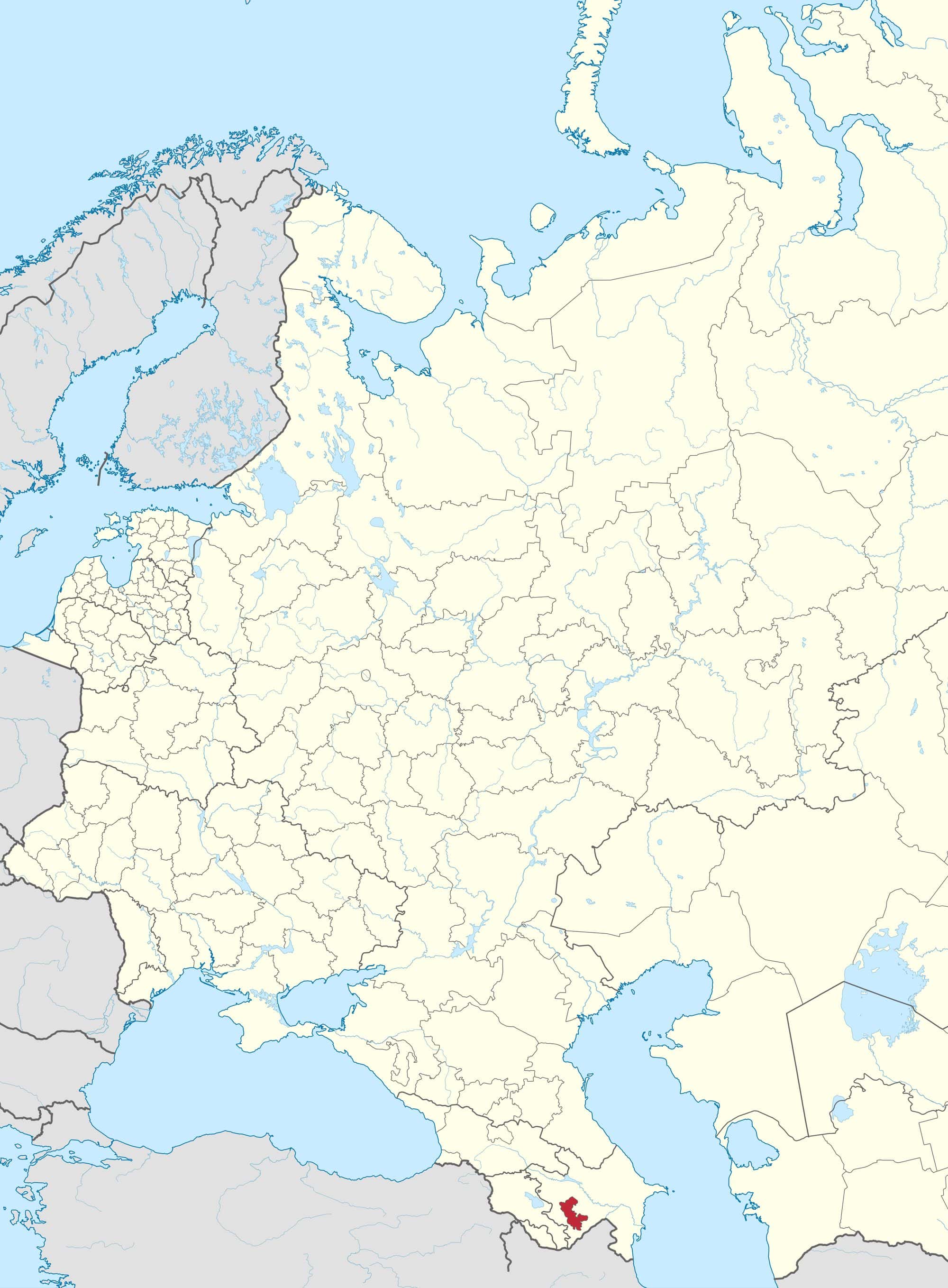
The Nagorno Karabakh Autonomous Oblast located within the Soviet UnionMilenioscuro · CC BY 4.0
12 January 1989 to 28 November 1989
Moscow imposes direct rule over Nagorno-Karabakh
The USSR placed the NKAO under a 'special form of administration' (direct rule from Moscow through the Volsky committee) after rejecting Armenia's request to transfer the region. Direct rule satisfied neither side and was lifted in late November 1989, returning the oblast to Azerbaijani jurisdiction.
After Moscow returned Nagorno-Karabakh to Azerbaijani administration, the Armenian Supreme Soviet and the Karabakh Armenian National Council adopted a joint resolution declaring the unification of Armenia and Nagorno-Karabakh. The declaration was never implemented but hardened positions on both sides.
Definitive academic account of the conflict based on interviews with participants on both sides.
Related
13-19 January 1990
Baku pogrom against Armenians
Beginning 13 January 1990, mobs attacked the remaining Armenian population of Baku with beatings, killings and apartment raids while police and 12,000 Interior Ministry troops stationed in the city failed to intervene. Helsinki Watch and Memorial documented 48 people killed outright, 46 of them Armenians, with 2,044 apartment raids and evidence that attackers worked from lists of Armenian addresses; the pogrom effectively ended Baku's centuries-old Armenian community.
Comprehensive HRW field investigation of the first war: Operation Ring, Khojalu, Karvachar, Akna, displacement figures and background.
Related
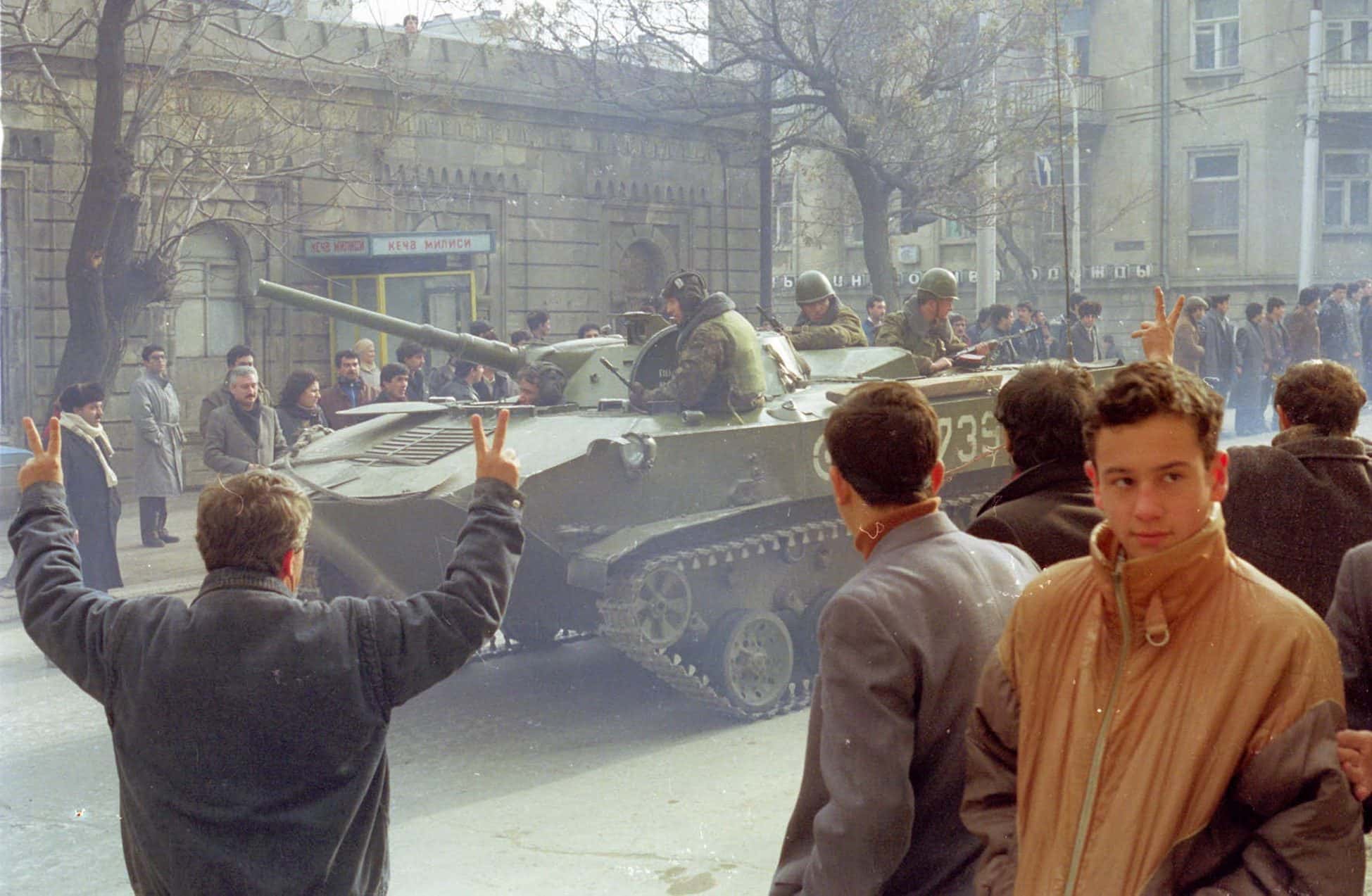
Soviet troops and an armoured vehicle in Baku in early 1990K. Martens · CC BY 3.0
19-20 January 1990
'Black January': Soviet army storms Baku
Late on 19-20 January 1990 Soviet troops stormed Baku to crush the Azerbaijani Popular Front, killing more than 100 people, the majority unarmed civilians, in what Helsinki Watch and Memorial called violence 'so out of proportion... as to constitute an exercise in collective punishment.' The crackdown came too late to stop the anti-Armenian pogroms and radicalized politics in Baku.
Operation Ring: forced deportation of Armenian villages
From late April into the summer of 1991, Azerbaijani OMON riot troops backed by the Soviet Army carried out 'Operation Ring,' a passport-and-arms check in Armenian villages of Nagorno-Karabakh and the Shahumyan and Getashen districts. Human Rights Watch found it resulted in hundreds of arrests, the temporary deportation of thousands of Armenians and the emptying of 22-24 Armenian villages, 'carried out with an unprecedented degree of violence and a systematic violation of human rights.'
Getashen, Shahumyan and the villages of Artsakhviolencedisplacementfirst-war
Following the failed August coup in Moscow, the Nagorno-Karabakh oblast soviet and the council of the neighboring Shahumyan district jointly proclaimed the Nagorno-Karabakh Republic, declaring the territory no longer under Azerbaijani jurisdiction. No state, including Armenia, extended formal recognition.
Definitive academic account of the conflict based on interviews with participants on both sides.
Related
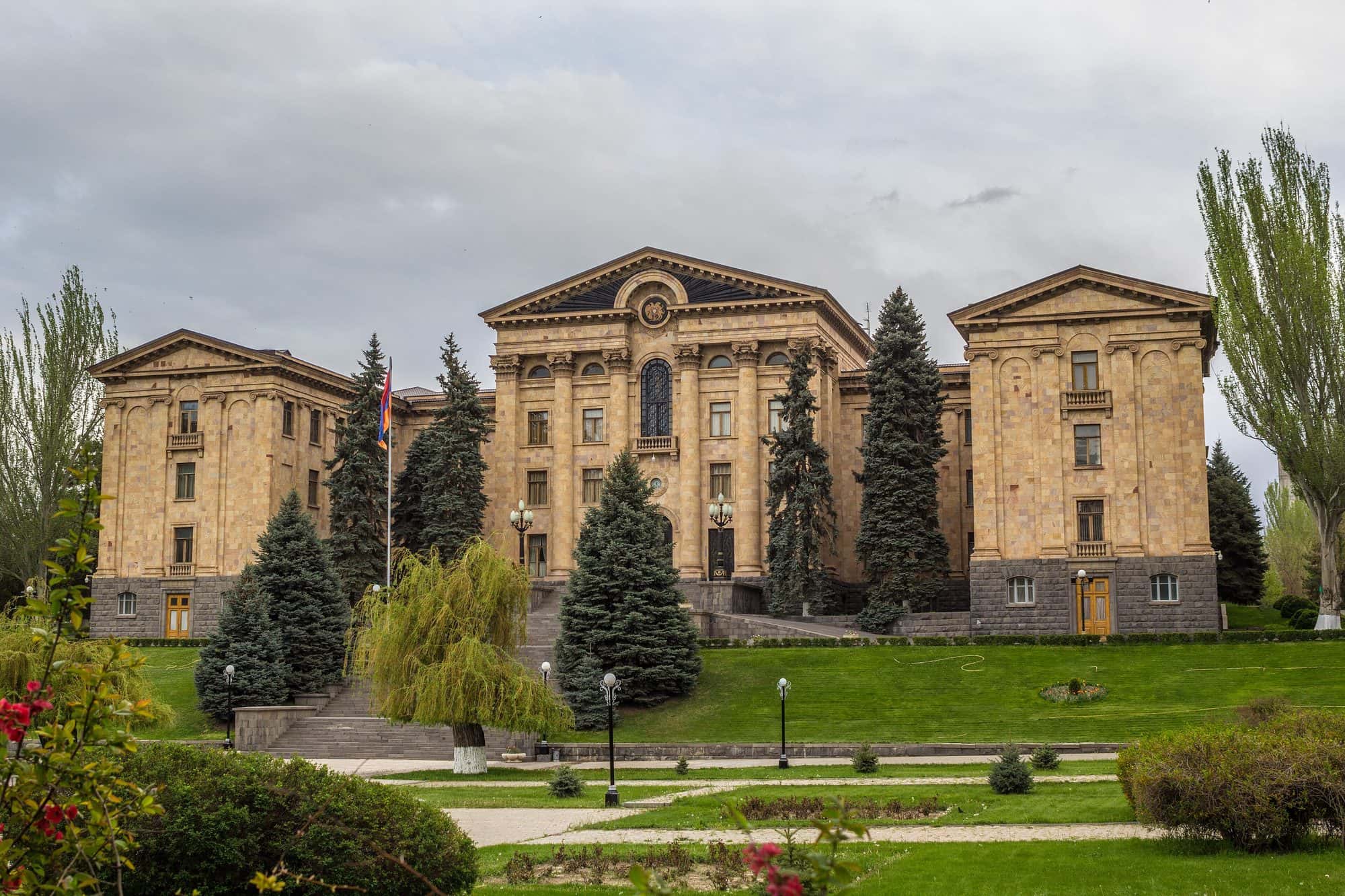
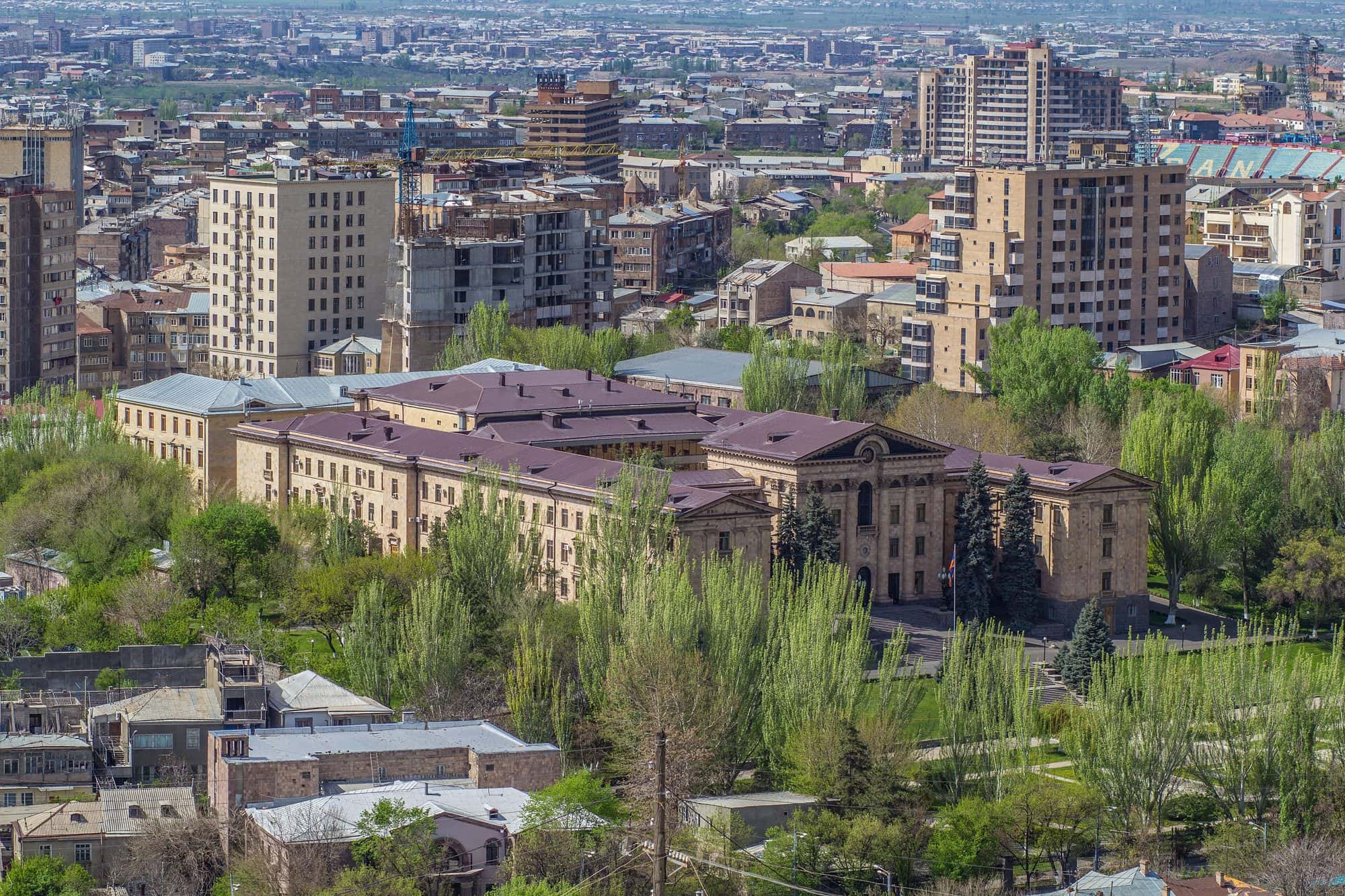
Aerial view of the Armenian parliament, which declared independence in September 1991Serouj Ourishian · CC BY-SA 3.0
21 September 1991
Independence referendum of the Republic of Armenia
Armenians voted overwhelmingly to leave the USSR: official results recorded 95 percent turnout with 99 percent voting yes, and on 23 September the parliament declared the Republic of Armenia independent. The vote came nineteen days after Artsakh's own declaration of the Nagorno-Karabakh Republic, giving the two Armenian polities parallel legal exits from the collapsing Soviet Union.
Republic of Armenianationindependencepoliticalreferendum
US government observer report on the 21 September 1991 balloting.
Related
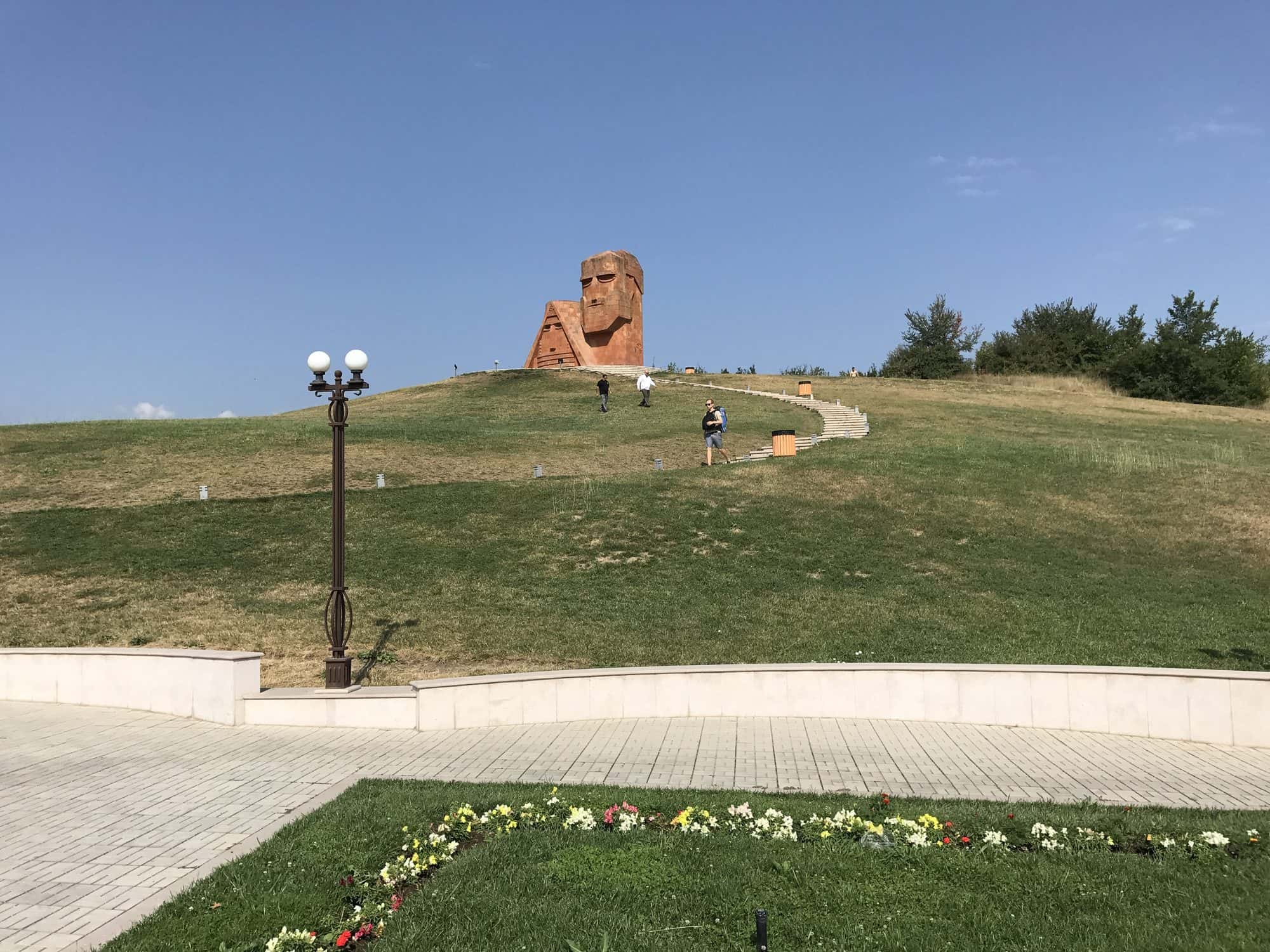
We Are Our Mountains, the monument above Stepanakert and symbol of ArtsakhBenoît Prieur · CC0
10 December 1991
Nagorno-Karabakh independence referendum
After Azerbaijan's parliament annulled Nagorno-Karabakh's autonomous status in November 1991, the region's authorities held an independence referendum in which residents voted overwhelmingly for independence; the region's Azerbaijani minority boycotted the vote. The Karabakh parliament formally declared independence on 6 January 1992; the referendum received no international recognition.
Through the winter and spring of 1992, Azerbaijani forces fired Grad multiple-rocket salvos into blockaded Stepanakert from Shushi and Khojalu, forcing the civilian population into cellars without heat, water or electricity. Helsinki Watch documented the deliberate shelling of civilian targets; Baroness Cox counted 400 Grad rockets striking the city on a single day in March 1992.
On the night of 25-26 February 1992, Karabakh Armenian forces, reportedly supported by soldiers of the 366th CIS regiment, seized the town of Khojalu; large numbers of fleeing Azerbaijani civilians were killed. Human Rights Watch documented the deaths of more than 200 of the town's civilians, which it called 'the largest massacre to date in the conflict', and placed direct responsibility for the civilian deaths with Karabakh Armenian forces; the Memorial Human Rights Center reached parallel findings. The Armenian account, maintained since 1992, is that a corridor out of the town had been left open and that the civilians were killed in crossfire as they fled across an active battle zone.
1992 field investigation documenting the shelling of Stepanakert, the Khojalu attack, and violations by both sides.
Related
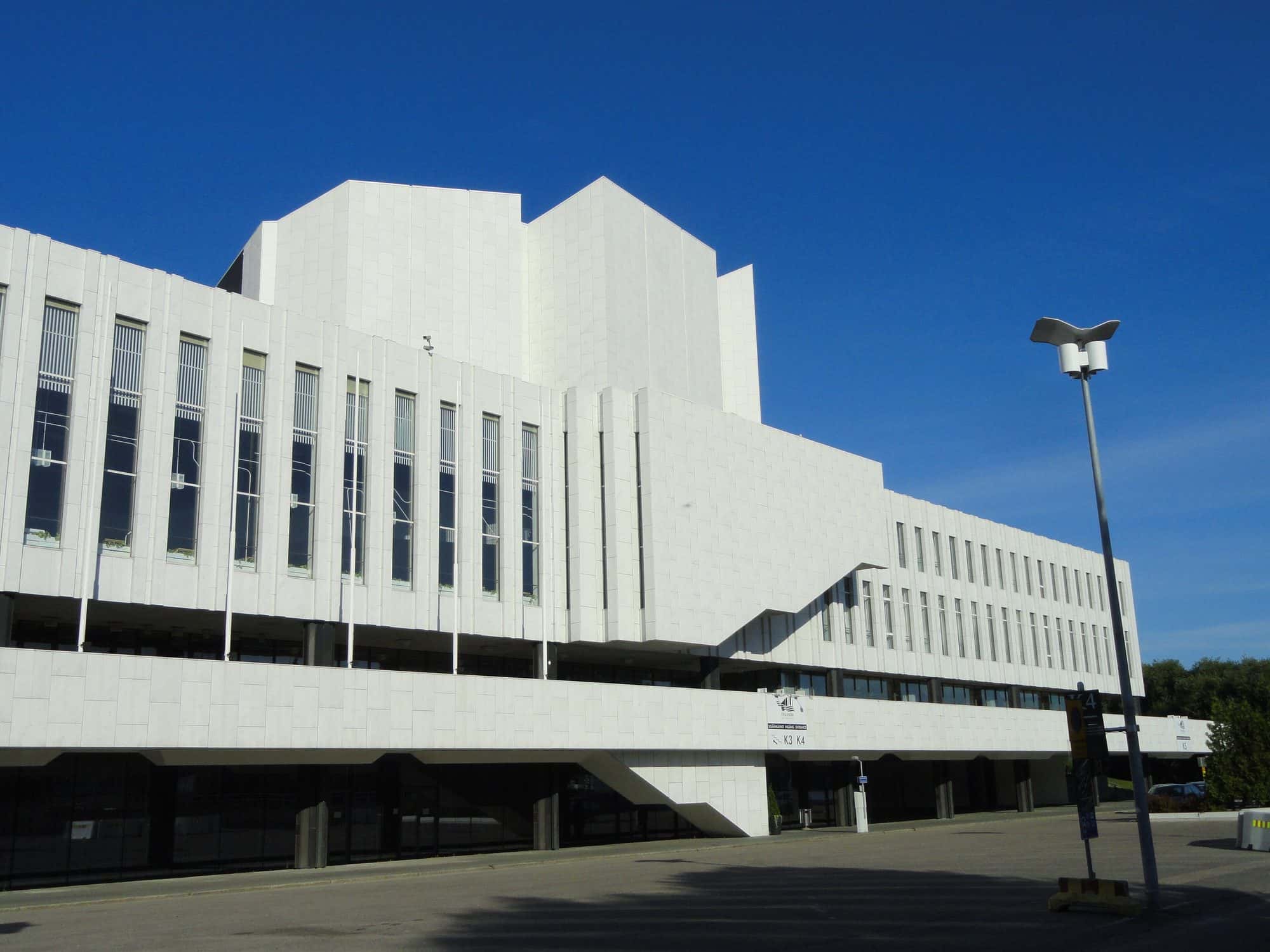
Finlandia Hall in Helsinki, home of the CSCE meetings of 1992Daderot · CC0
24 March 1992
CSCE creates the Minsk process for a negotiated settlement
At its First Additional Meeting in Helsinki, the CSCE Council called for an immediate ceasefire and mandated a peace conference on Nagorno-Karabakh to be convened in Minsk, with eleven participating states and 'elected and other representatives of Nagorno-Karabakh' as interested parties. The conference never convened, but it created the Minsk Group framework that mediated the conflict for three decades.
OSCE's official page on the origin and mandate of the Minsk Group.
Related
Memorial to those killed at Maragha, in the Martakert districtЛіонкінг · CC BY-SA 3.0
10 April 1992
Maragha massacre
Azerbaijani forces overran the Armenian village of Maragha in northern Karabakh. Baroness Caroline Cox, who reached the village days later with a Christian Solidarity International delegation, testified to the House of Lords that 45 villagers had been massacred, many decapitated, with homes burned and hostages taken; Human Rights Watch likewise recorded that the attack 'reportedly took forty civilian lives and several dozen hostages.'
Independent field report by repeated eyewitness visitors, with chapters on Operation Ring and Maragha.
Related
The tank memorial at the approach to Shushi, marking the 1992 battleJulian Nyča · CC BY-SA 3.0
8-9 May 1992
Karabakh Armenian forces capture Shushi
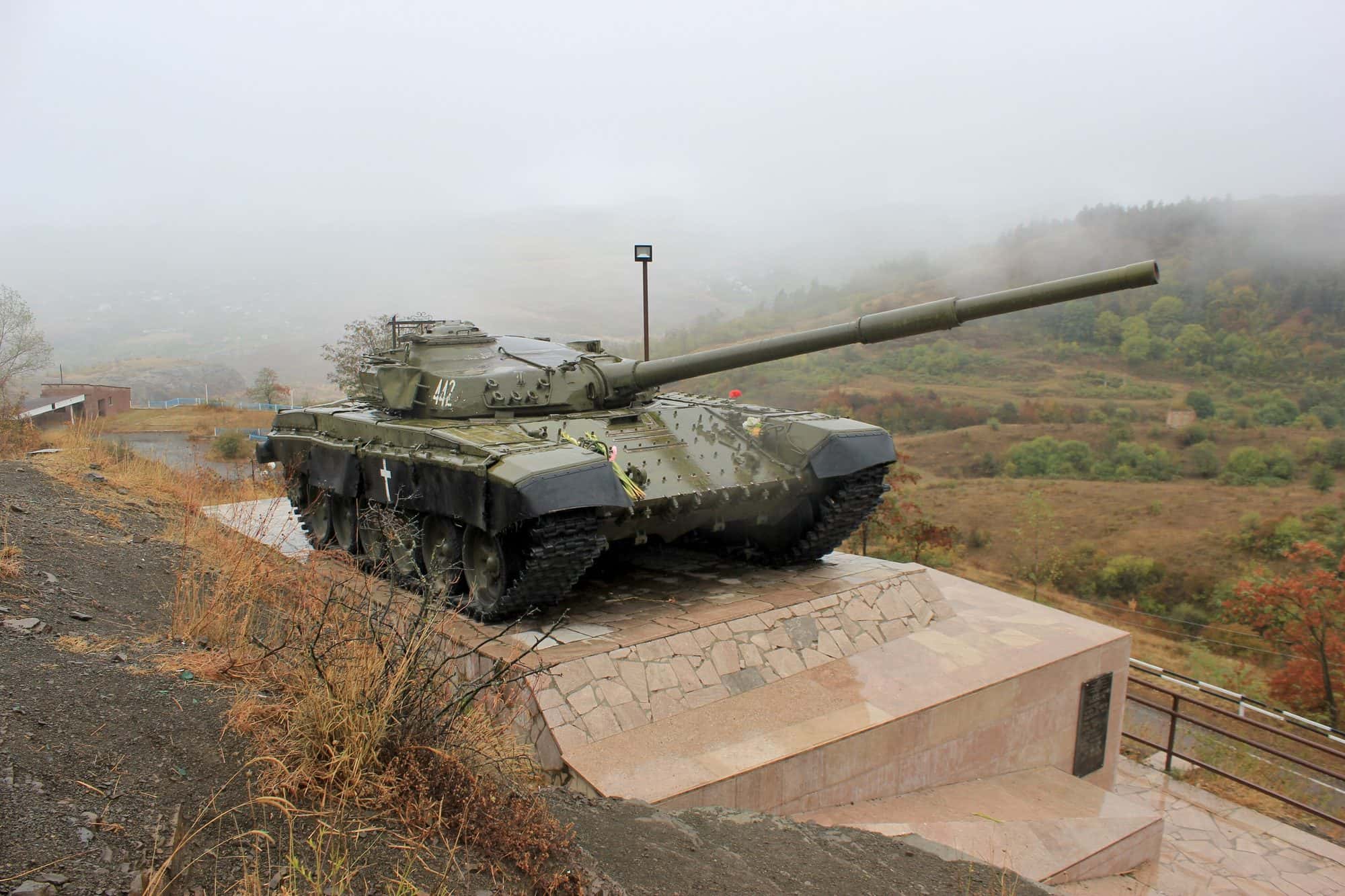
Karabakh Armenian forces seized Shushi, the last Azerbaijani-populated town in Nagorno-Karabakh and the fire base from which Grad rockets had been launched onto Stepanakert; the town's Azerbaijani population fled. The capture ended the bombardment of the Karabakh capital and shifted the military balance of the war in the Armenians' favor.
Definitive academic account of the conflict based on interviews with participants on both sides.
Related
The mountain road between Goris and Berdzor, the land link to ArtsakhԱվետիսյան91 · CC BY-SA 4.0
18 May 1992
Opening of the Berdzor corridor
Karabakh Armenian forces took the Azerbaijani-held town on the Artsakh-Armenia road, soon renamed Berdzor, opening a land corridor between Artsakh and Armenia and breaking a blockade that had cut the enclave off for nearly four years. Contemporaneous reporting described convoys of food and medicine reaching a population emerging from months in cellars, while the town itself was left burned and pillaged.
Comprehensive HRW field investigation of the first war: Operation Ring, Khojalu, Karvachar, Akna, displacement figures and background.
Related
The town of Martakert, photographed in 2002, ten years after the offensiveSergey Avdalian · Public domain (released by the author)
June 1992
Azerbaijan's summer offensive empties Shahumyan and northern Karabakh
In June 1992 Azerbaijan's army, newly equipped with heavy weapons from the divided Soviet arsenal, launched a large-scale offensive against the Shahumyan region and Mardakert province, capturing nearly 80 percent of Mardakert and creating close to 40,000 ethnic Armenian refugees according to Human Rights Watch. Civilians endured withering air and artillery bombardment through the summer before the front stabilized in September.
Shahumyan and Mardakert, Artsakhfirst-warwardisplacement
1992 field investigation documenting the shelling of Stepanakert, the Khojalu attack, and violations by both sides.
Related
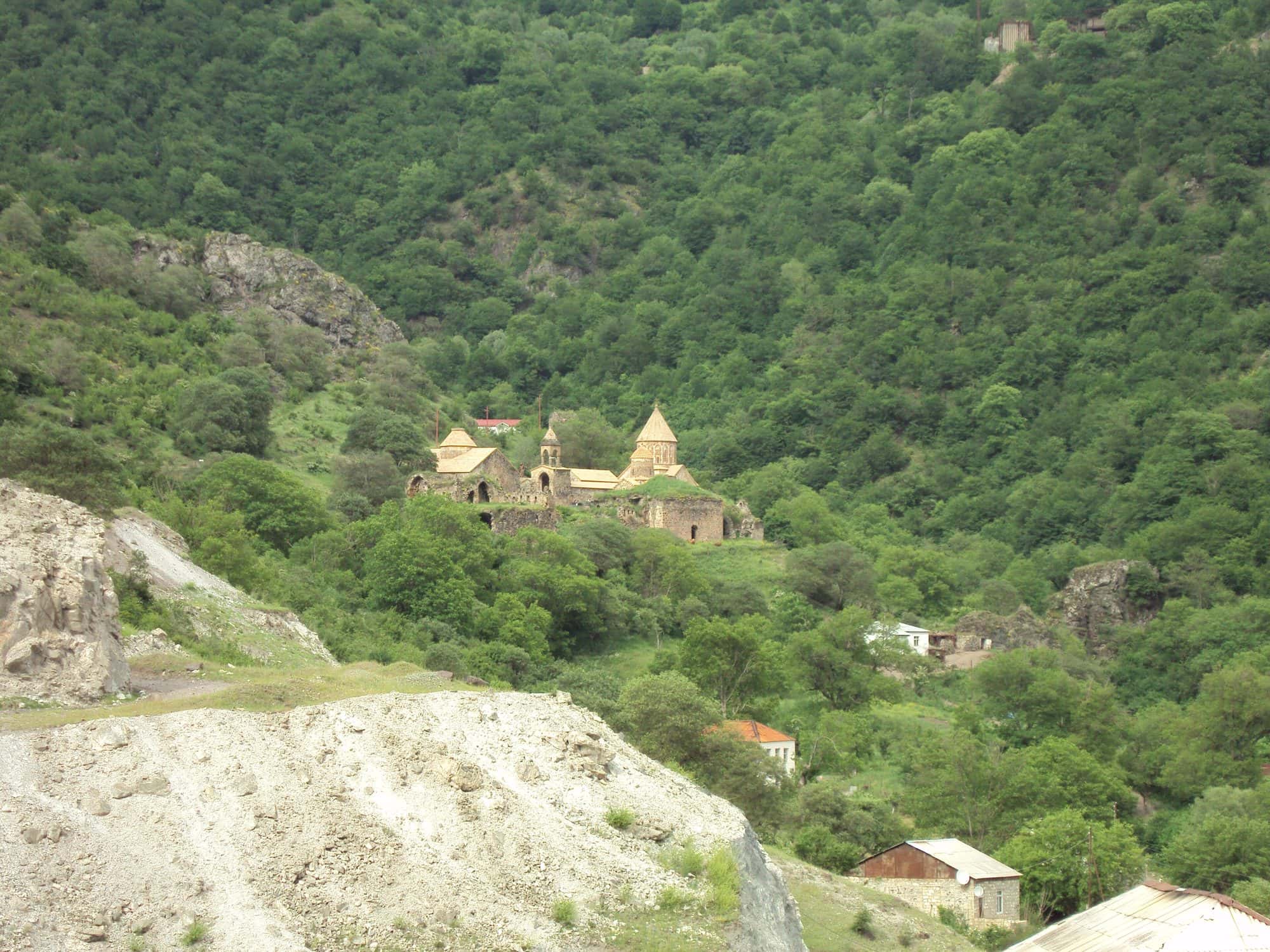
Dadivank monastery in Karvachar, the province taken in spring 1993Julian Nyča · CC BY-SA 3.0
27 March 1993
Karabakh Armenian forces seize Karvachar
Beginning 26-27 March 1993, Karabakh Armenian forces, with what Human Rights Watch reported as some support from Republic of Armenia forces, seized the entire Karvachar province between Artsakh and Armenia in a week-long operation. HRW found that some 60,000 people, mostly Azeri and Kurdish civilians, were forced to flee, many under fire over the Mrav mountains, and documented violations including hostage-taking and firing on civilians.
Karvachar, between Artsakh and Armeniafirst-warwardisplacement
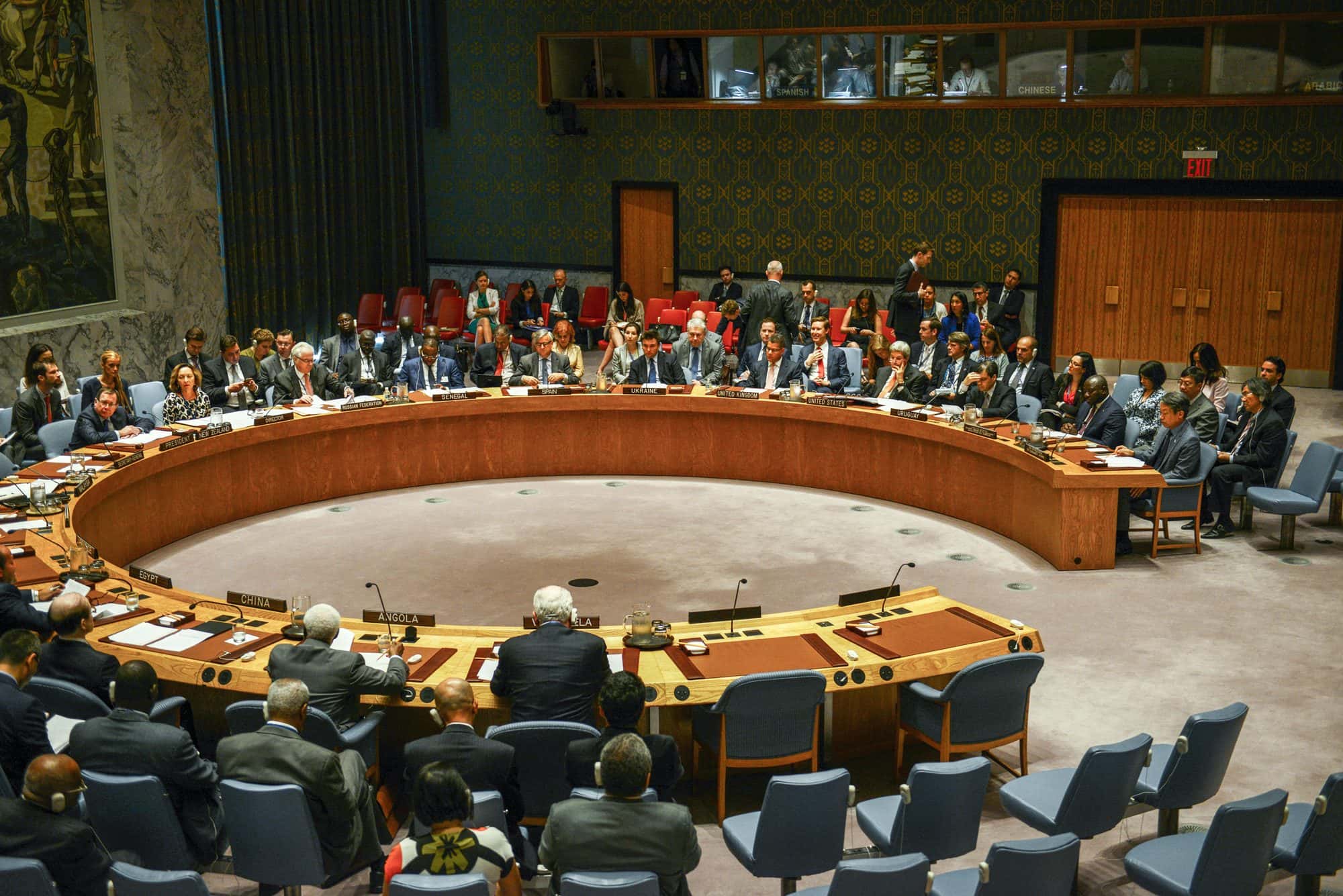
Responding to the Karvachar offensive, the Security Council unanimously adopted Resolution 822, demanding an immediate ceasefire and 'immediate withdrawal of all occupying forces from the Kelbajar district and other recently occupied areas of Azerbaijan,' while reaffirming the inviolability of international borders. It was the first of four 1993 resolutions on the conflict.
Fall of Akna and UN Security Council Resolution 853
After Karabakh Armenian forces captured and looted the emptied city of Akna (pre-war population about 50,000) in July 1993, the Security Council adopted Resolution 853, condemning 'the seizure of the district of Agdam' and demanding withdrawal from all recently occupied areas. Human Rights Watch documented the city's systematic looting and the displacement of its population.
Akna / New York (UN Security Council)first-warwarundisplacement
As Karabakh Armenian forces pushed south into the Varanda, Jrakan and Sanasar districts in the autumn of 1993, the Security Council adopted Resolution 874, calling for an effective and permanent ceasefire, endorsing the CSCE Minsk Group's 'Adjusted timetable' for withdrawal from recently occupied territories, and urging the resumption of negotiations.
Following the late-October occupation of the southernmost districts down to the Arax, which completed Karabakh Armenian control over the belt of territory between Artsakh and Iran, the Security Council adopted Resolution 884, condemning the occupation of what its text calls 'the Zangelan district and the city of Goradiz' and the attacks on civilians, and demanding unilateral withdrawal.
New York (UN Security Council)undiplomacydisplacement
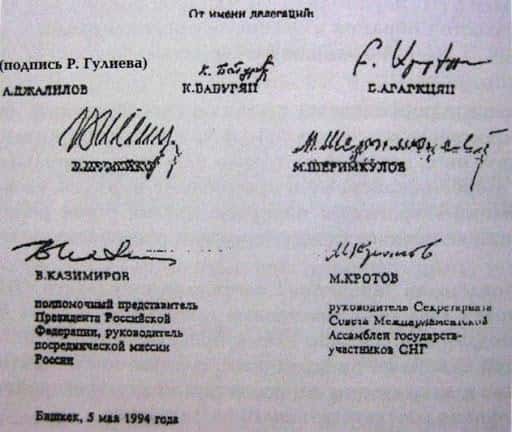
Meeting in Bishkek under CIS Inter-Parliamentary Assembly and Russian mediation, representatives of Azerbaijan, Armenia and Nagorno-Karabakh signed the Bishkek Protocol calling for a ceasefire and a binding agreement on non-resumption of hostilities, withdrawal of troops and return of refugees. An open-ended ceasefire took effect on 12 May 1994, freezing the front lines and ending large-scale fighting.
Comprehensive HRW field investigation of the first war: Operation Ring, Khojalu, Karvachar, Akna, displacement figures and background.
Related
The Museum of Fallen Soldiers in Stepanakert, which records the war deadJulian Nyča · CC BY-SA 3.0
December 1994
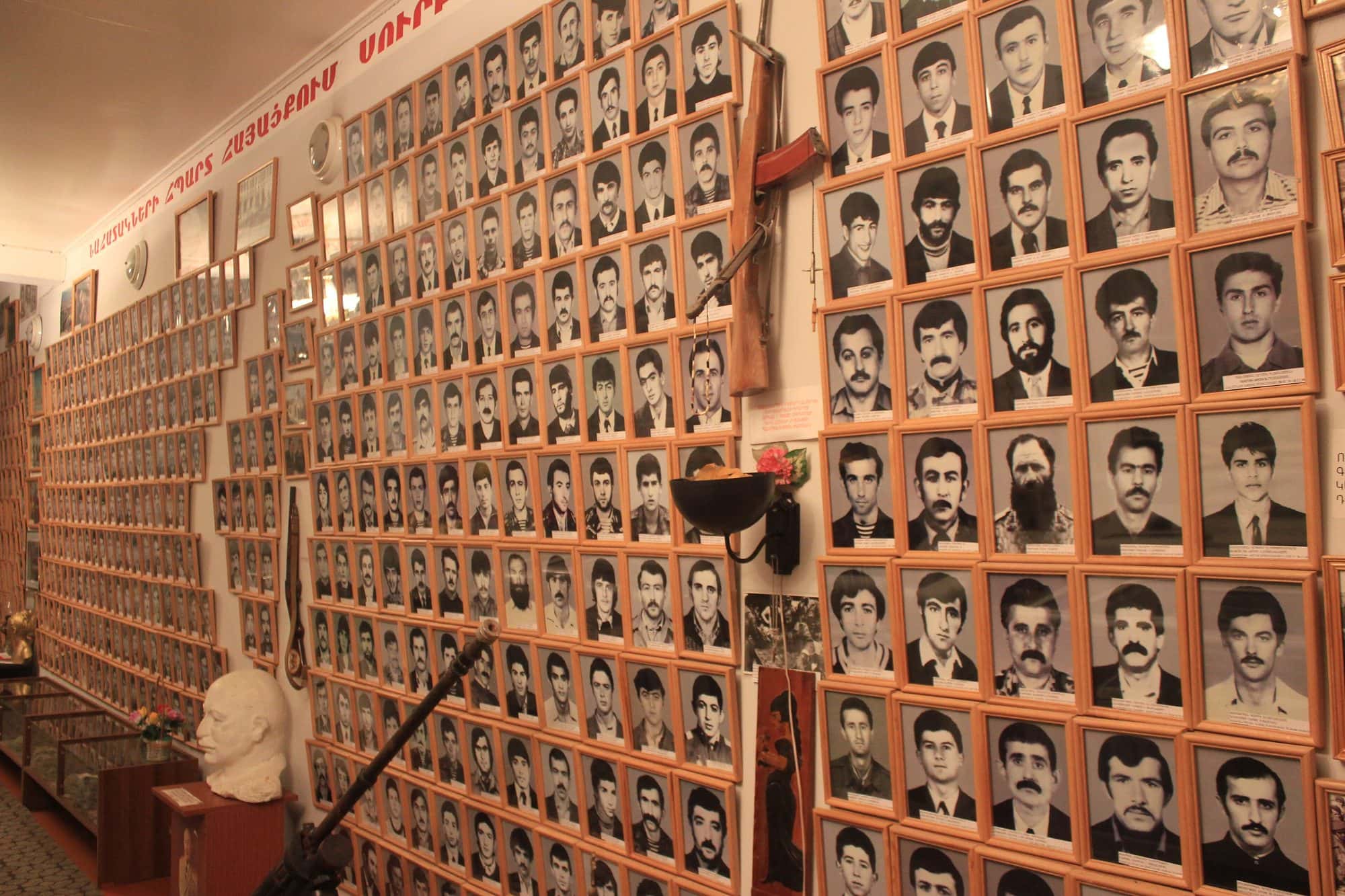
The war's human toll: an estimated 25,000 dead, over one million displaced
By the end of 1994 Human Rights Watch estimated roughly 25,000 killed and over one million people displaced on both sides of the conflict. UNHCR counted some 620,000 internally displaced persons in Azerbaijan and 198,000 ethnic Azeri refugees who had left Armenia, while HRW estimated that 300,000-350,000 Armenians fled or were deported in the opposite direction between 1988 and 1990.
Armenia, Nagorno-Karabakh and Azerbaijandisplacementhumanitarianfirst-war
OSCE Budapest Summit creates Minsk Group co-chairmanship
At the Budapest Summit, CSCE/OSCE heads of state adopted the decision 'Intensification of CSCE Action in Relation to the Nagorno-Karabakh Conflict,' establishing a co-chairmanship for the Minsk process and declaring political will to deploy multinational peacekeeping forces following an agreement. This institutionalized the mediation format that governed negotiations for the next quarter-century.
Official summit document establishing the Minsk Group co-chairmanship and pledging peacekeeping deployment after an agreement.
Related
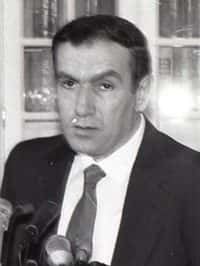
Levon Ter-Petrosyan, president of Armenia, photographed in the early 1990sUSAID or other U.S. government agency · Public domain (US federal government, USAID)
3 December 1996
OSCE Lisbon Summit statement on Karabakh; Armenia dissents
At the Lisbon Summit, the OSCE Chairman-in-Office issued a statement endorsing three principles for settlement, including Azerbaijan's territorial integrity and 'the highest degree of self-rule' for Nagorno-Karabakh within Azerbaijan. Armenia alone withheld consensus, arguing the statement predetermined the status question and contradicted self-determination; its counter-statement was annexed to the Lisbon Document.
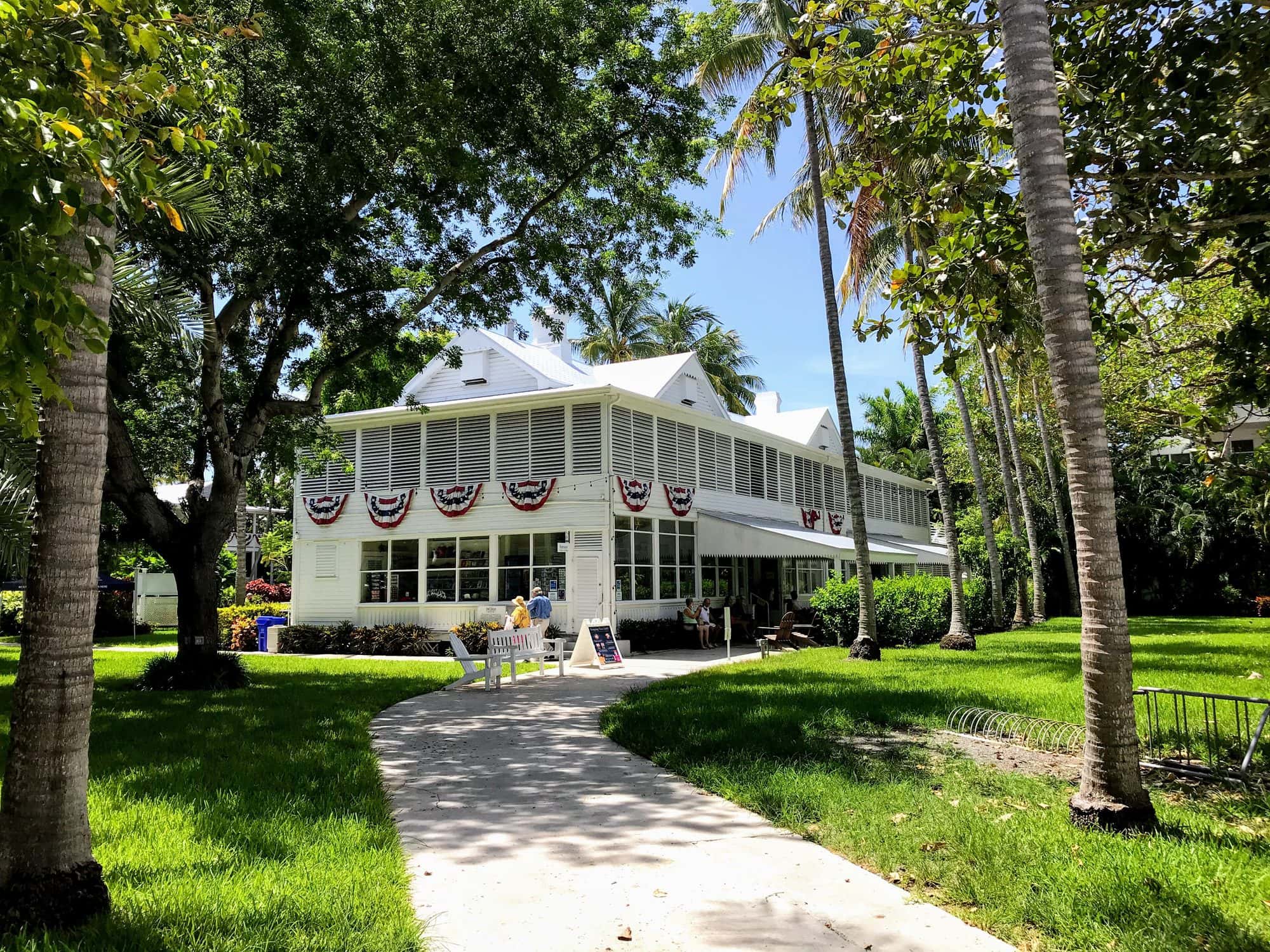
OSCE Minsk Group co-chairs convened Presidents Robert Kocharian and Heydar Aliyev for four days of proximity talks in Key West, Florida, followed by separate White House meetings with President George W. Bush. Mediators called the talks 'a bold and significant step forward,' but no agreement was signed and the momentum collapsed in the following months.
After a decade of fruitless full-format talks, a new negotiating track, the Prague Process, began in 2004, based on direct bilateral meetings between the foreign ministers of Armenia and Azerbaijan under OSCE Minsk Group co-chair facilitation, supplemented by occasional presidential meetings. The process produced the framework later formalized as the Madrid Basic Principles.
Independent analysis of the negotiations documenting the Prague Process initiated in 2004.
Related
The excavated citadel of Tigranakert of Artsakh in the Khachenaget valleyRob (Armenian Wikipedia) · Public domain (released by the author)
Founded 1st century BCE; excavated from 2005
Tigranakert of Artsakh rediscovered and excavated
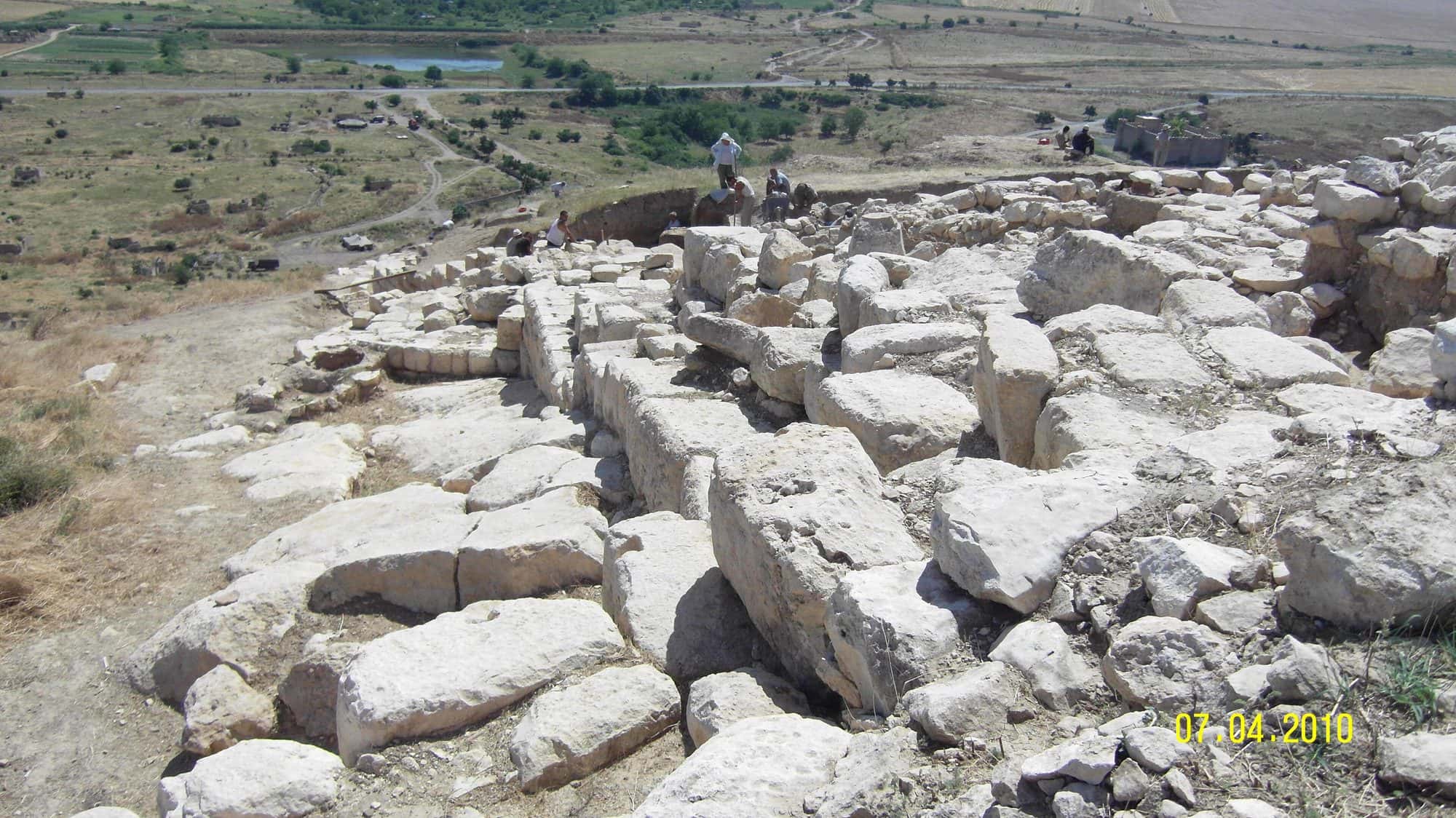
Tigranakert of Artsakh, a city founded in the early first century BCE by King Tigranes the Great on the Khachenaget river, was located and excavated from 2005 by an expedition led by Hamlet Petrosyan. Fifteen years of work uncovered a Hellenistic fortified district, antique quarters, an Early Christian square with churches, and thousands of finds including Parthian coins, Sasanian seals, and fifth-to-seventh-century Armenian inscriptions. The site and its museum passed under Azerbaijani control after the 2020 war, and Monument Watch has documented the threats to it since.
Khachenaget valley, Artsakharchaeologyantiquitycultural-heritagescholarship
Note, with excavation director Hamlet Petrosyan, on the site's status under Azerbaijani control.
Related
Khachkars standing in the Armenian cemetery of Jugha, photographed in 1915Aram Vruyr · Public domain (age expired)
December 2005
Final destruction of the Jugha khachkar cemetery in Nakhichevan
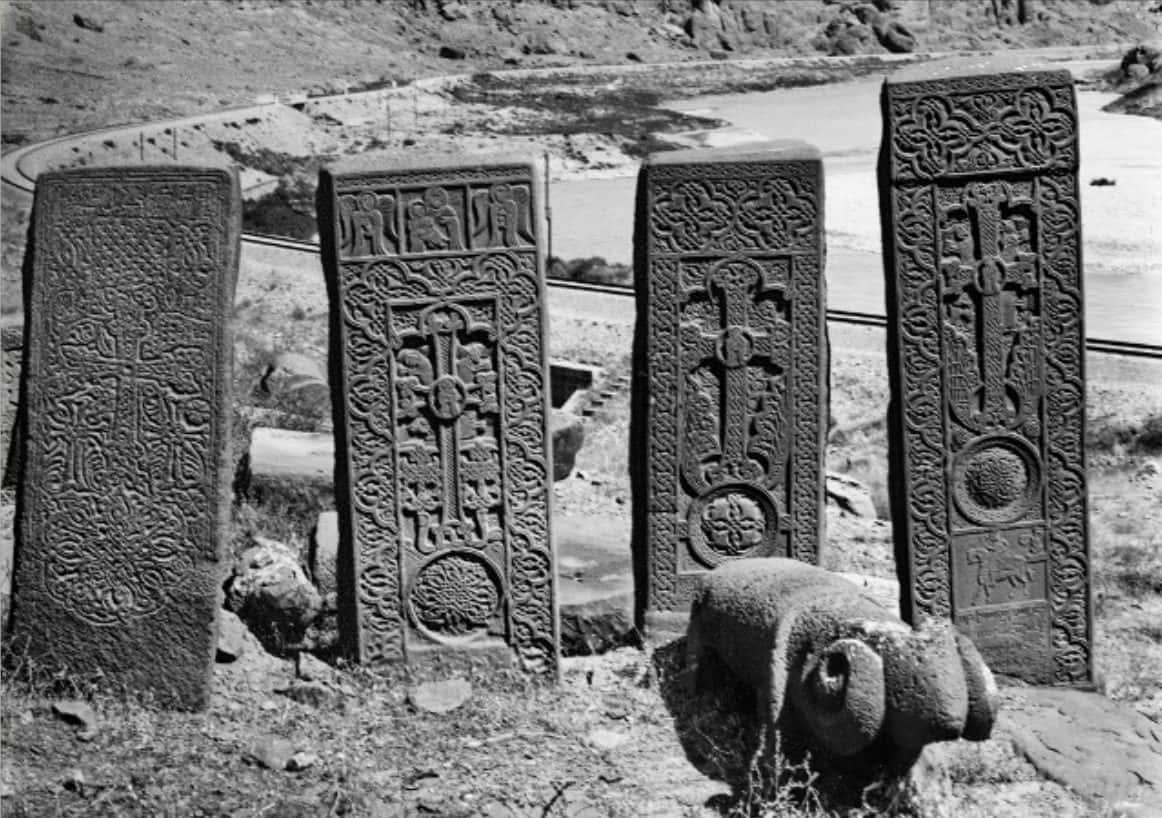
The medieval Armenian cemetery at Jugha in Nakhichevan, which contained thousands of 15th-16th century carved khachkar burial monuments, was destroyed in phases reported in 1998, 2002, and December 2005. AAAS satellite-imagery analysis comparing 2003 and 2009 images found the site leveled by earth-moving equipment, consistent with ICOMOS reports; the European Parliament condemned the destruction in February 2006 and was later denied access for a fact-finding mission.
EP resolution condemning the destruction of the Jugha cemetery and demanding access for inspection.
Related
Arkadi Ghukasyan, president when the constitution was put to a vote517design · CC BY-SA 4.0
10 December 2006
Nagorno-Karabakh constitutional referendum
Voters in Nagorno-Karabakh approved the entity's first constitution, describing it as a sovereign state, with 98.6 percent in favor according to preliminary official results. Baku rejected the vote as legally void, and both the EU and the OSCE Chairman-in-Office declined to recognize it.
Madrid Principles presented to Armenia and Azerbaijan
At the OSCE Ministerial Council in Madrid, the ministers of the Minsk Group co-chair countries presented Armenia and Azerbaijan a preliminary version of the Basic Principles for settlement. Its elements included return of territories surrounding Nagorno-Karabakh to Azerbaijani control, an interim status with security and self-governance guarantees, a corridor to Armenia, future determination of final status by a legally binding expression of will, return of displaced persons, and international security guarantees including peacekeeping.
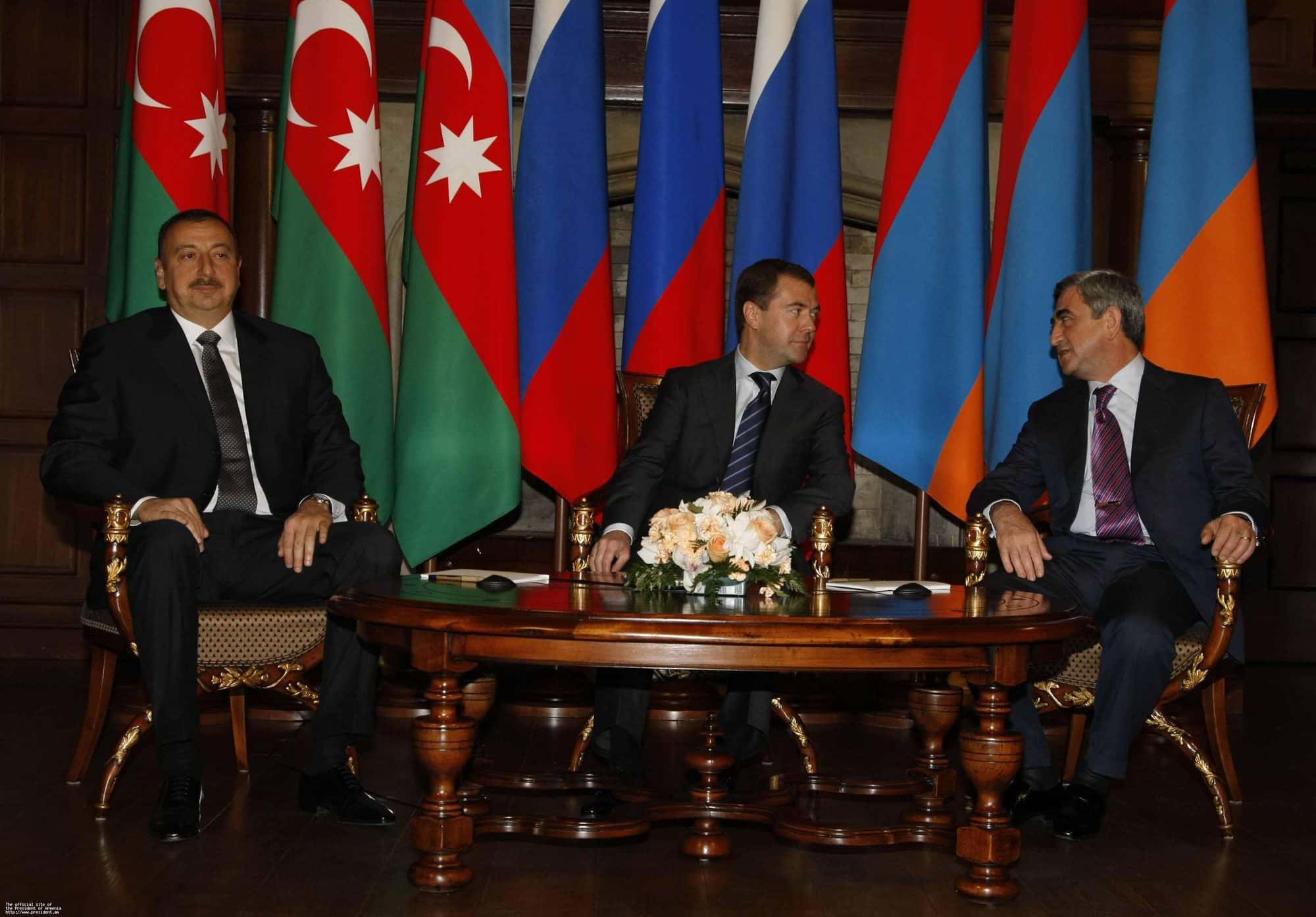
Presidents Serzh Sargsyan and Ilham Aliyev, with Russian President Dmitry Medvedev, signed a joint declaration at Meiendorf Castle pledging a political settlement of the conflict and instructing their foreign ministers to intensify negotiations with the OSCE Minsk Group co-chairs. It was the first document signed by Armenia and Azerbaijan on the conflict since the 1994 ceasefire.
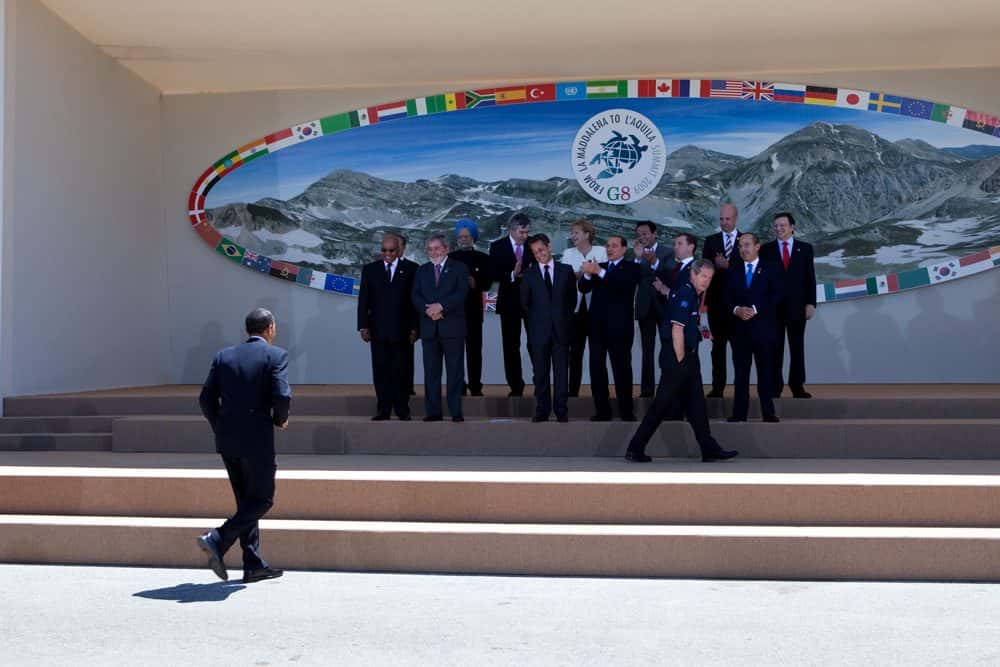
L'Aquila statement by Minsk Group co-chair presidents
Presidents Obama, Medvedev, and Sarkozy issued a joint statement at the G8 summit in L'Aquila instructing their mediators to present an updated version of the Madrid Document and urging the presidents of Armenia and Azerbaijan to resolve their remaining differences on the Basic Principles. The attached fact sheet publicly enumerated the six core elements of the proposed settlement for the first time.
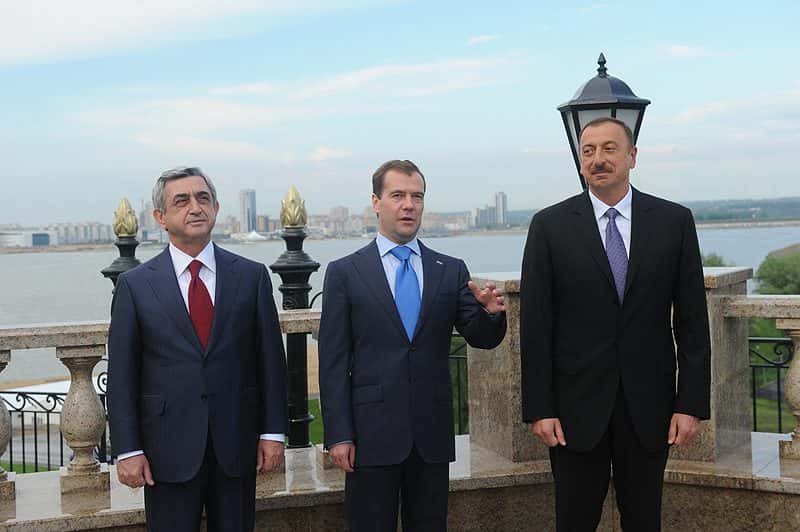
President Medvedev hosted Presidents Sargsyan and Aliyev in Kazan for a heavily anticipated summit intended to finalize agreement on the Basic Principles, after the co-chair presidents declared in May 2011 that 'the time has arrived' for decisive steps. The summit ended without agreement, and the Madrid Principles process never again came as close to a settlement.
Ramil Safarov extradited by Hungary and pardoned by Azerbaijan
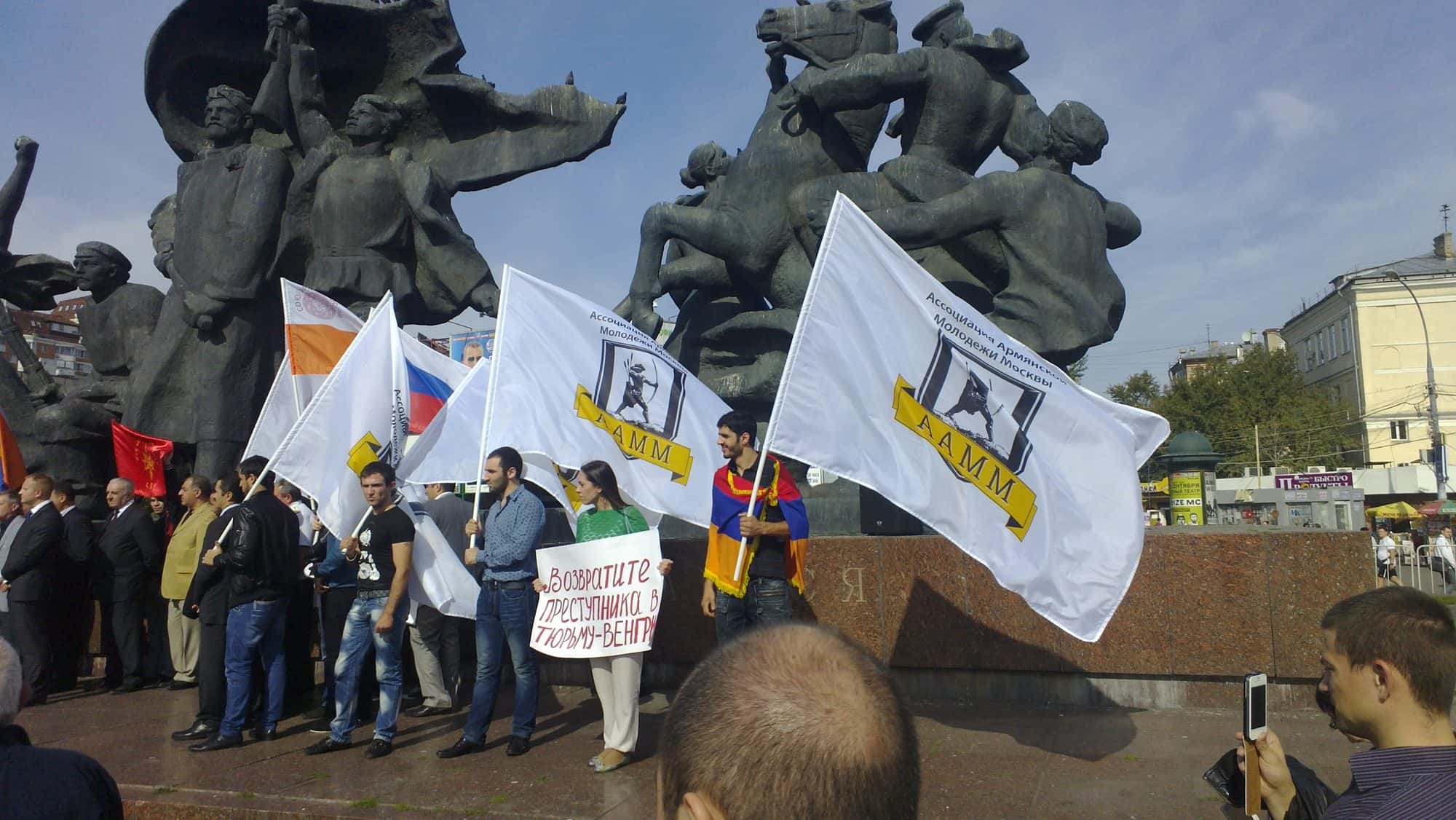
Ramil Safarov, an Azerbaijani army officer serving a life sentence in Hungary for the 2004 axe murder of sleeping Armenian officer Gurgen Margaryan at a NATO course in Budapest, was extradited to Azerbaijan and immediately pardoned by President Aliyev, promoted, and given an apartment and back pay. Armenia suspended diplomatic relations with Hungary; the European Parliament condemned the pardon, and in 2020 the ECHR found Azerbaijan violated the Convention by failing to enforce the sentence.
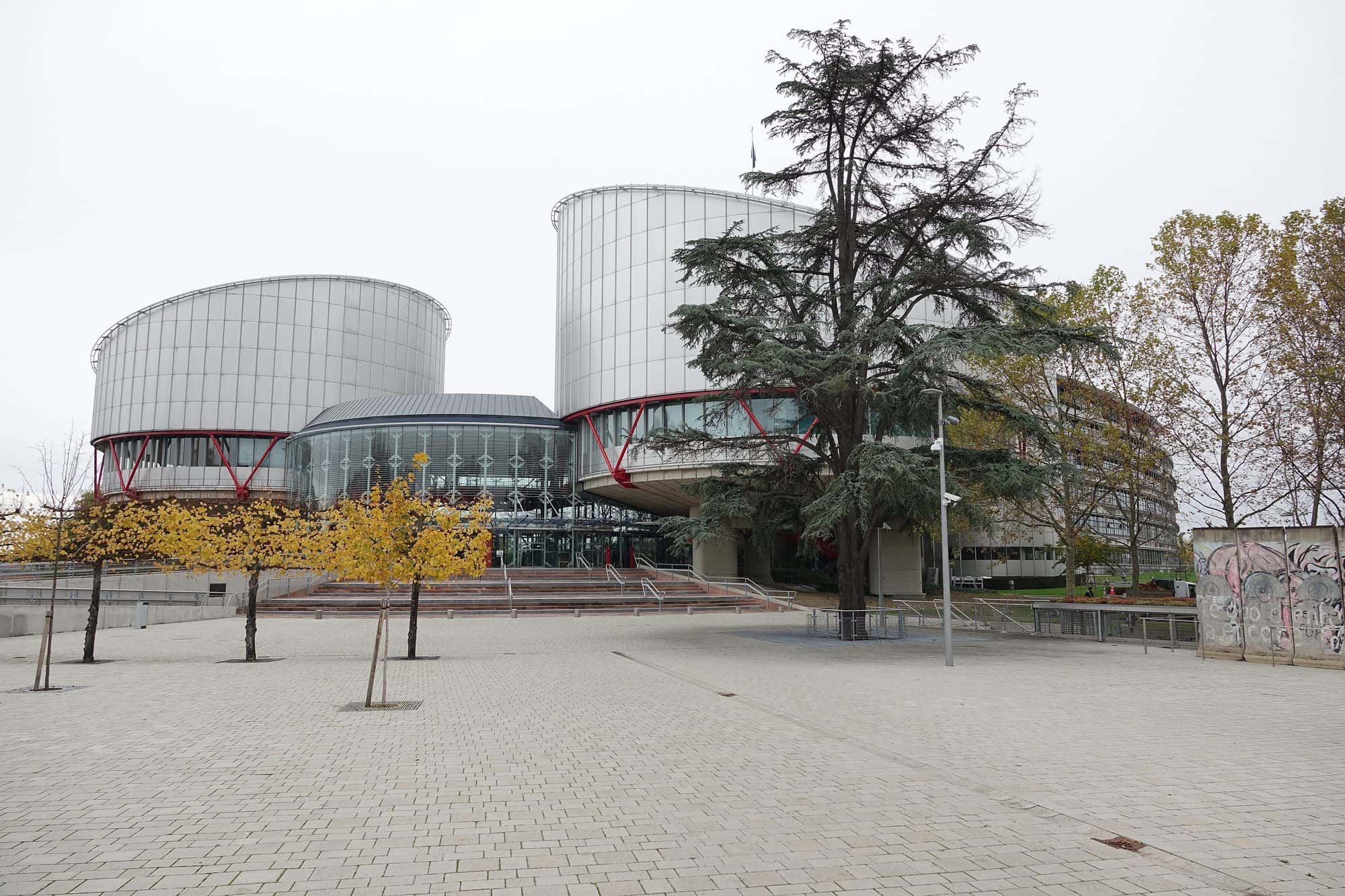
ECHR Grand Chamber rules in Chiragov v. Armenia and Sargsyan v. Azerbaijan
In twin Grand Chamber judgments, the European Court of Human Rights held in Chiragov and Others v. Armenia that Armenia exercised effective control over Nagorno-Karabakh and violated the property rights of Kurds displaced from the Kashatagh (Berdzor) region, and in Sargsyan v. Azerbaijan that Azerbaijan violated the rights of an Armenian displaced from Gulistan. The paired rulings established mirror-image state responsibility for the displaced of both sides.
On 2-5 April 2016 the heaviest fighting since the 1994 ceasefire erupted along the Line of Contact, with tanks, heavy artillery, rocket systems and attack drones; Crisis Group documented up to 200 killed and small but strategic territorial gains by Azerbaijan before a Moscow-brokered ceasefire. The Artsakh ombudsman reported that Azerbaijani forces killed and mutilated civilians in Talish and beheaded or dismembered several Armenian soldiers, findings documented with photographic evidence but issued by an Armenian institution.
Line of Contact, Artsakh (Talish, Martakert, Hadrut directions)warescalationviolenceoscearmenian-reported
Armenian official institution's report on civilian killings, mutilations, and beheadings during the April 2016 war, with photographic evidence. Attributed as an Armenian source.
Related
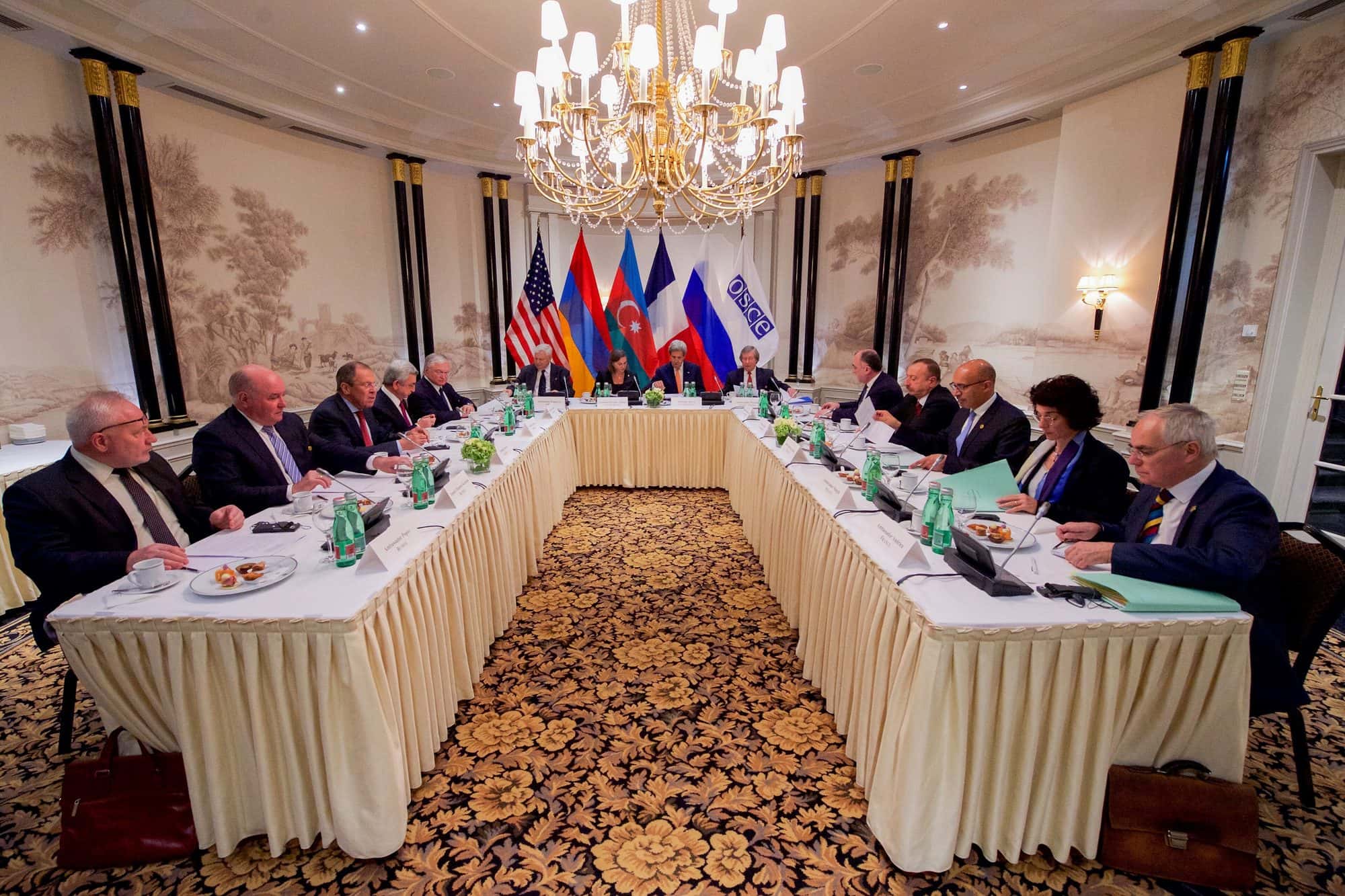
The Vienna meeting on Nagorno Karabakh, 16 May 2016U.S. Department of State · Public domain (US federal government)
16 May 2016
Vienna summit: agreement on investigative mechanism and expanded monitoring
At a summit convened in Vienna by the Minsk Group co-chair countries, Presidents Sargsyan and Aliyev recommitted to the 1994-95 ceasefire agreements and agreed to finalize an OSCE investigative mechanism for ceasefire violations, expand OSCE monitoring, and continue exchanging data on missing persons through the ICRC. The confidence-building measures were never fully implemented.
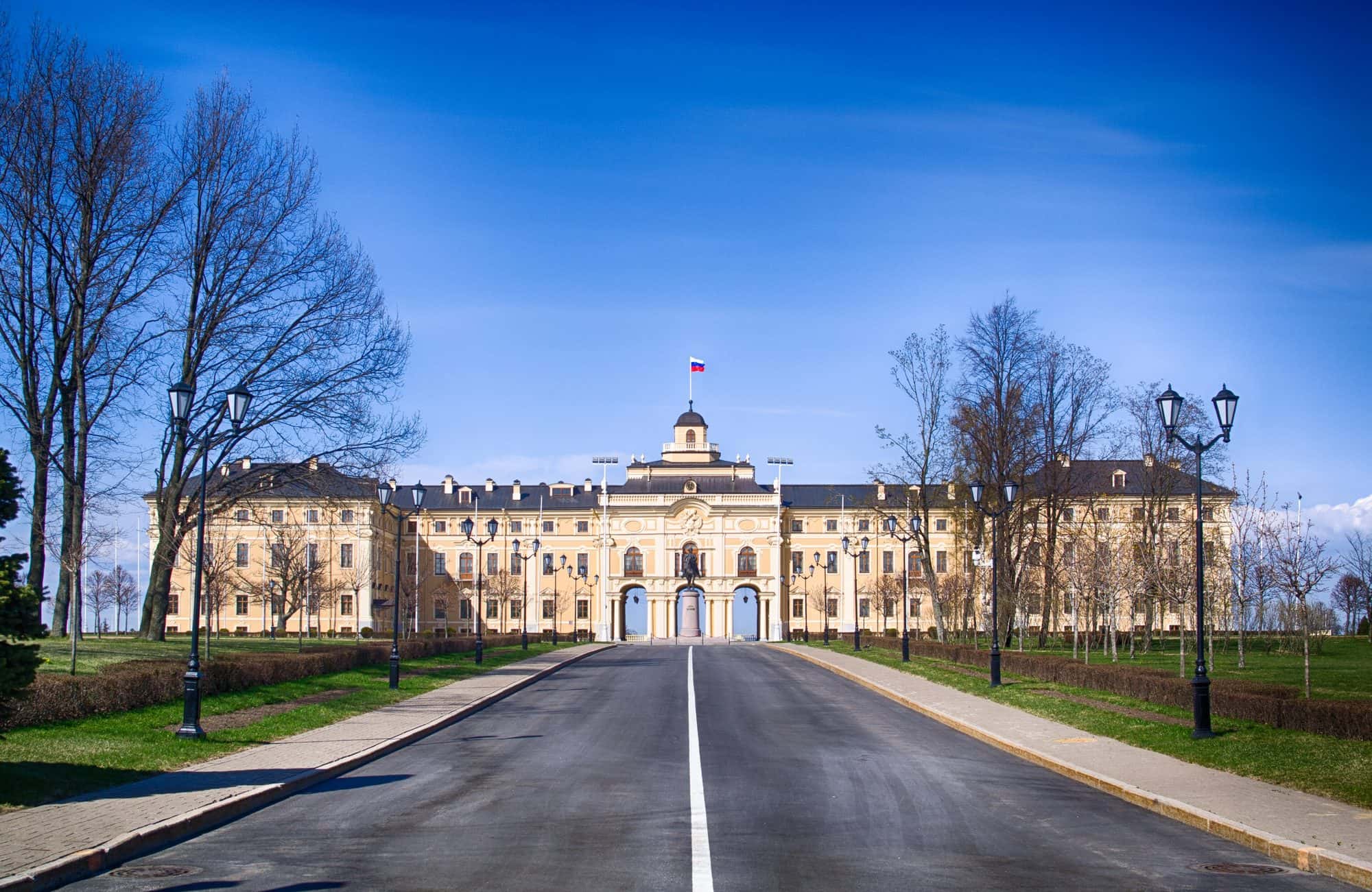
President Putin hosted Presidents Sargsyan and Aliyev at the Constantine Palace in St Petersburg, where the three adopted a joint statement reaffirming commitment to normalizing the situation on the Line of Contact and approving an increase in the number of OSCE observers in the conflict zone.
Official Kremlin record of the St Petersburg trilateral meeting and joint statement.
Related
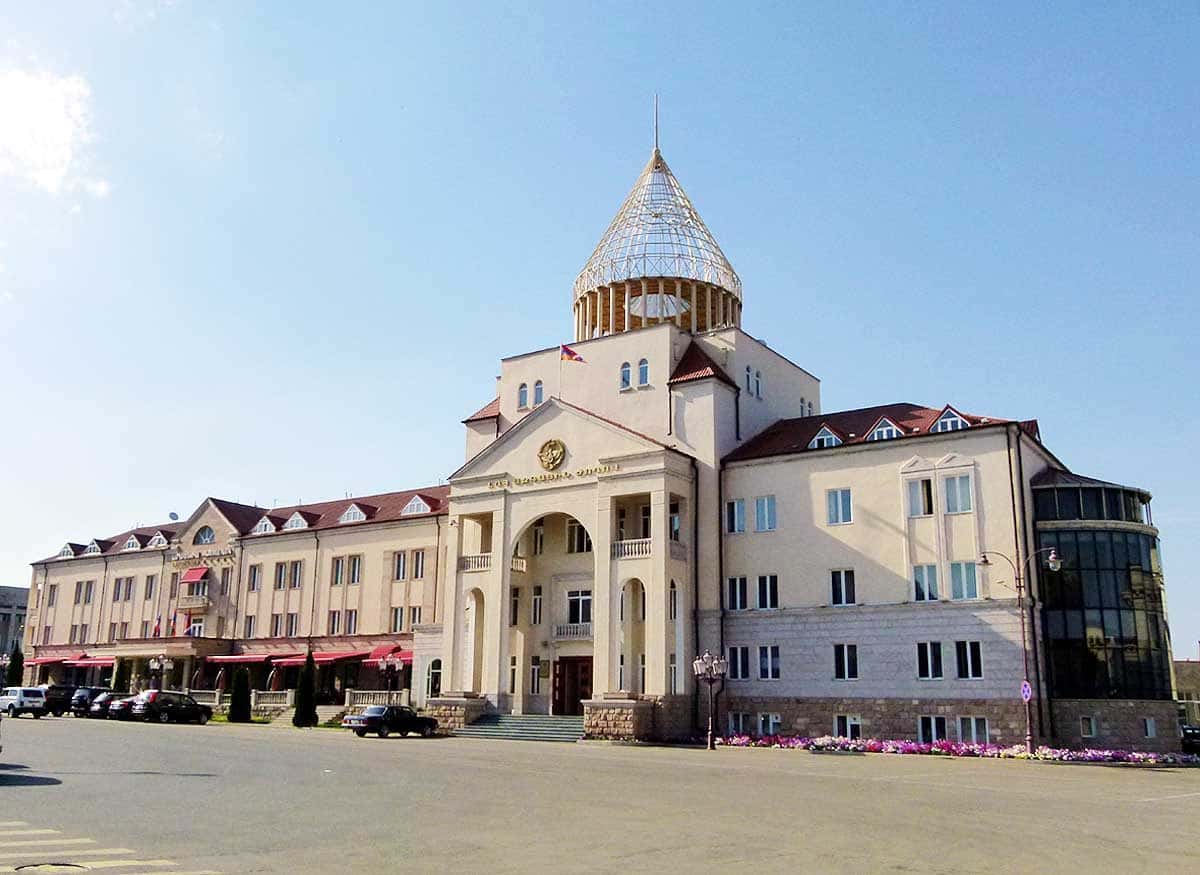
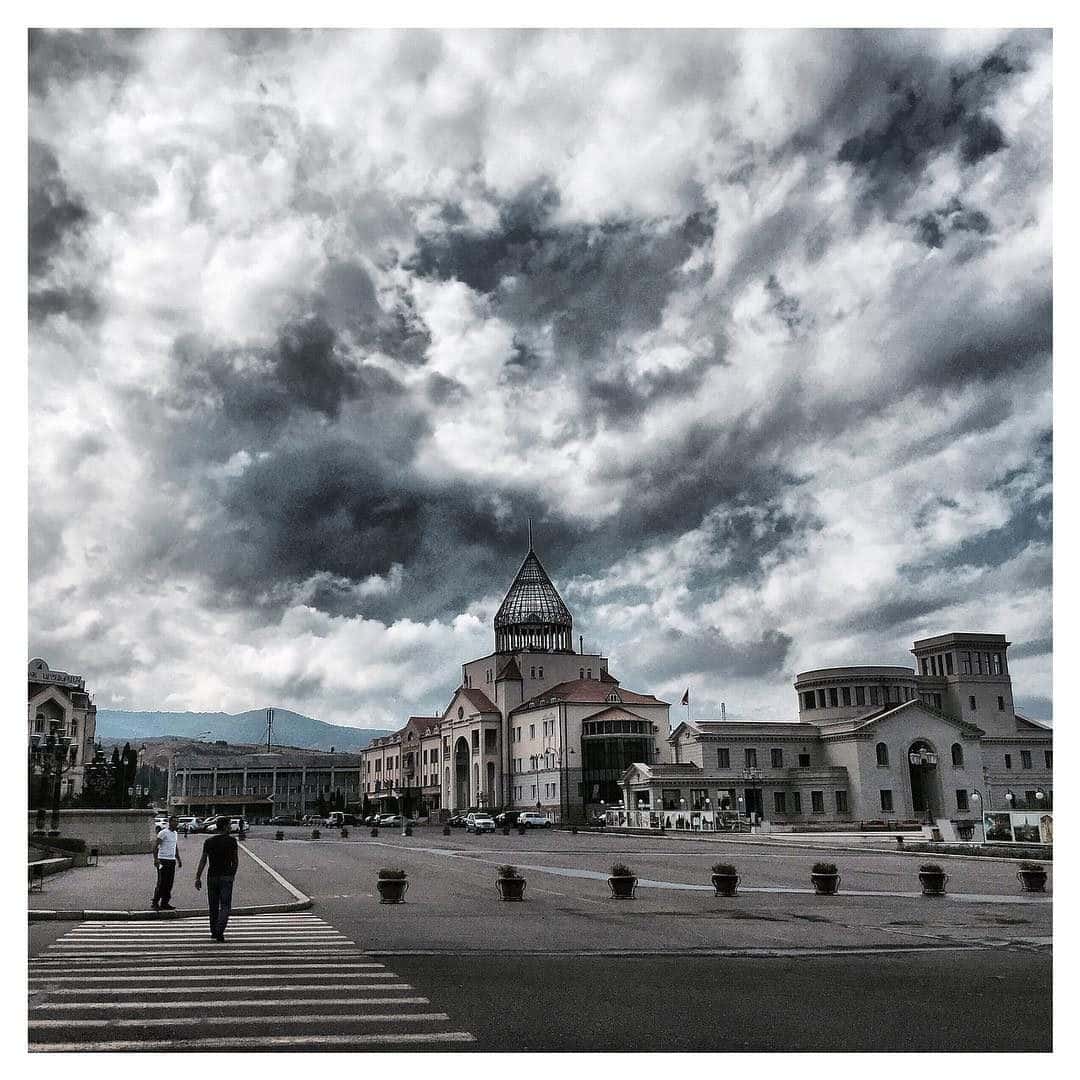
The parliament in Stepanakert, the seat renamed under the 2017 constitutionGovorkov (Flickr) · CC BY 2.0
20 February 2017
Constitutional referendum renames NKR the Republic of Artsakh
Voters in Nagorno-Karabakh approved a new constitution with 87.6 percent support on 76 percent turnout, per the region's election commission, switching to a fully presidential system and changing the entity's name from the Nagorno-Karabakh Republic to the Republic of Artsakh. Baku and the OSCE Minsk Group co-chair countries denounced the referendum as illegal.
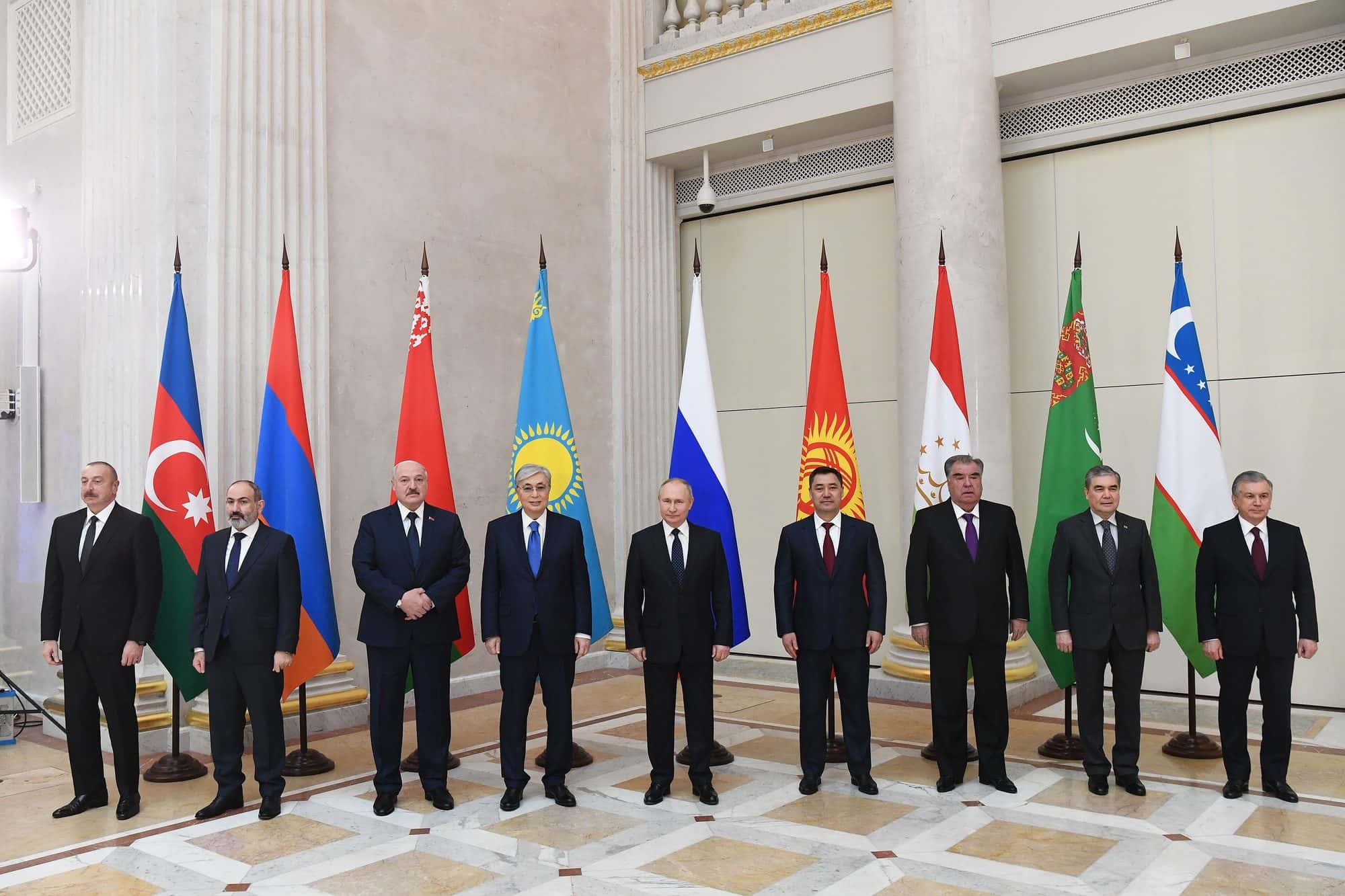
Dushanbe understanding between Pashinyan and Aliyev
On the sidelines of the CIS summit in Dushanbe, Armenian Prime Minister Nikol Pashinyan and Azerbaijani President Ilham Aliyev held their first substantive talks and agreed to reduce incidents on the border, establish a direct line of communication, and continue negotiations. The understanding was followed by a marked drop in ceasefire violations into 2019.
Pashinyan declares 'Artsakh is Armenia' in Stepanakert
Addressing a rally in the central square of Stepanakert, Prime Minister Nikol Pashinyan said: 'I am convinced that many of you wonder why I am saying nothing about Artsakh. The answer is very simple: Artsakh is Armenia. Period.' He led the crowd in chants of miatsum, meaning unification. Four years later his government recognized the region as Azerbaijani territory; both statements are part of this record.
Arayik Harutyunyan wins Artsakh's last presidential election
In combined presidential and parliamentary elections held on 31 March 2020, former prime minister Arayik Harutyunyan won 49.3 percent, just short of an outright majority, and took the 14 April runoff with 88 percent against foreign minister Masis Mayilyan, who had urged a boycott over the coronavirus outbreak. It was the last presidential election held in Artsakh.
Armenian artillery near Norashen village on the Tavush borderElegant's (Commons user) · Public domain (released by the author)
12-16 July 2020
July clashes on Armenia's northeastern border (Tavush)
Heavy fighting broke out on Armenia's northeastern state border along Tavush province, the most serious escalation since 2016. At least sixteen soldiers on both sides were killed, including an Azerbaijani major general, in artillery and drone exchanges that presaged the autumn war.
Tavush province, on Armenia's northeastern borderwarviolenceescalation
Analysis of the July 2020 escalation and its strategic context.
Related
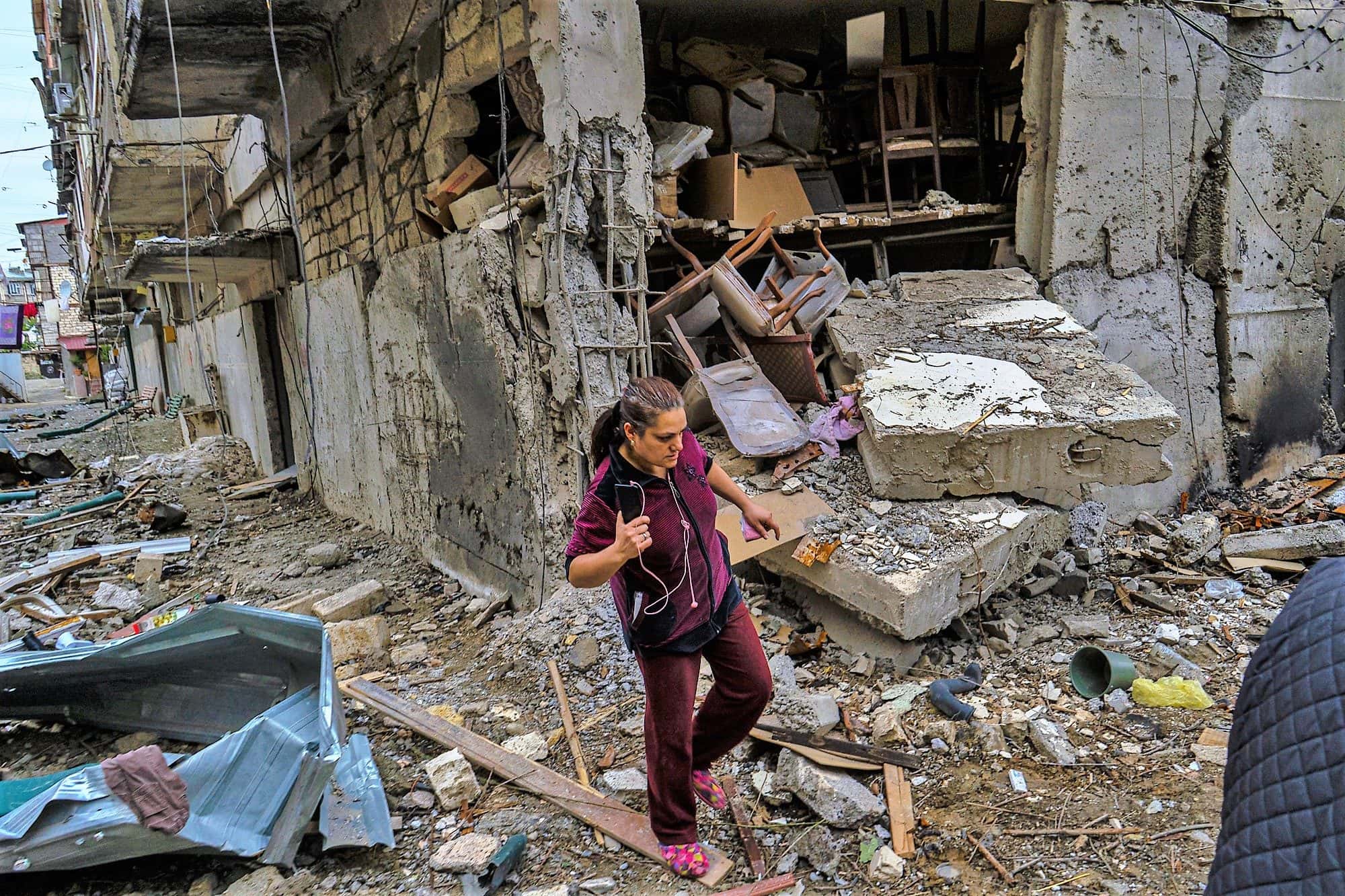
A woman crosses rubble beside a housing block wrecked by shelling in ArtsakhYan Boechat/VOA · Public domain (US federal government work, Voice of America)
27 September 2020
Outbreak of the Second Nagorno-Karabakh War
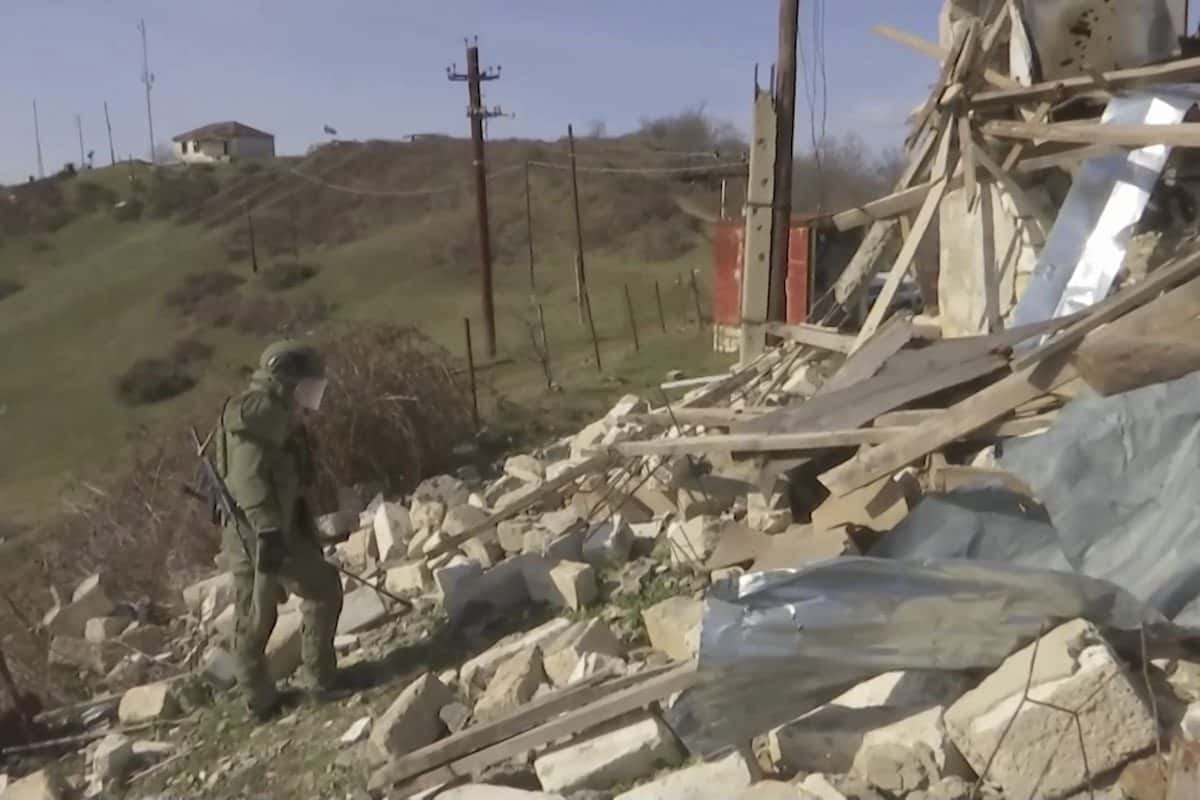
On the morning of 27 September 2020 large-scale hostilities erupted along the entire Nagorno-Karabakh line of contact, with Azerbaijan launching an offensive and strikes reported on civilian settlements including Stepanakert. Armenia and the Artsakh authorities declared martial law and general mobilization; a 44-day war followed.
European Court of Human Rights indicates interim measures
Two days into the war, the European Court of Human Rights granted Armenia's Rule 39 request, calling on both Azerbaijan and Armenia to refrain from measures, in particular military action, that might endanger the Convention rights of the civilian population. The measure was later interpreted as addressed to both states and kept in force.
Cluster munitions and indiscriminate strikes on Stepanakert and Hadrut
Human Rights Watch documented on site Azerbaijan's repeated use of widely banned cluster munitions in residential areas of Stepanakert and Hadrut, and later documented apparently indiscriminate strikes that damaged homes, schools, businesses and hospitals in violation of the laws of war.
Stepanakert and Hadrut, Artsakh2020-warviolencehumanitarian
HRW investigation into indiscriminate Azerbaijani attacks on Stepanakert homes, schools and hospitals.
Related
The site of the October 2020 missile strike on a residential quarter of GandzakJavid Nabizade · CC BY-SA 4.0
17-28 October 2020
Strikes on civilians in Gandzak and Partav
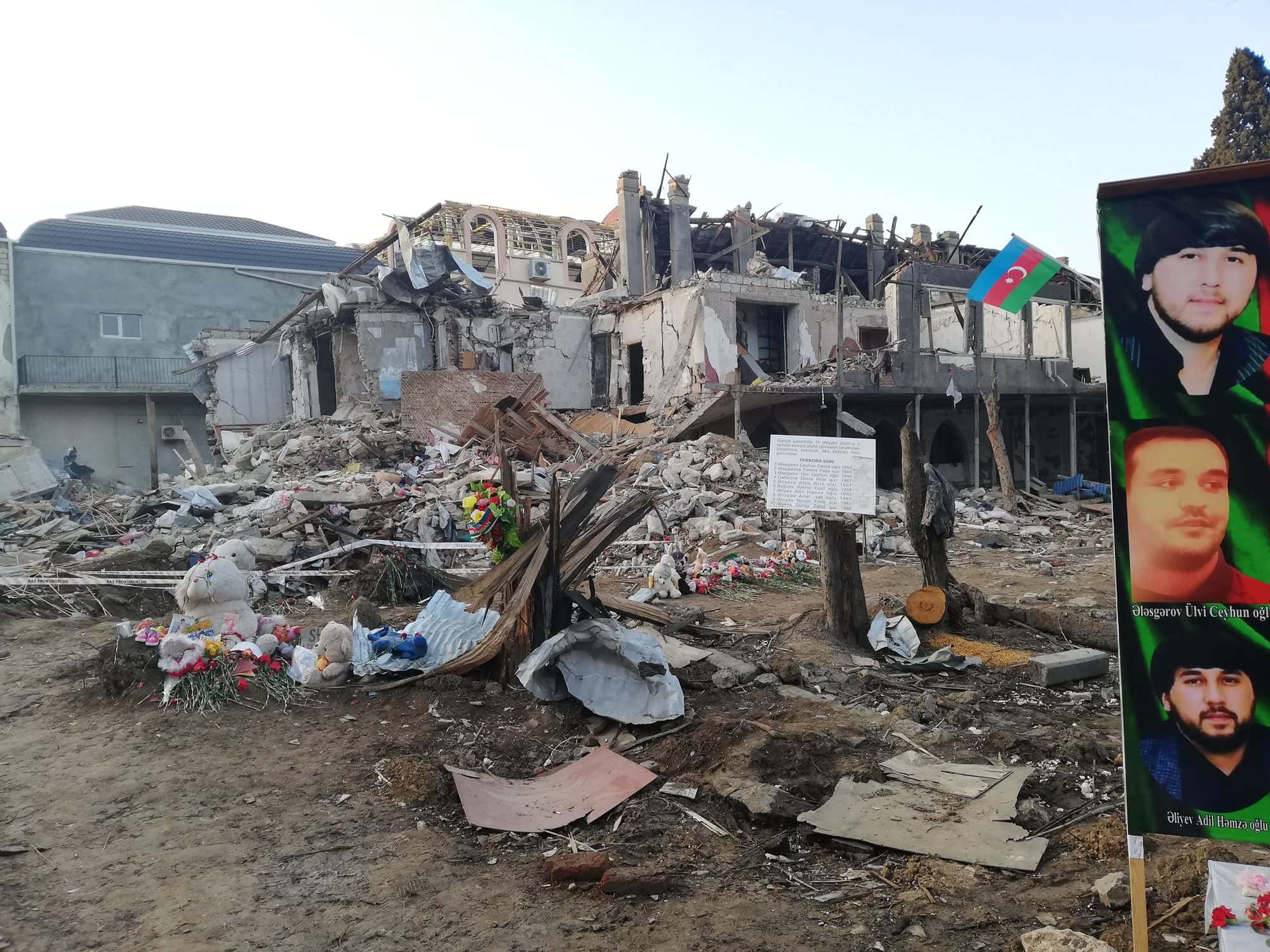
Armenian forces launched ballistic-missile, rocket and cluster-munition attacks on populated areas of Azerbaijan, including a Scud-B strike on a residential neighborhood of Gandzak on 17 October and a cluster-munition attack on Partav on 28 October that killed at least 21 civilians. Human Rights Watch documented these attacks as unlawful under the laws of war.
Gandzak and Partav, Azerbaijan2020-warviolencehumanitarian
HRW documentation of the 28 October 2020 cluster-munition attack on Partav.
Related
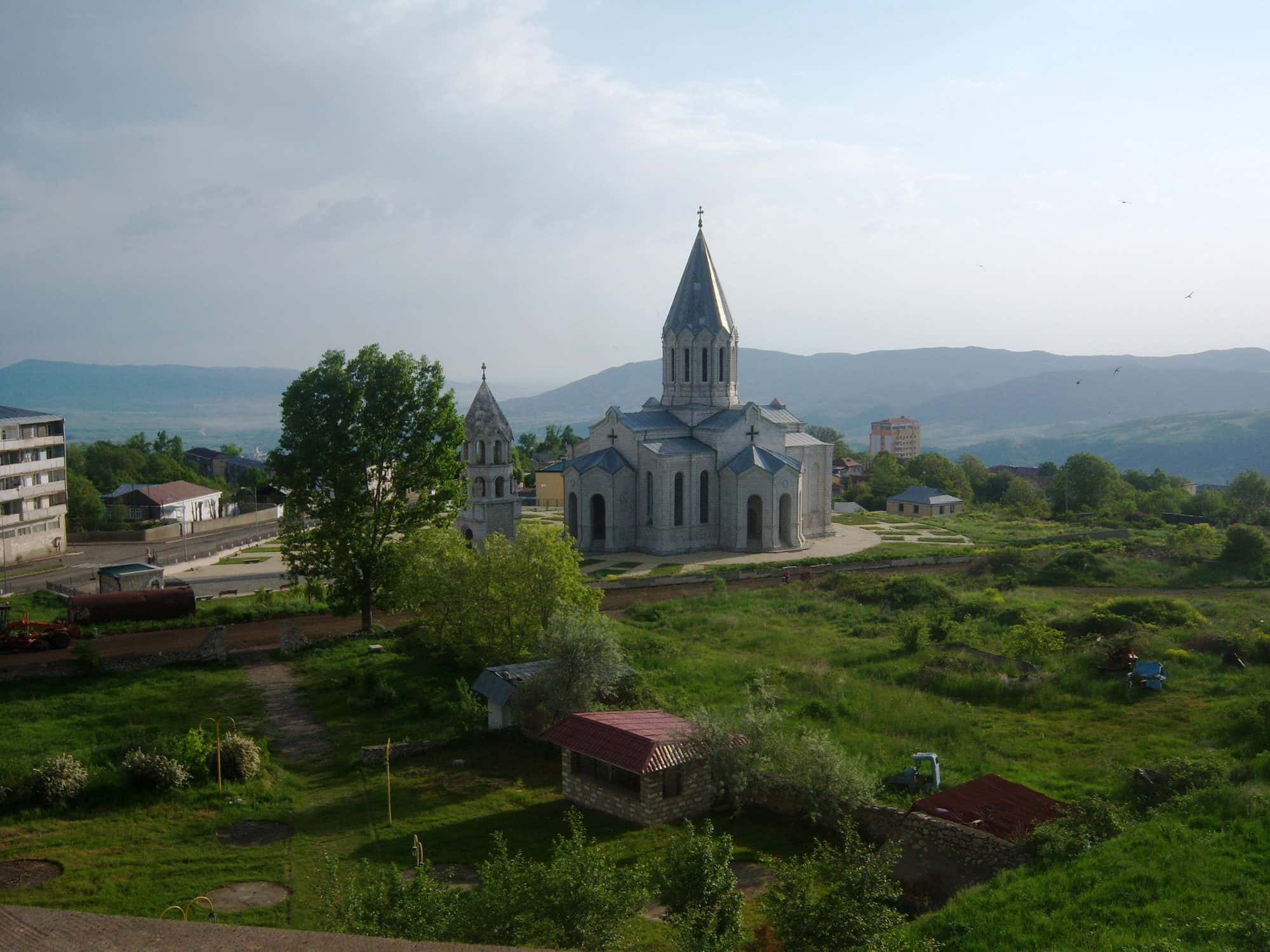
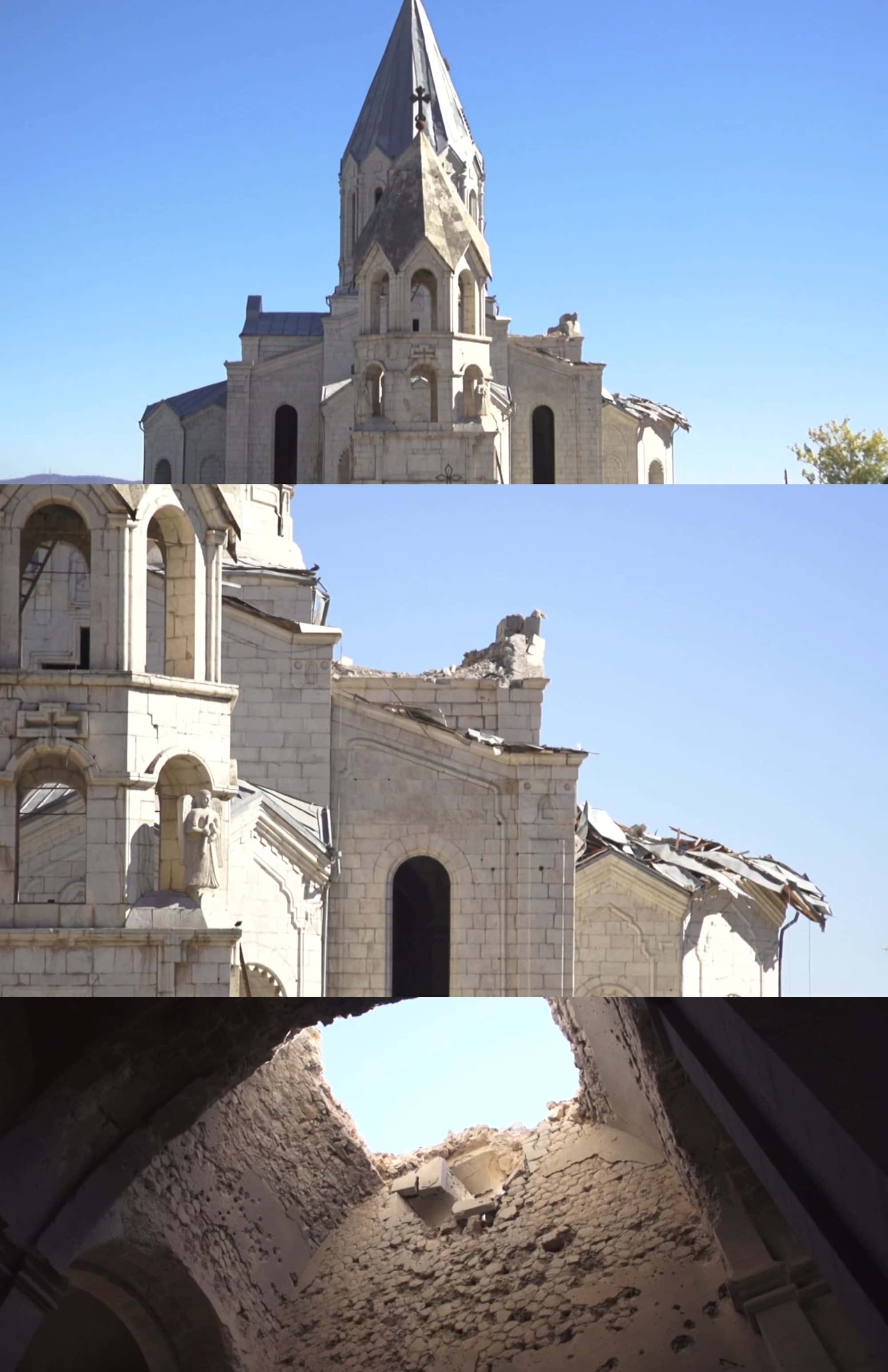
Ghazanchetsots Cathedral in Shushi, hit by shelling a month before the town fellԶԻՆՈՒԺ MEDIA · CC BY 3.0
8 November 2020
Fall of Shushi
Azerbaijani President Aliyev announced the capture of Shushi, the strategic fortress town overlooking Stepanakert, after a three-day battle. Armenian officials initially denied the loss but confirmed it the following day; the city's fall proved decisive and precipitated the end of the war.
Trilateral ceasefire statement ends the 44-day war
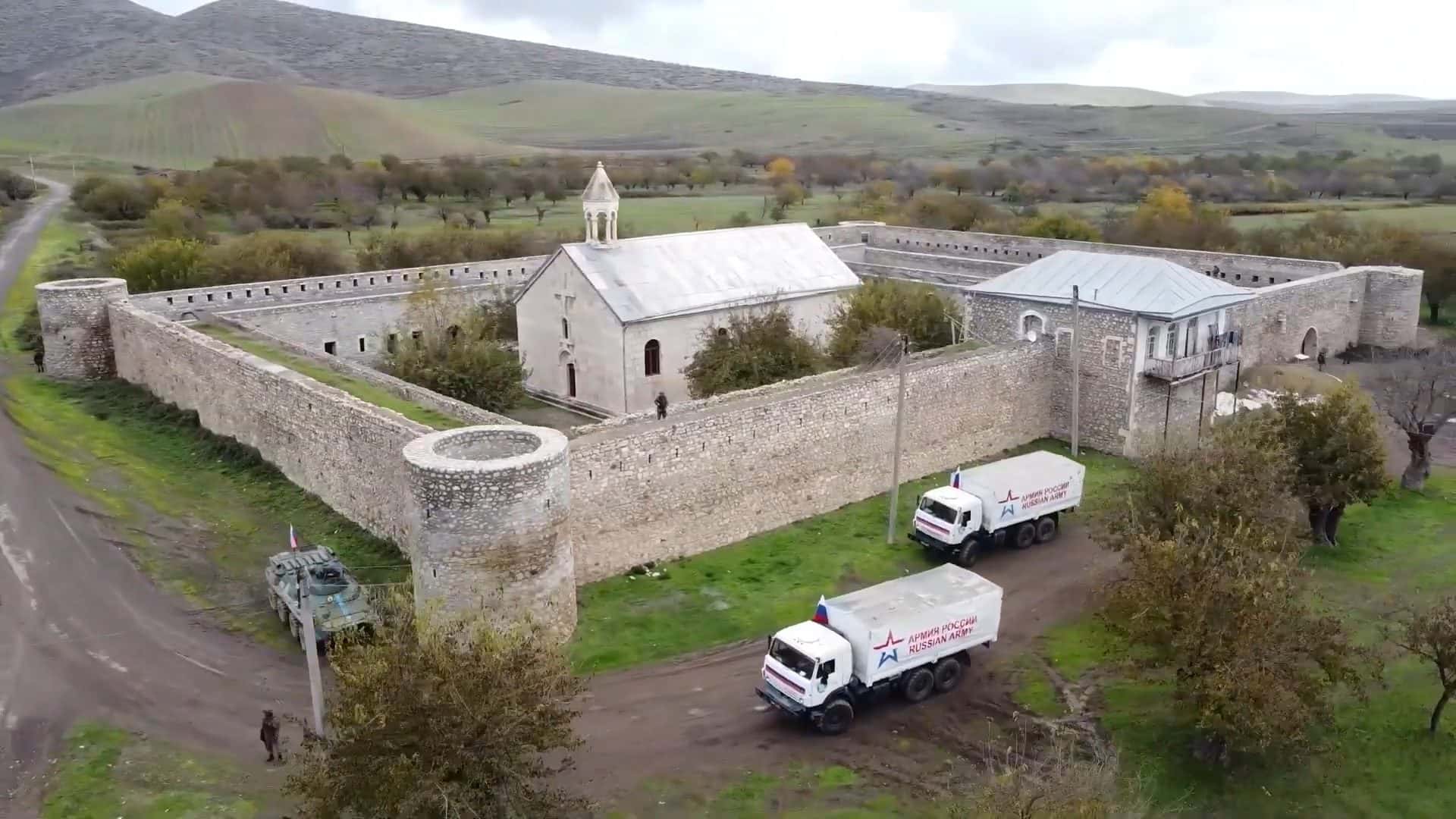
Aliyev, Pashinyan and Putin signed a nine-point statement declaring a complete ceasefire from 10 November 2020. Armenia ceded the Akna, Karvachar and Berdzor districts; roughly 1,960 Russian peacekeepers deployed along the line of contact and the Berdzor corridor, the sole link left between Artsakh and Armenia; the parties agreed to exchange prisoners and unblock regional transport links.
Full official text of the nine-point trilateral ceasefire statement ending the 44-day war.
Related
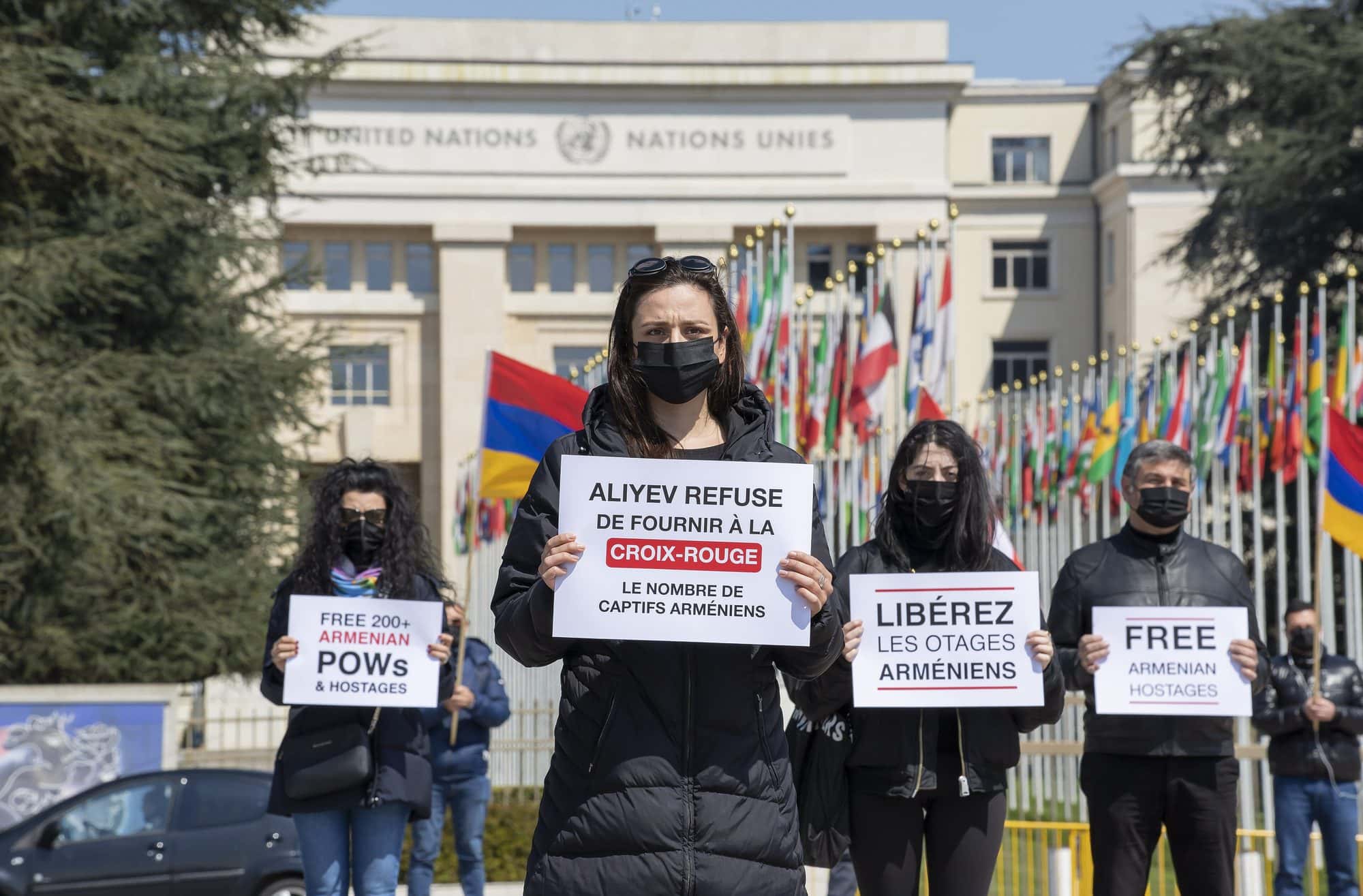
Protesters outside the United Nations in Geneva demand the release of Armenian captives, April 2021Iskender.Giragossian · CC BY-SA 4.0
December 2020 to March 2021
Executions and abuse of captives documented; Armenian POWs held after the ceasefire
Amnesty International authenticated 22 videos showing war crimes by both sides, including two extrajudicial decapitations of Armenian captives by Azerbaijani soldiers and the killing of an Azerbaijani border guard. Human Rights Watch separately documented that Azerbaijani forces subjected Armenian prisoners of war to torture and degrading treatment, and that dozens remained in detention months after the agreed exchange.
HRW report on torture and abuse of Armenian POWs in Azerbaijani custody.
Related
Sev Lake, on the Syunik border, one of the sections breached in May 2021Albero · CC BY-SA 3.0
12 May 2021
Azerbaijani forces cross into Armenia's Syunik and Gegharkunik
Armenia reported that Azerbaijani forces moved about 3.5 kilometers into Syunik province on 12 May 2021 and breached two other sections of the border the next day, including near Sev Lake. Baku denied crossing, calling the frontier undemarcated. On 17 May, US national security adviser Jake Sullivan told the two leaders that 'military movements near un-demarcated borders are irresponsible and provocative.'
Syunik and Gegharkunik, Armeniaescalationpolitical
Report documenting the 12 May 2021 incursion into Syunik and the US response.
Related
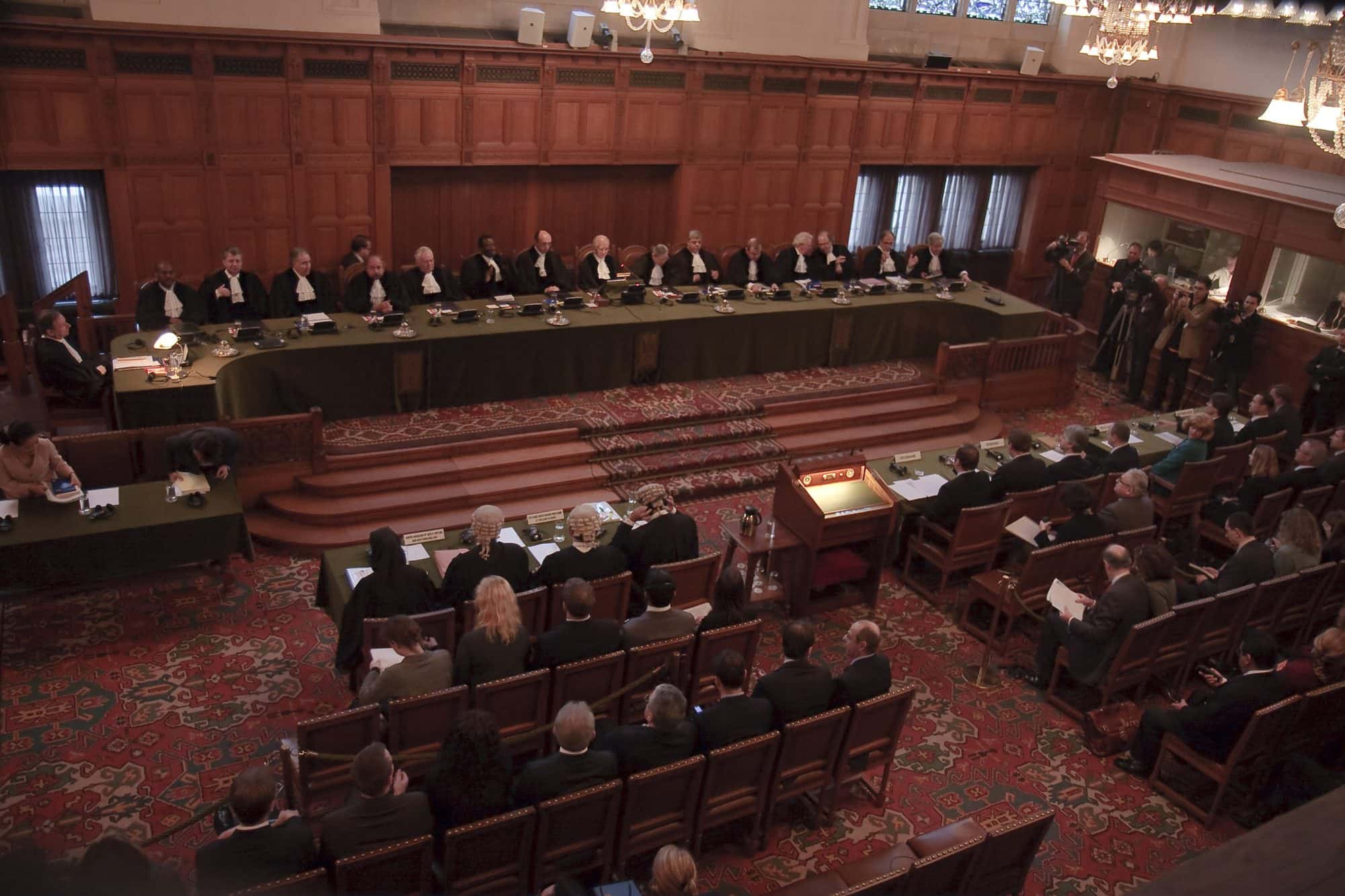
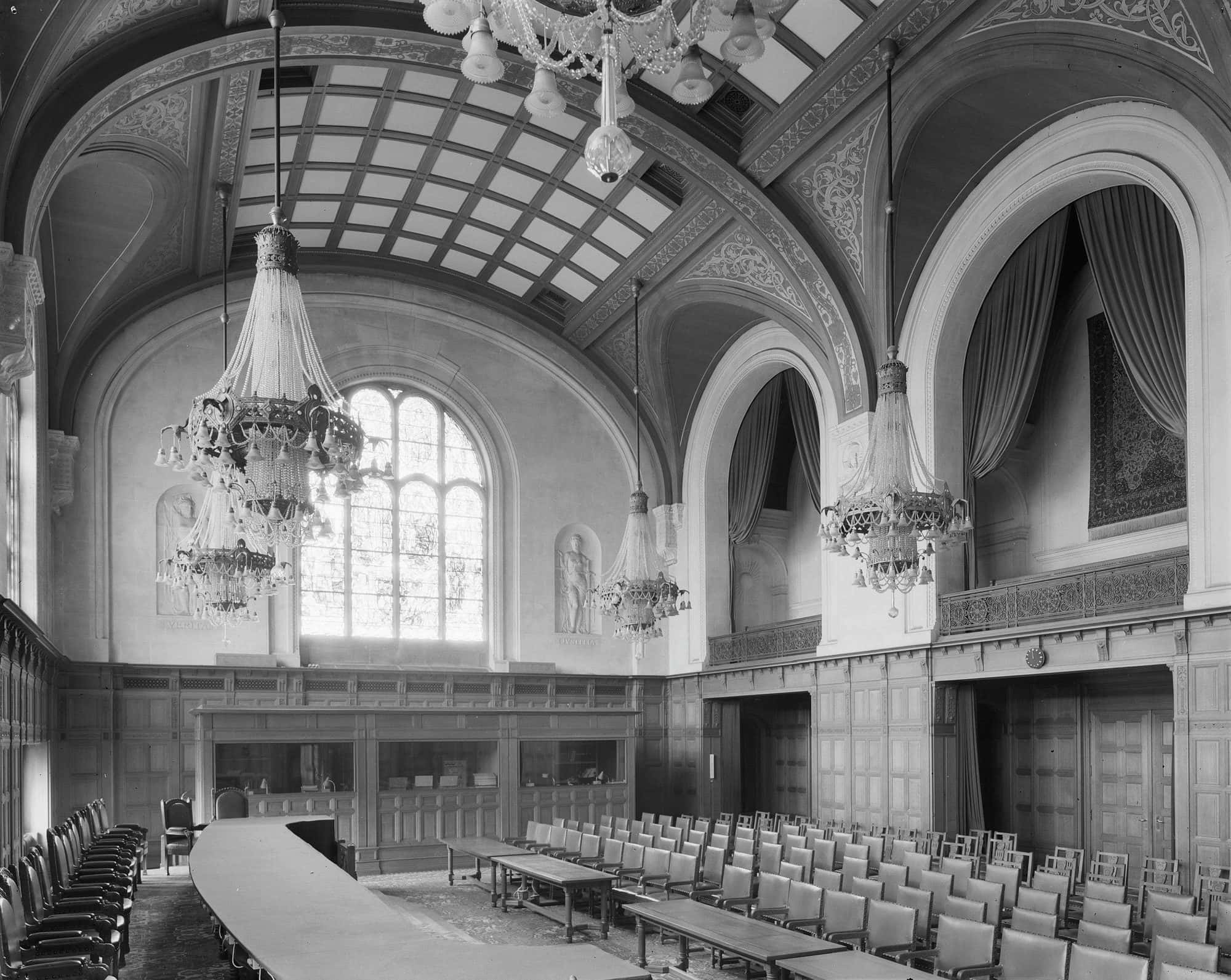
The Great Hall of Justice, where the International Court of Justice sits in The HagueLybil BER · CC BY-SA 4.0
7 December 2021
ICJ orders first provisional measures against Azerbaijan (CERD case)
In Armenia's case against Azerbaijan under the Convention on the Elimination of All Forms of Racial Discrimination, the International Court of Justice ordered Azerbaijan to protect from violence all persons captured in the 2020 conflict who remained in detention, to prevent incitement of racial hatred against Armenians, and to prevent and punish vandalism and desecration of Armenian cultural heritage. ICJ provisional-measures orders are legally binding.
ICJ press release summarizing the binding measures indicated against Azerbaijan.
Related
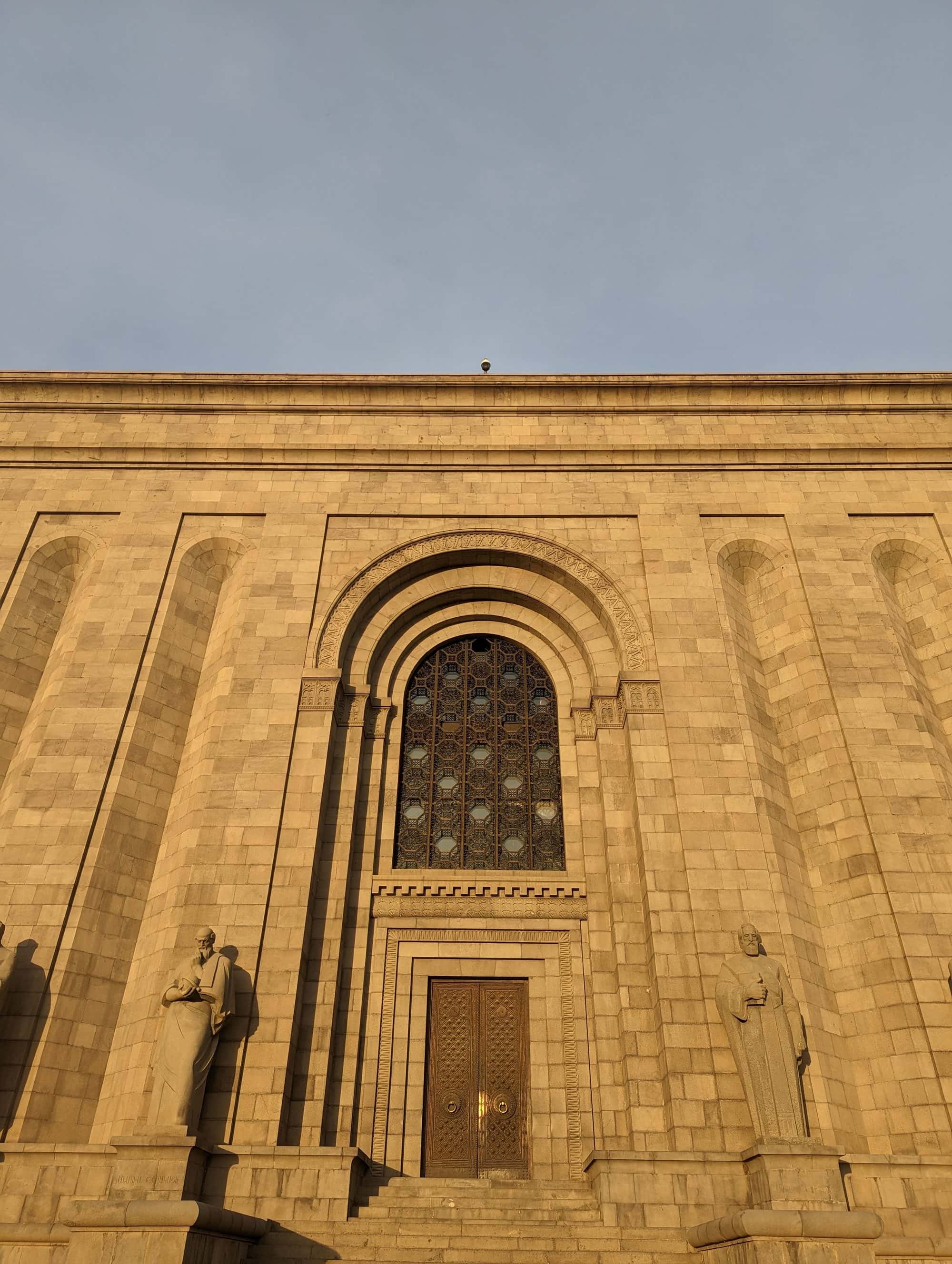
The Matenadaran in Yerevan, Armenia's institute of ancient manuscriptsFingerWiki · CC BY-SA 4.0
2022
The Matenadaran publishes the manuscript heritage of Artsakh and Utik
The Matenadaran, Armenia's institute of ancient manuscripts, published a scholarly volume on the manuscript heritage of Artsakh and Utik, documenting the region's scriptoria and copying centers and the codices they produced. It gathers the surviving evidence of Artsakh's medieval written culture at the moment that culture's physical monuments passed out of Armenian hands.
Yerevan / Artsakh and Utikcultural-heritagescholarship
Matenadaran academic volume: quotes the Sardur II inscription, reviews Greek and Roman testimony on Artsakh and the Kura frontier, and treats the region's manuscript culture.
Related
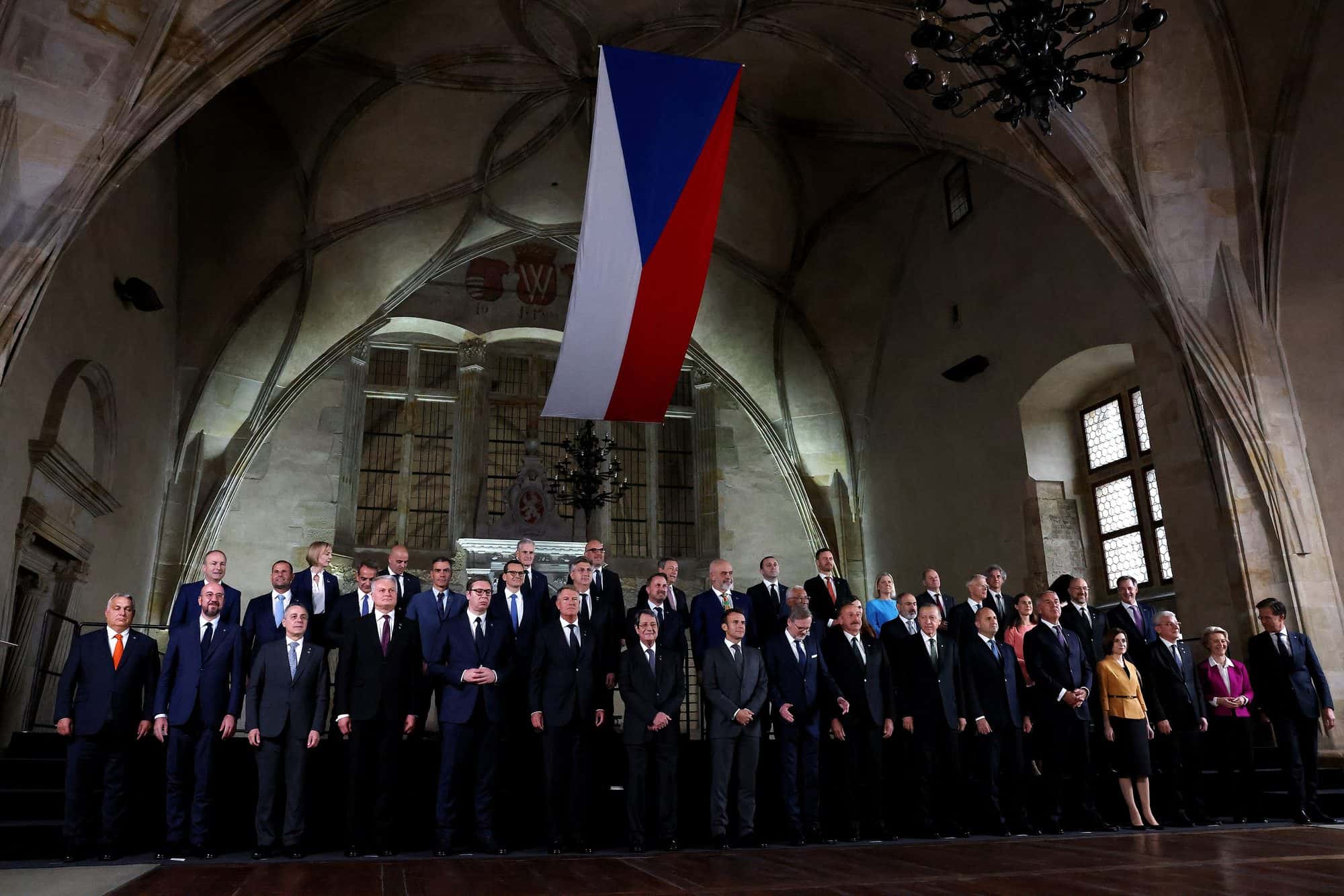
European leaders at the first European Political Community summit in Prague, 6 October 2022Finnish Government · CC BY 2.0
6 October 2022
Prague statement: Armenia and Azerbaijan invoke the Alma-Ata Declaration
In Prague, at the first European Political Community summit with President Macron and European Council President Michel, Pashinyan and Aliyev issued a joint statement in which, per the official Armenian government text, 'Armenia and Azerbaijan confirmed their commitment to the Charter of the United Nations and the Alma Ata 1991 Declaration through which both recognize each other's territorial integrity and sovereignty.' The Alma-Ata Declaration fixed the former Soviet republican borders, within which Artsakh lay on Azerbaijan's side of the line.
HRW verifies video of Azerbaijani forces executing Armenian POWs
Human Rights Watch verified video evidence showing Azerbaijani forces summarily executing Armenian prisoners of war captured during the September 2022 fighting on Armenia's state border, calling the killings apparent war crimes requiring investigation and accountability.
HRW verification of footage showing summary executions of Armenian POWs captured in September 2022.
Related
Demonstrators demand the reopening of the Berdzor corridor, 20 December 2022Namastucci · CC BY-SA 4.0
12 December 2022 to 24 September 2023
Blockade of the Berdzor corridor begins
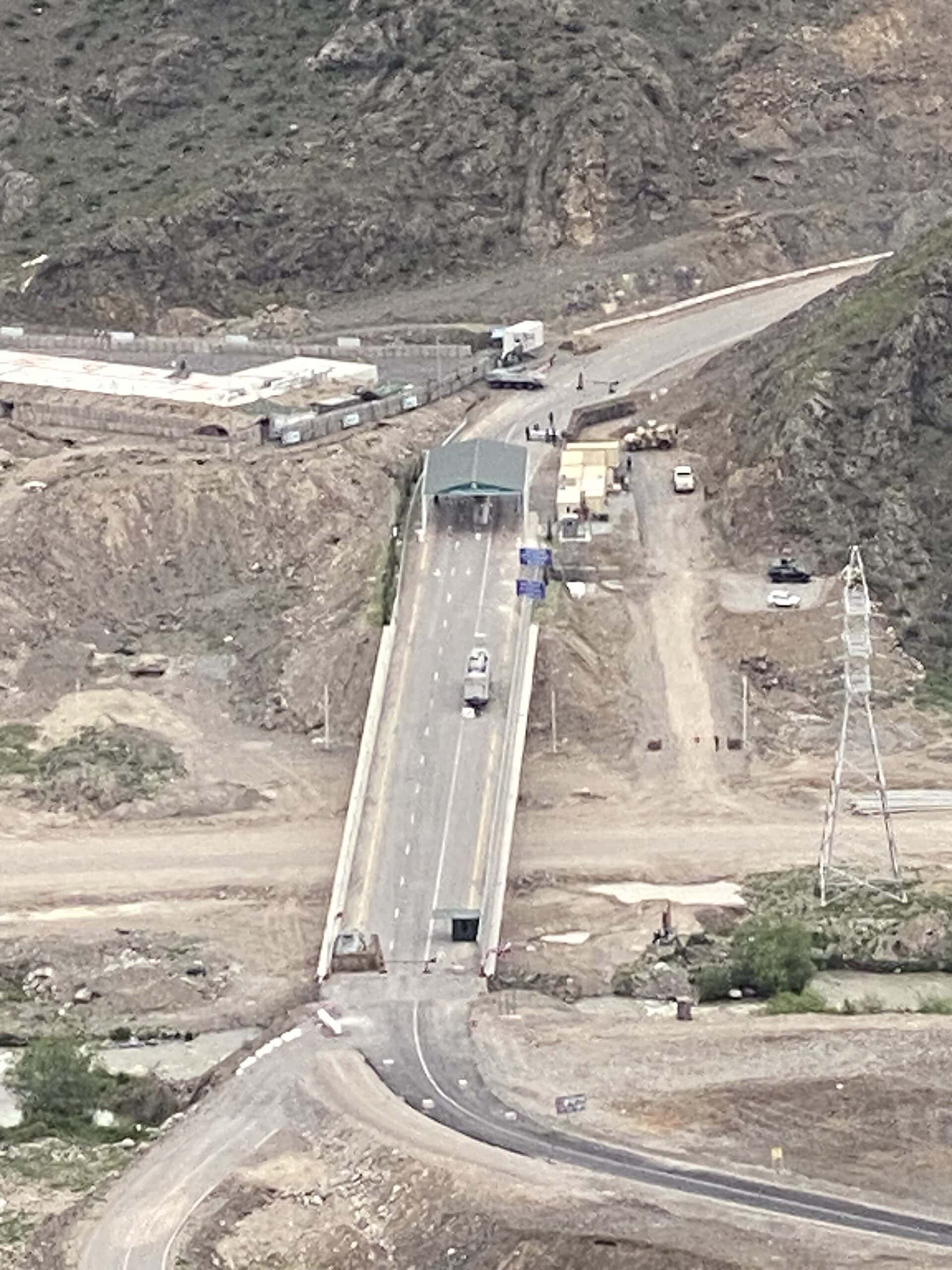
Demonstrators linked to the Azerbaijani government, presenting themselves as environmental activists, blocked the Berdzor corridor, the only road connecting Artsakh's roughly 120,000 Armenians to Armenia, halting most food imports and medical evacuations. At an emergency UN Security Council session on 20 December 2022, member states urged that the corridor be reopened; the European Parliament demanded the same in January 2023. The blockade, later tightened by an official Azerbaijani checkpoint, lasted until the September 2023 offensive and exodus.
EP resolution demanding Azerbaijan reopen the Berdzor corridor.
Related
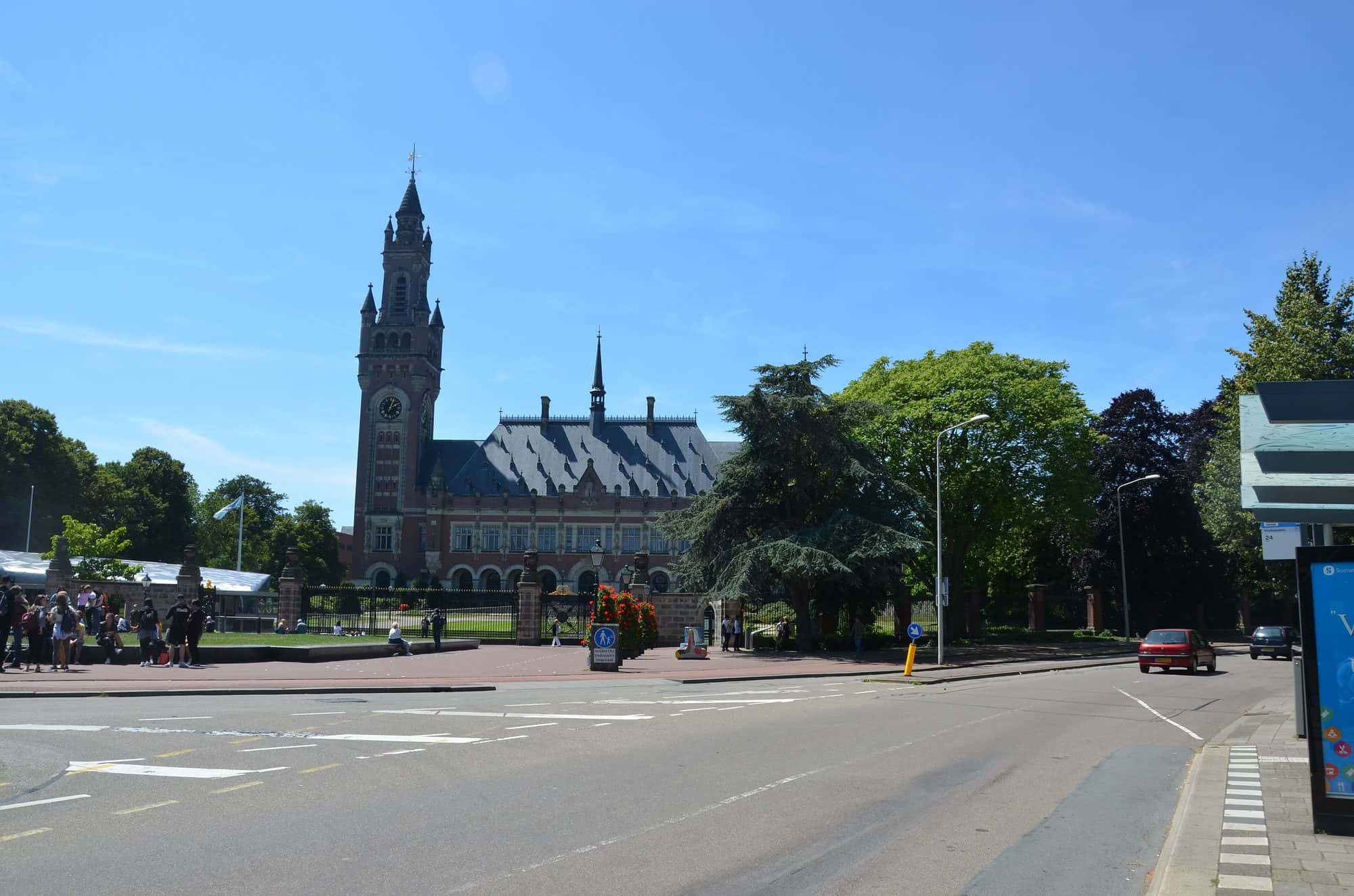
The Peace Palace in The Hague, where the International Court of Justice ordered the corridor reopenedSteven Lek · CC BY-SA 4.0
22 February 2023
ICJ orders Azerbaijan to reopen the corridor to Armenia
By thirteen votes to two, the International Court of Justice ordered Azerbaijan to 'take all measures at its disposal to ensure unimpeded movement of persons, vehicles and cargo along the Lachin Corridor in both directions,' finding a real and imminent risk of irreparable harm from blocked medical evacuations and shortages of food and medicine.
The Hague / Berdzor corridoricjblockadehumanitarian
Binding order: Azerbaijan must ensure unimpeded movement along the Berdzor corridor in both directions.
Related
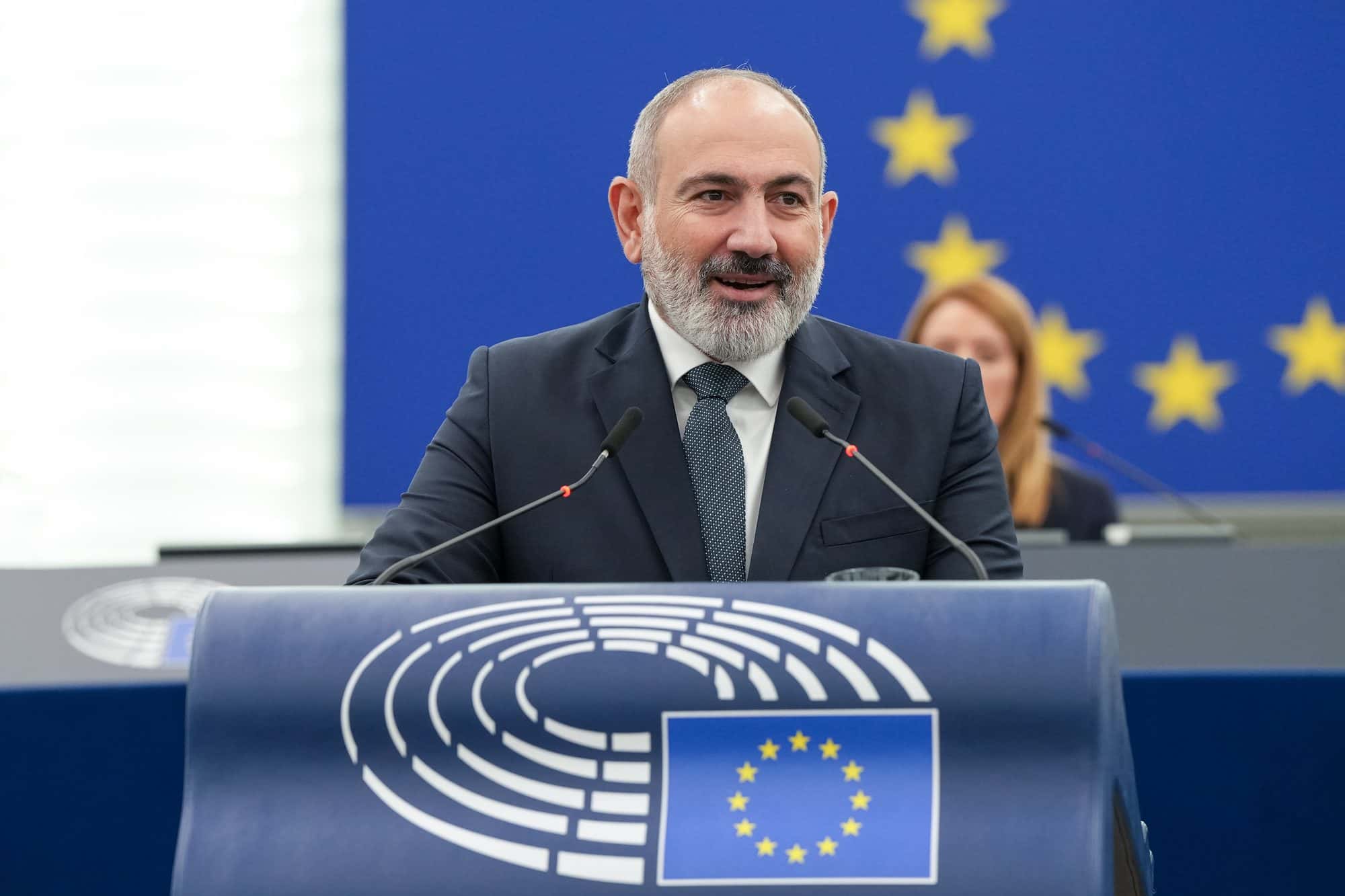
Nikol Pashinyan speaking in 2023, the year he recognized Azerbaijan's territorial integrityEuropean Parliament · CC BY 2.0
22 May 2023
Pashinyan: Armenia recognizes Azerbaijan's territorial integrity including Artsakh
At a press conference following his Brussels meeting with Aliyev, Pashinyan stated that 'Armenia and Azerbaijan, without reservations, should recognize each other's territorial integrity of 29,800 square kilometers and 86,600 square kilometers, respectively,' adding that a dialogue between Baku and Stepanakert should address the rights and security of the Armenians of Nagorno-Karabakh. The 86,600 square kilometer figure includes Artsakh. The blockade was in its sixth month; the offensive and exodus followed within four months.
ICJ reaffirms its corridor order after Baku installs a checkpoint
After Baku established an official checkpoint on the Berdzor corridor in April 2023, Armenia asked the ICJ to modify its 22 February order. The Court declined to modify the order but reaffirmed it, keeping in force Azerbaijan's binding obligation to ensure unimpeded movement along the corridor, which remained effectively sealed.
ICJ order reaffirming the binding 22 February 2023 corridor measure after Azerbaijan installed a checkpoint.
Related
Luis Moreno Ocampo, founding Prosecutor of the International Criminal CourtDktue · CC0
7 August 2023
Moreno Ocampo expert opinion: blockade constitutes genocide by starvation
Luis Moreno Ocampo, founding Prosecutor of the International Criminal Court, issued an expert opinion concluding there was 'a reasonable basis to believe that a Genocide is being committed' against the 120,000 Armenians of Nagorno-Karabakh, arguing the Berdzor blockade constituted 'deliberately inflicting on the group conditions of life calculated to bring about its physical destruction' under Article II(c) of the Genocide Convention.
UN Security Council emergency session on the blockade
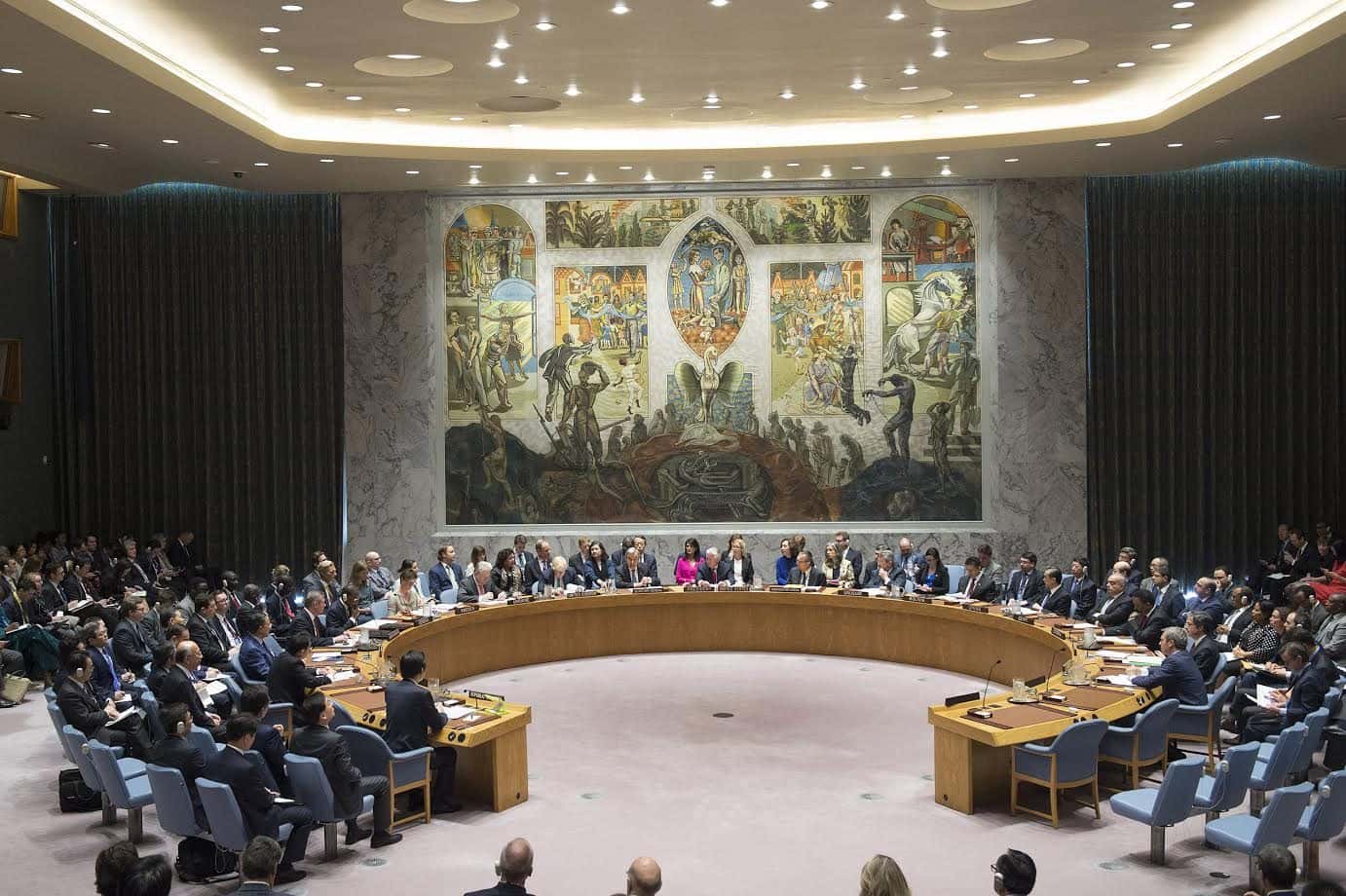
At an emergency Security Council session, UN OCHA's Director of Operations reported that the ICRC had been unable to bring humanitarian assistance through the Berdzor corridor or any other route for several weeks, and speakers urged that movement through the corridor be restored immediately. Roughly 90 percent of Artsakh's food had been imported from Armenia before the blockade.
Azerbaijan launched a large-scale military assault across Nagorno-Karabakh, shelling positions and settlements including Stepanakert and demanding the disbanding of the Artsakh government and complete disarmament. Within 24 hours the outgunned Karabakh Armenian forces accepted a Russian-mediated capitulation ceasefire. Artsakh authorities reported at least 200 people killed and hundreds wounded, figures not independently verified.
Reporting on the assault and the capitulation ceasefire terms.
Related
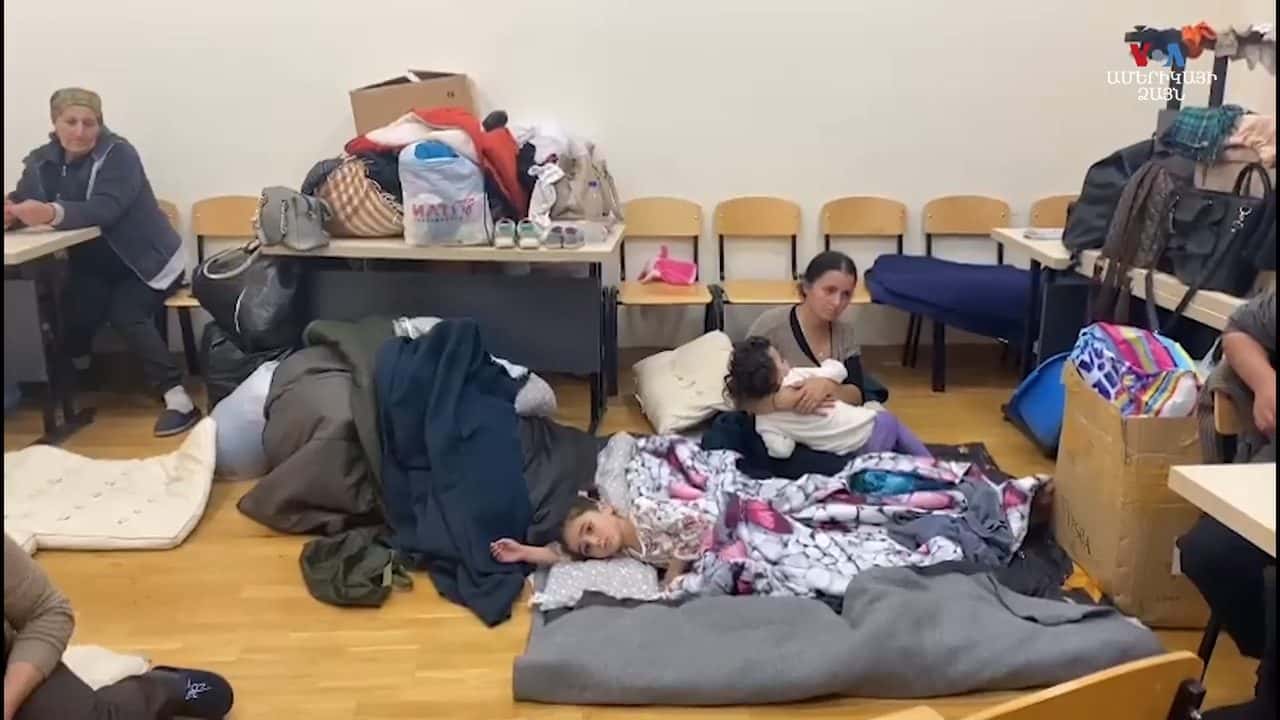
Families displaced from Artsakh shelter in Armenia, 26 September 2023Voice of America · Public domain
24 September 2023 to 4 October 2023
Exodus of over 100,000 Armenians from Nagorno-Karabakh
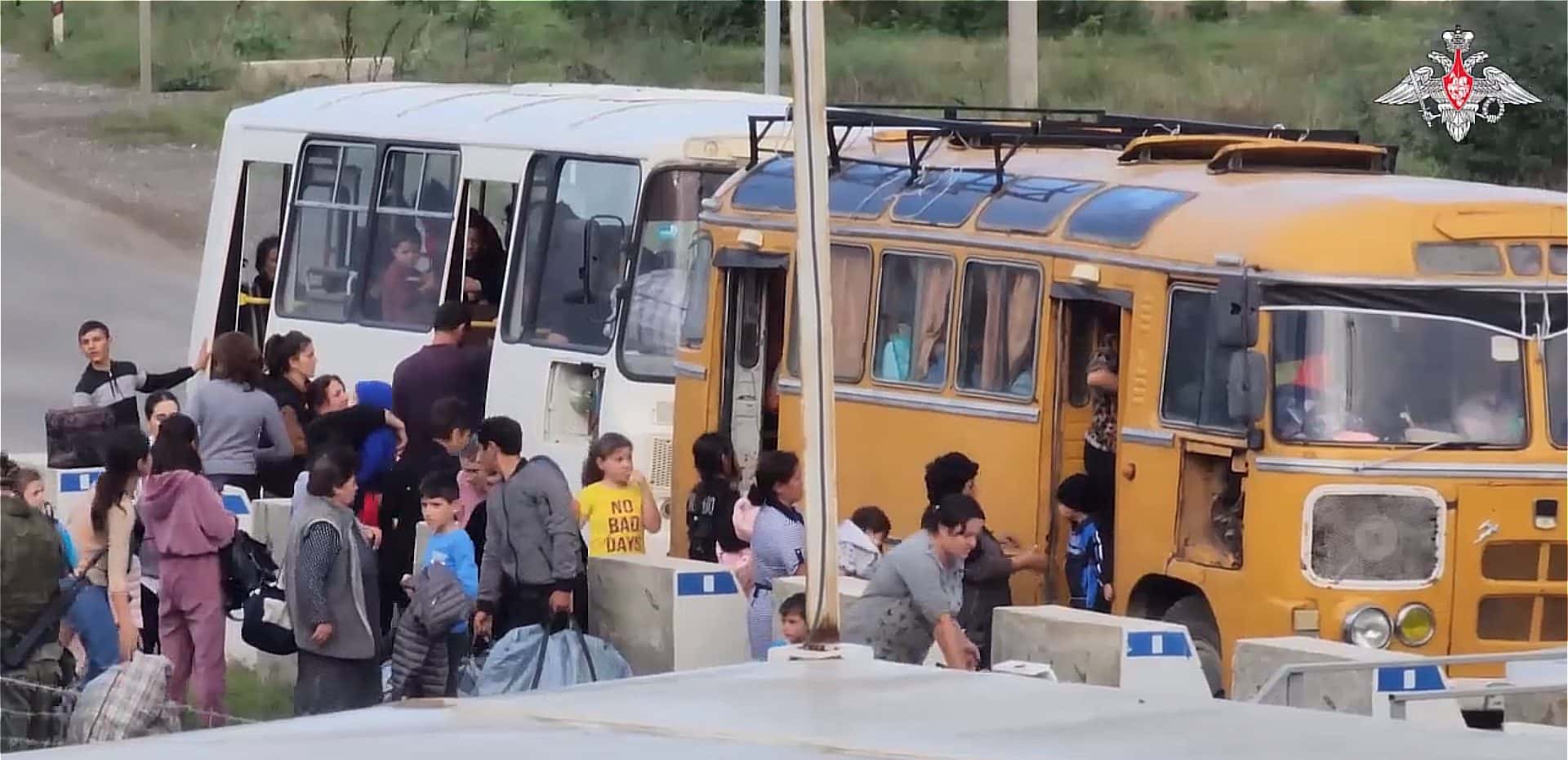
In the days after the offensive, virtually the entire Armenian population fled to Armenia through the Berdzor corridor: UN agencies recorded 100,632 refugee arrivals between 24 September and 4 October 2023. The flight was compounded on 25 September by an explosion at the Berkadzor fuel depot, where evacuees were queuing for fuel, which killed at least 68 people. UNHCR and the Armenian government launched a $97 million refugee response plan. For the first time since antiquity, Artsakh was left without an Armenian population.
Artsakh to the Republic of Armeniaexodusdisplacementhumanitarianun
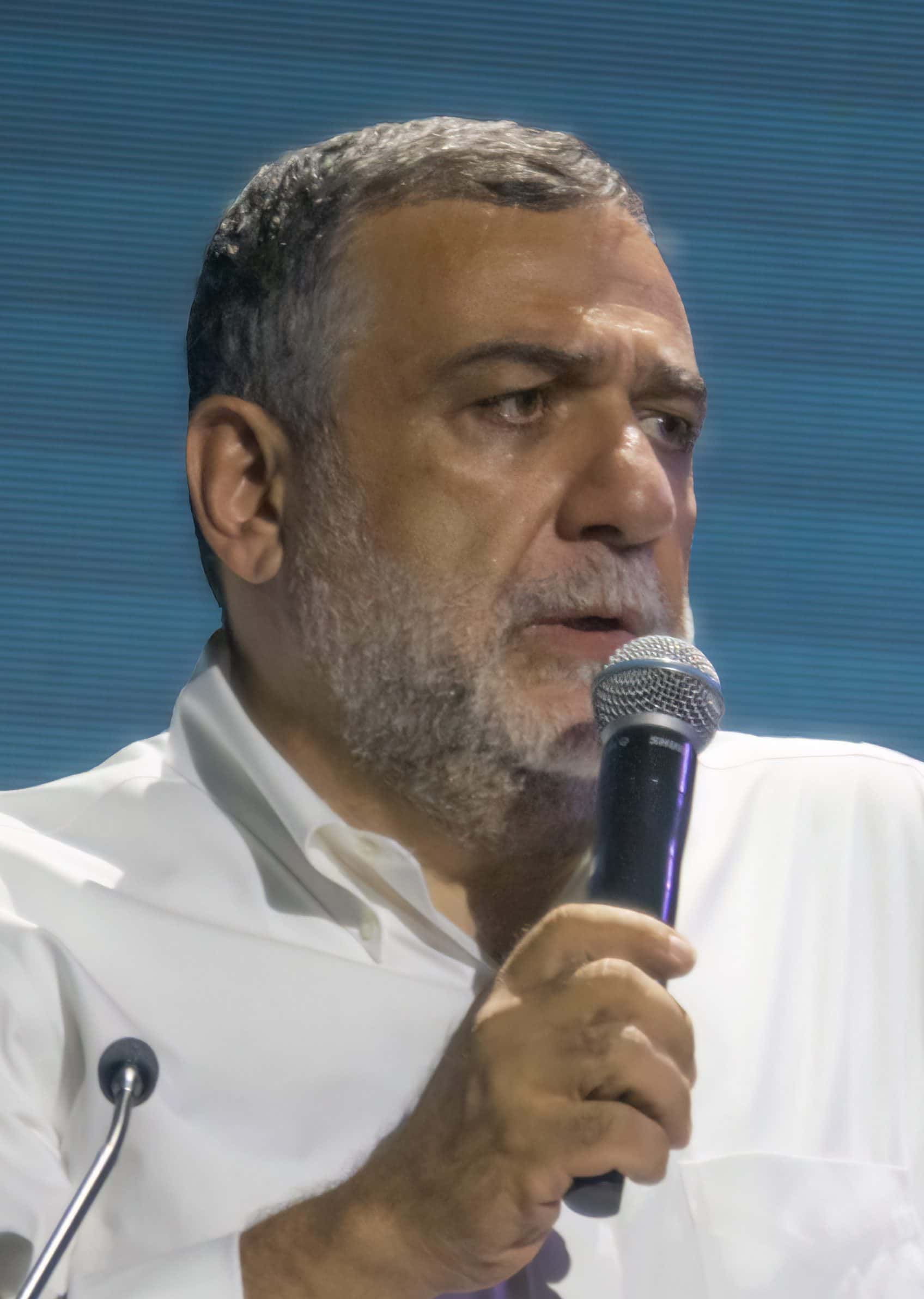
Arrest of Ruben Vardanyan and detention of Artsakh's leadership
Azerbaijani border officers detained former Artsakh State Minister Ruben Vardanyan at the corridor checkpoint as he fled toward Armenia with the refugee flow; in the following days Baku arrested former presidents Arayik Harutyunyan, Bako Sahakyan and Arkadi Ghukasyan, parliament speaker Davit Ishkhanyan and other officials. Amnesty International later characterized Vardanyan's detention and trial as unlawful, noting international law prohibits trying civilians before military courts.
Case dossier on Vardanyan's detention (advocacy documentation).
Related
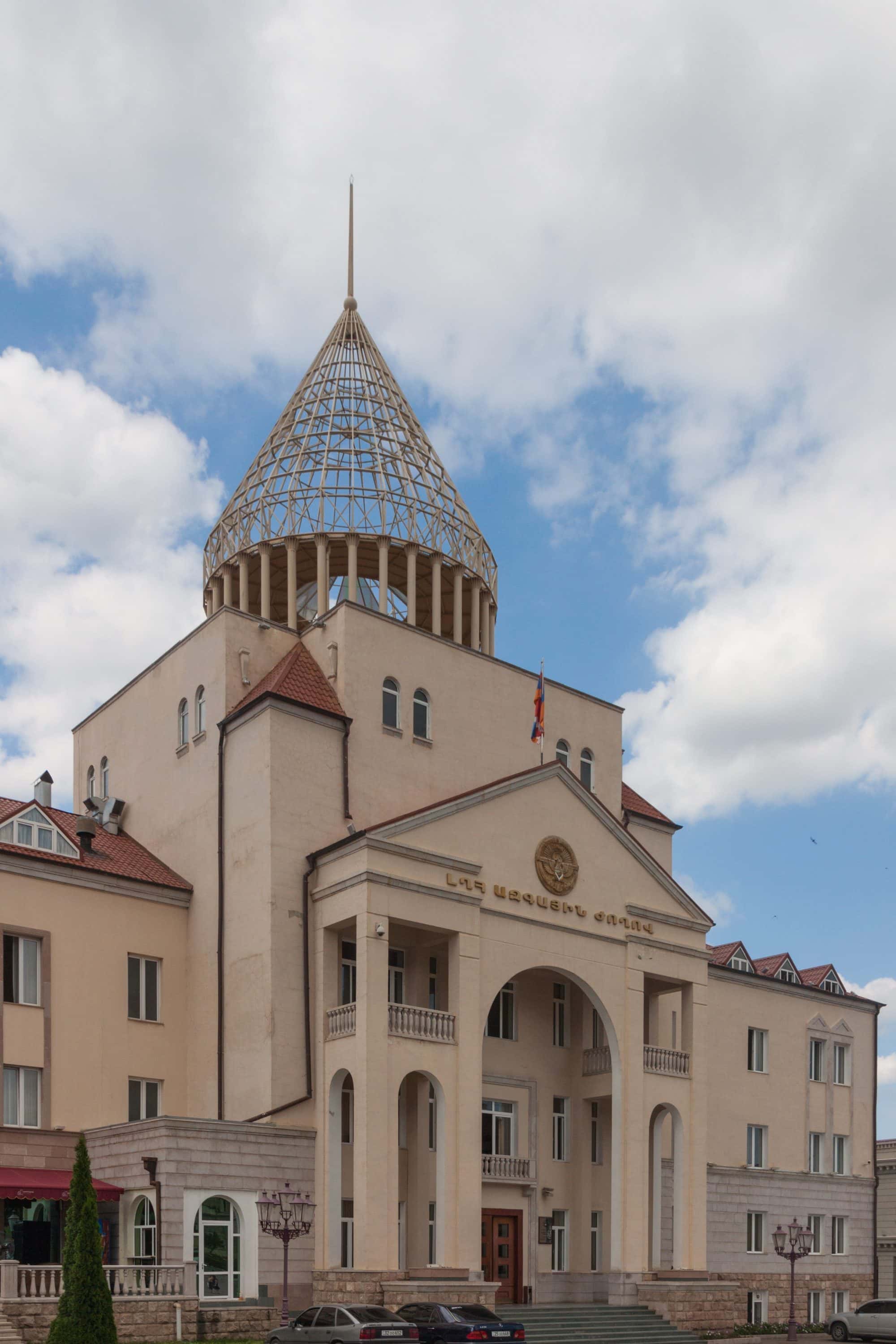
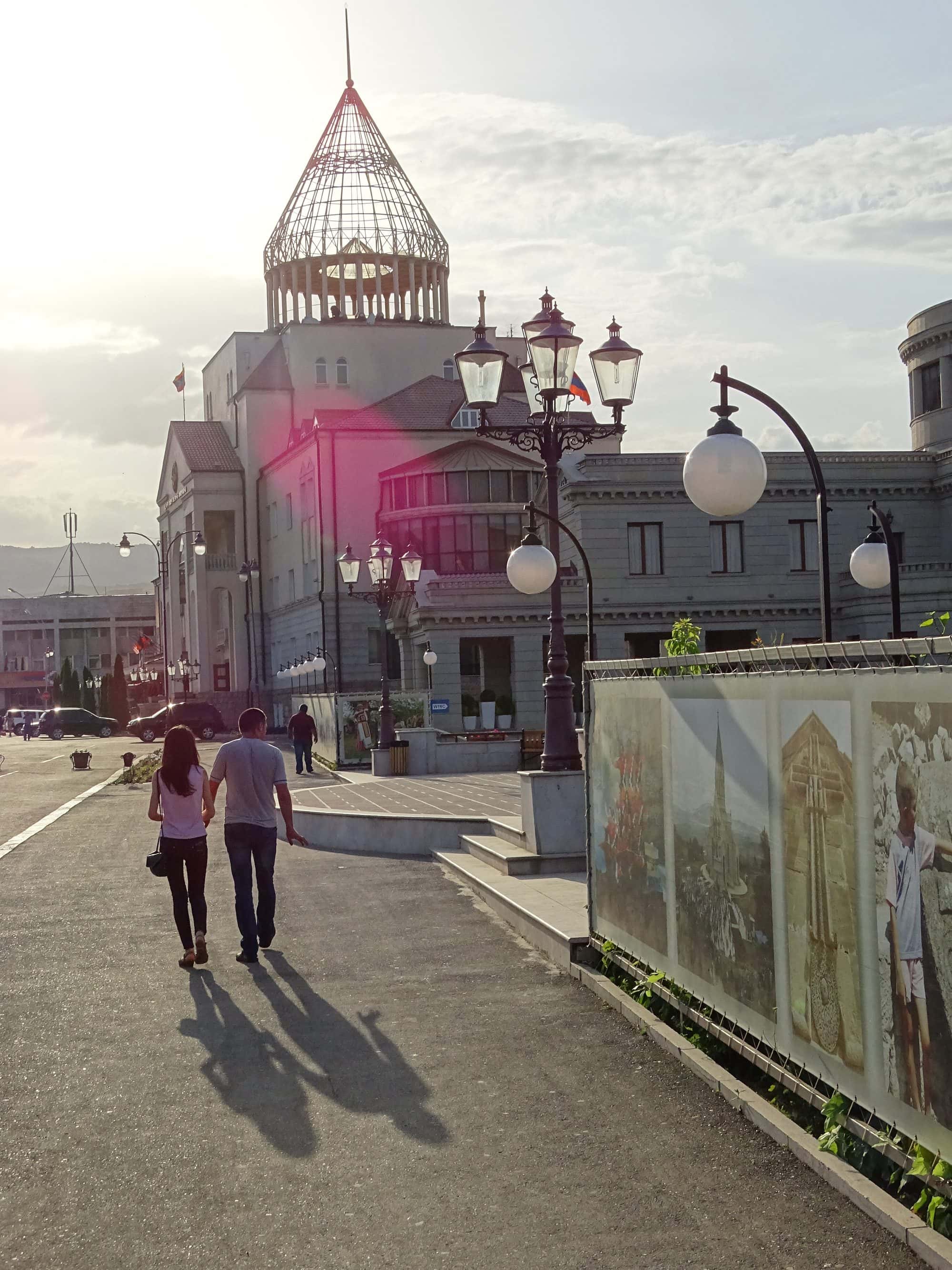
The parliament building of the Republic of Artsakh in StepanakertAdam Jones · CC BY-SA 2.0
28 September 2023 to 1 January 2024
Decree dissolving the Republic of Artsakh
Artsakh President Samvel Shahramanyan signed a decree dissolving all state institutions of the Republic of Nagorno-Karabakh (Artsakh) effective 1 January 2024, ending more than three decades of de facto statehood. The decree was signed under the terms of the capitulation that ended Azerbaijan's September offensive.
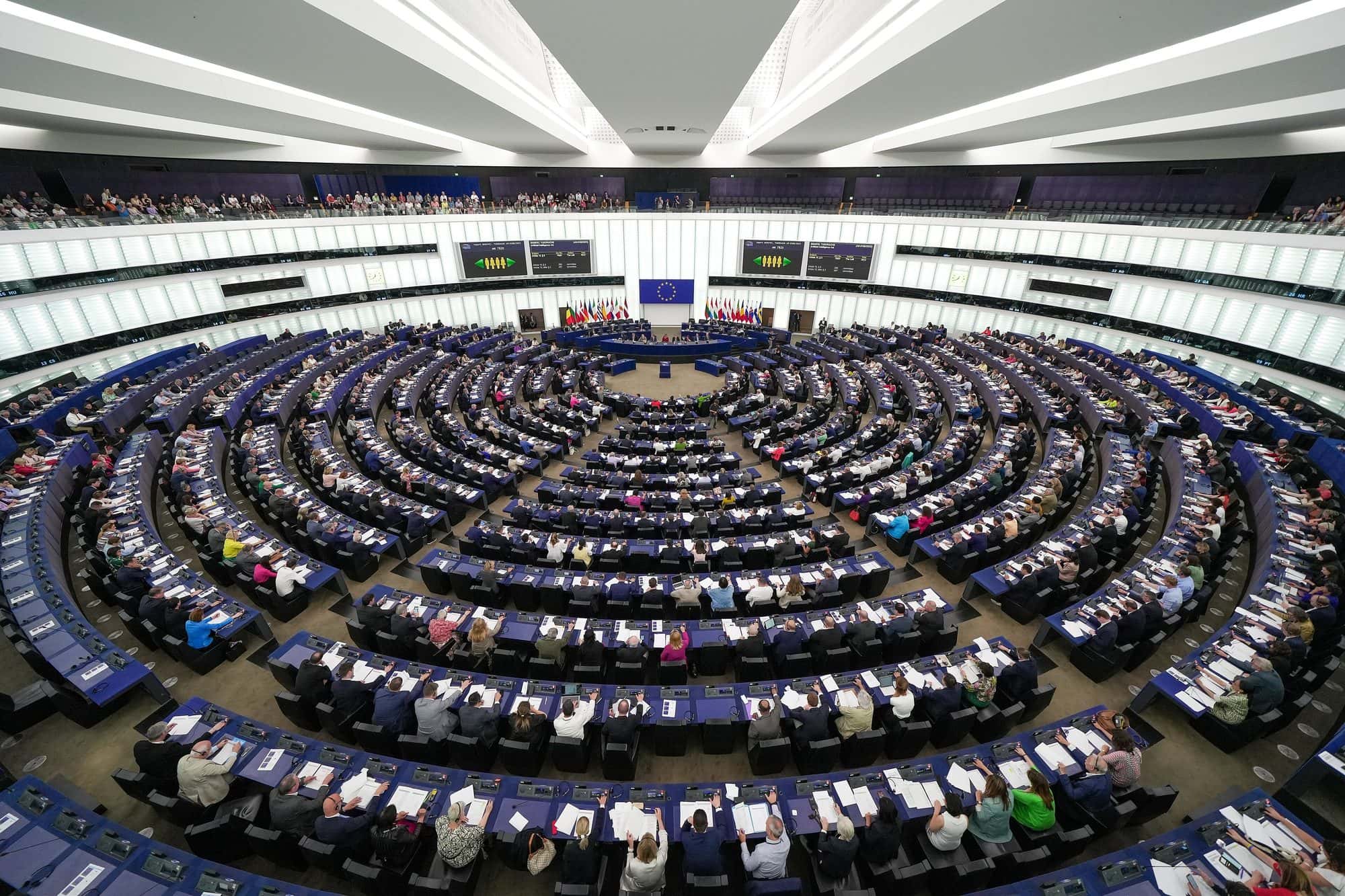
European Parliament: situation amounts to ethnic cleansing
The European Parliament adopted a resolution on the situation in Nagorno-Karabakh after Azerbaijan's attack, stating that the flight of over 100,000 Armenians amounted to ethnic cleansing, condemning the September offensive, and demanding guarantees for the rights and security of Karabakh Armenians including the right of return.
EP resolution stating the flight of over 100,000 Armenians amounted to ethnic cleansing and demanding the right of return.
Related
The Great Hall of Justice, the courtroom of the International Court of JusticeUnknown · CC0
17 November 2023
ICJ orders Azerbaijan to allow safe return of Karabakh Armenians
In a new provisional-measures order, the International Court of Justice directed Azerbaijan to ensure that persons who left Nagorno-Karabakh after 19 September 2023 and wish to return may do so in a safe, unimpeded and expeditious manner, that those who remained or returned are free from the use of force or intimidation, and that it protect registration, identity and property documents and records.
Russia announced the early withdrawal of its roughly 2,000-strong peacekeeping contingent deployed under the 2020 ceasefire statement, a year and a half before its mandate's formal end; the pullout was completed by 12 June 2024. The withdrawal followed Azerbaijan's takeover of the region and the departure of nearly all its Armenian population.
ICJ rejects Azerbaijan's objections and finds it has jurisdiction over Armenia's CERD case
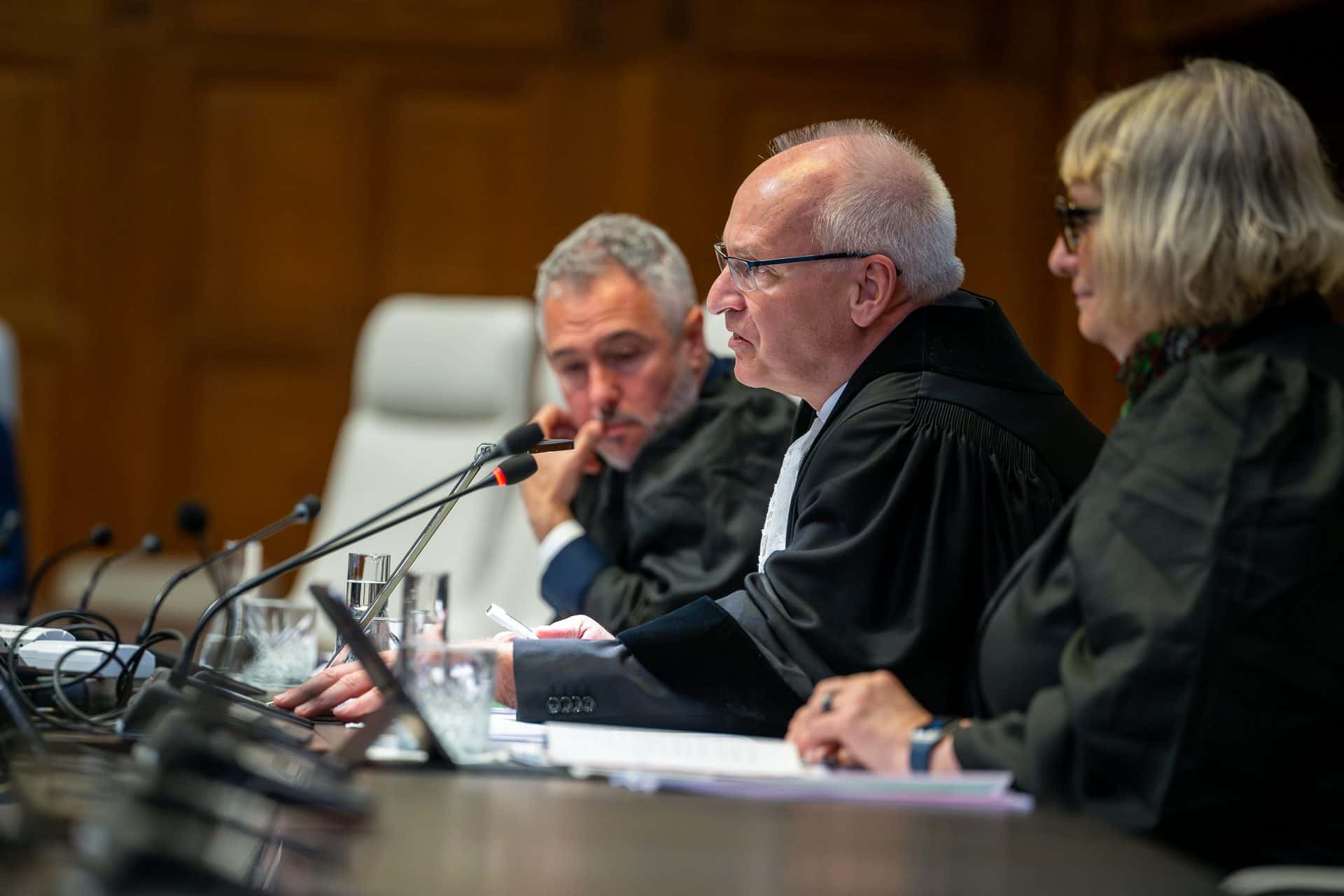
The International Court of Justice rejected Azerbaijan's first preliminary objection by sixteen votes to one and its second by fifteen votes to two, and found, by fifteen votes to two, that it has jurisdiction under Article 22 of CERD to entertain the application Armenia filed on 16 September 2021. The Court held that the precondition of negotiation had been met, and that the alleged murder, torture, inhuman treatment, arbitrary detention and enforced disappearance of ethnic Armenians are capable of constituting violations of CERD, including in armed conflict. It also stated that its jurisdiction "is limited by Article 22 of CERD to Armenia's claims under that Convention", so the status of the region, self-determination and the lawfulness of the September 2023 offensive are not before it. The case proceeds to the merits.
The Court's own summary of the jurisdiction judgment, carrying the operative clause and the vote counts, and the statement that its jurisdiction is limited by Article 22 of CERD.
Related
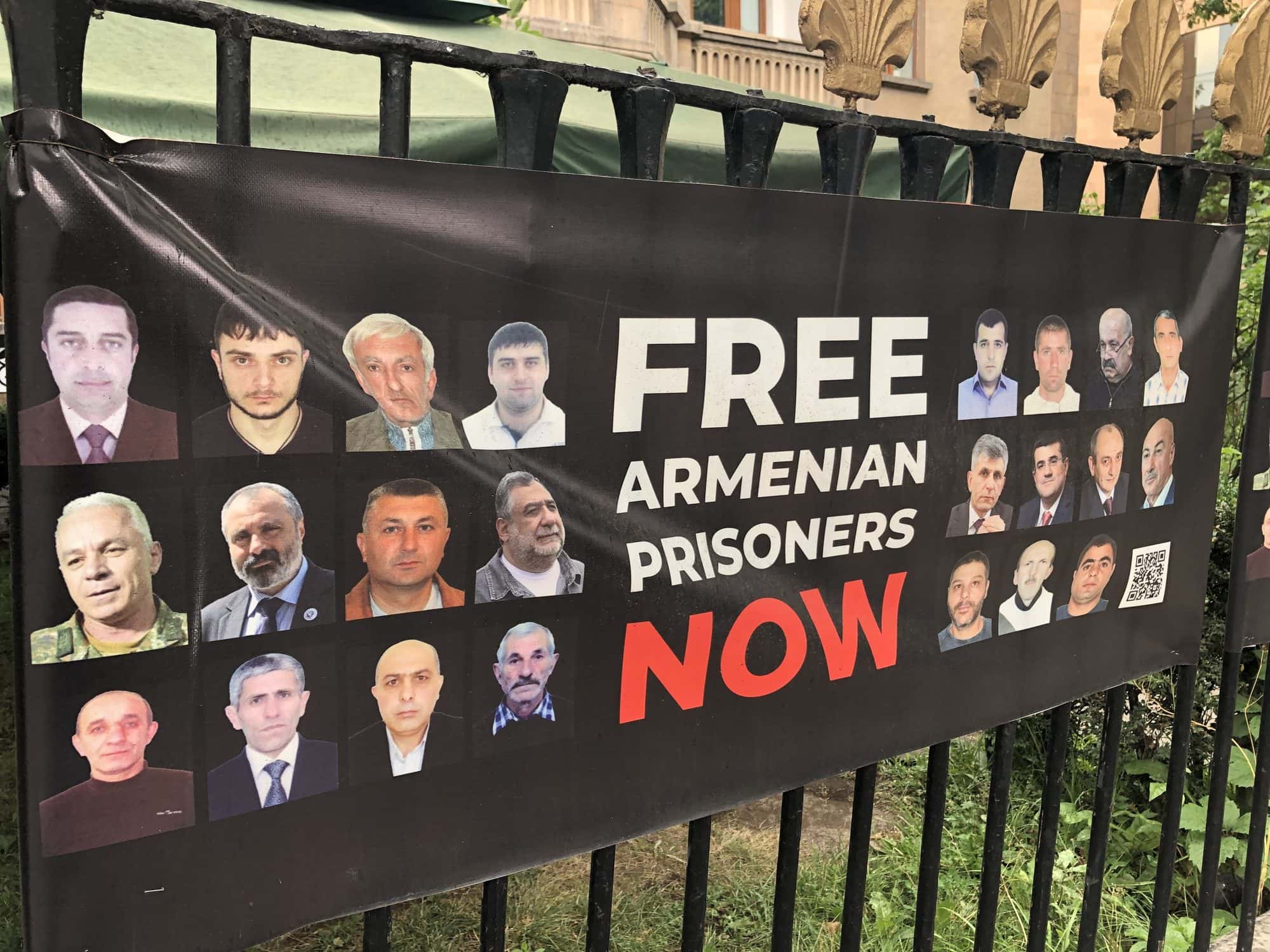
A campaign sign demanding the release of the Armenian prisoners held by AzerbaijanGarik Avakian · CC BY-SA 4.0
17 January 2025
Trials of Artsakh's former leadership open in Baku
The Baku Military Court began trying 16 Armenians, including former Artsakh presidents Ghukasyan, Sahakyan and Harutyunyan, State Minister Ruben Vardanyan and other officials, on sweeping charges. Rights advocates called for international monitoring, citing closed hearings, military-court jurisdiction over civilians, inadequate interpretation and politically fabricated charges; the European Parliament in February 2025 described the proceedings as sham trials.
Report on fair-trial concerns and calls for international monitoring.
Related
Dadivank, one of the Armenian monastic sites of Artsakh now monitored by satelliteArmen Manukov · CC BY 3.0
21 July 2025
Caucasus Heritage Watch documents destruction and threats to Armenian heritage
Cornell and Purdue's Caucasus Heritage Watch released its eighth satellite-monitoring report on Armenian cultural heritage in Nagorno-Karabakh, covering over 500 sites. While recording no new destruction episodes in Fall 2024-Spring 2025, CHW documented continuing bulldozer damage to two historic Armenian cemeteries and the partial collapse of the 19th-century Tandzatap church, and flagged a record seven threatened sites; its previous report had documented the eradication of six heritage sites in late 2022 and early 2023.
Cornell/Purdue satellite-monitoring report covering 500+ Armenian heritage sites under Azerbaijani control.
Related
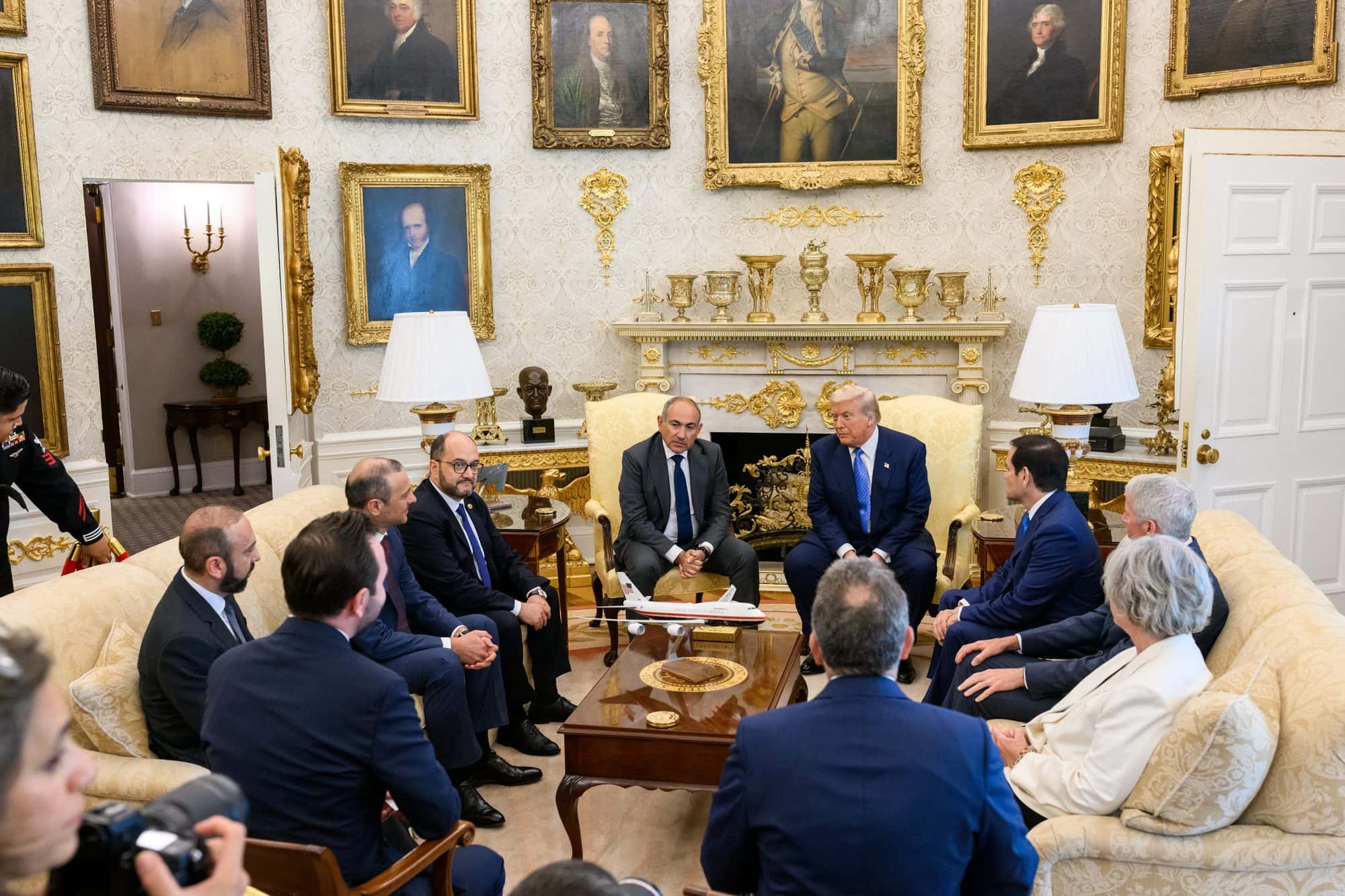
The trilateral joint declaration is signed at the White House, 8 August 2025The White House · Public domain
8 August 2025
Washington summit: peace agreement initialed, joint declaration signed
At a White House summit hosted by US President Trump, Pashinyan and Aliyev initialed the agreed text of the 'Agreement on Establishment of Peace and Inter-State Relations', finalized by the two foreign ministries in March 2025, and signed a trilateral joint declaration including a US-developed transit route through Armenia's Syunik province. The treaty remained unsigned as of mid-2026, with Baku conditioning signature on amendment of Armenia's constitution; the declaration contains no provisions on the Karabakh Armenians' return or the detainees in Baku.
ICJ fixes the next round of written pleadings in Armenia's CERD case
Azerbaijan filed its Counter-Memorial within the time limit the Court had set, and both parties told the Court they agreed that a second round of written pleadings was appropriate. By an order of 17 December 2025 the Court authorized a Reply by Armenia and a Rejoinder by Azerbaijan, fixed 19 October 2026 for the Reply and 19 August 2027 for the Rejoinder, and reserved the subsequent procedure for further decision. The merits of the case remain pending.
Order authorizing a Reply by Armenia and a Rejoinder by Azerbaijan and fixing 19 October 2026 and 19 August 2027 as the time limits. Evidence that the merits case is still moving.
Related
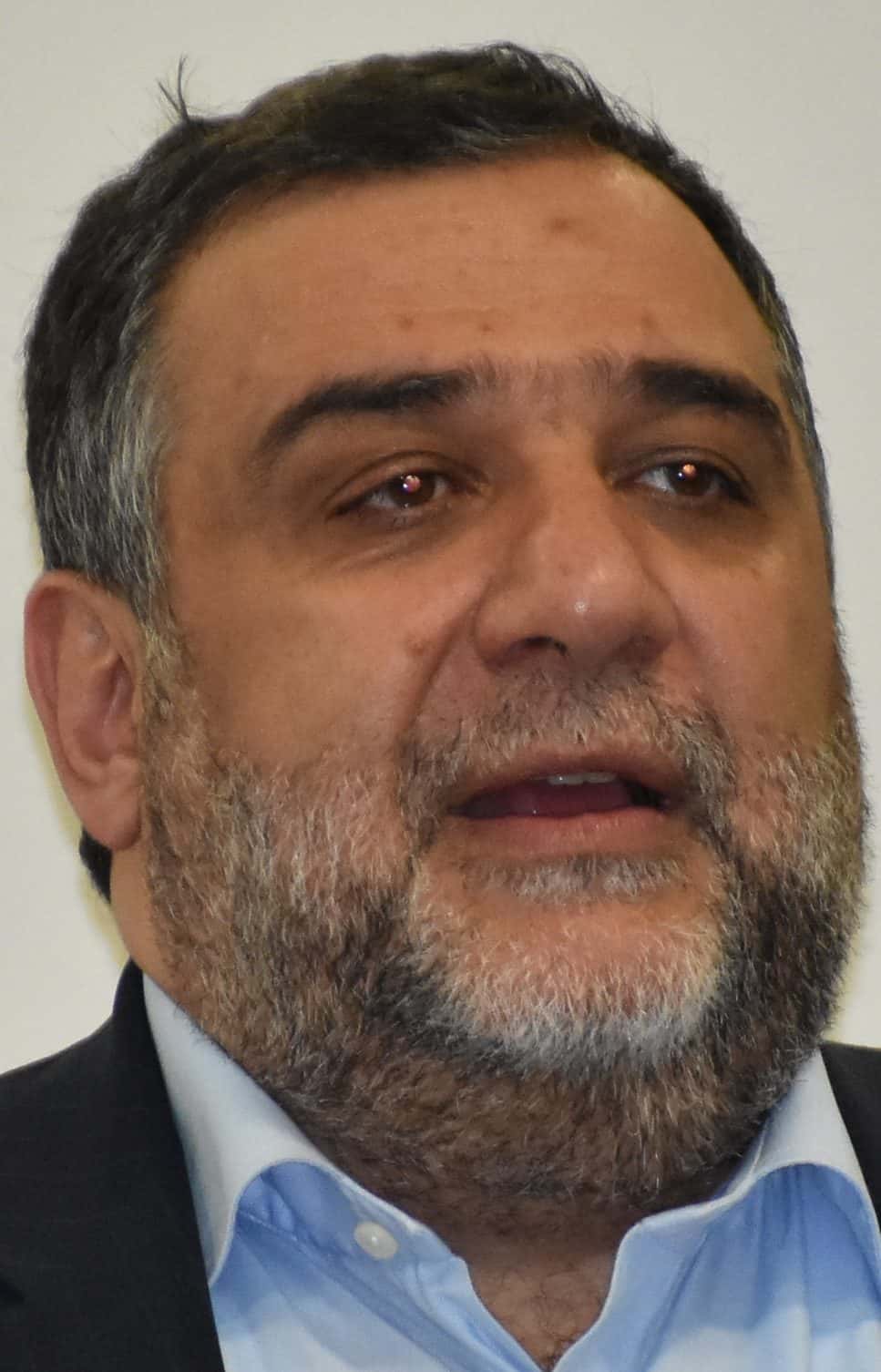
Ruben Vardanyan, sentenced to twenty years by the Baku Military CourtYerevantsi · CC BY-SA 4.0
5-17 February 2026
Baku Military Court sentences Artsakh's leaders
The Baku Military Court sentenced five former Artsakh officials (including ex-president Arayik Harutyunyan, foreign minister David Babayan and parliament speaker Davit Ishkhanyan) to life imprisonment, gave former presidents Ghukasyan and Sahakyan 20-year terms, and on 17 February sentenced Ruben Vardanyan to 20 years after nearly 60 closed hearings. Amnesty International called the verdicts the culmination of a 'travesty' of a trial; defense lawyers said they would appeal, including to the ECHR.